Birds Guide
Arctic Tern
What Is a Arctic Tern? The Arctic tern (Sterna paradisaea) is a slender, graceful seabird in the tern family, renowned for undertaking one of the longest migrations of any animal on Earth. Each year it travels between …
At a glance
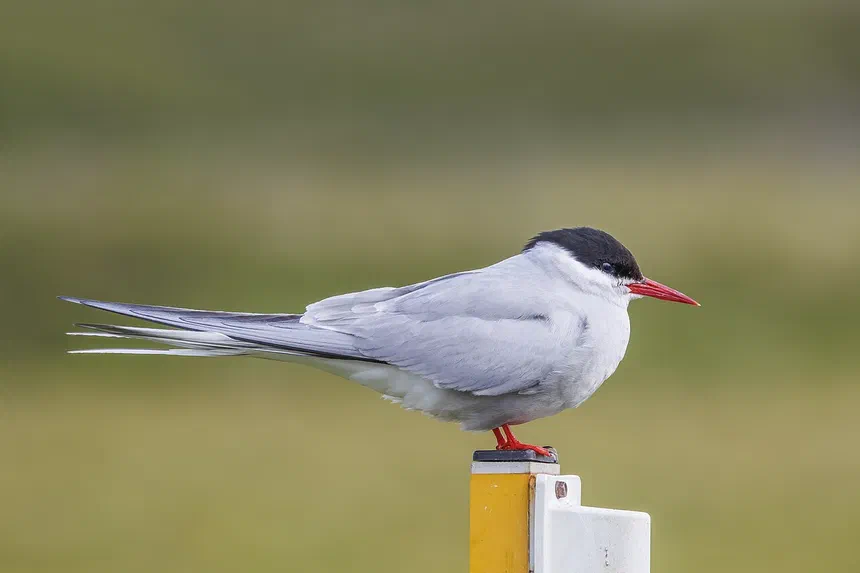
Image: Charles J. Sharp — CC BY-SA 4.0 · source
What Is a Arctic Tern?
The Arctic tern (Sterna paradisaea) is a slender, graceful seabird in the tern family, renowned for undertaking one of the longest migrations of any animal on Earth. Each year it travels between its breeding grounds in the far north and its wintering waters near Antarctica, chasing the polar summers and the daylight they bring.
Appearance and Identification
Arctic terns are lightly built birds with long, narrow wings and deeply forked tails that give them a buoyant, almost swallow-like flight. Breeding adults show a neat black cap, pale gray upperparts and underparts, and a white rump and tail. The bill and short legs are a striking blood-red. In winter the cap fades and the bill darkens. They closely resemble the common tern but have shorter legs, a smaller head, and an all-red bill without the black tip common terns often carry.
Habitat and Range
During the breeding season Arctic terns nest across the Arctic and subarctic, including northern North America, Greenland, Iceland, northern Europe, and Siberia. They favor open, treeless habitats such as coastal tundra, gravel beaches, rocky islands, and grassy islets that offer clear sightlines and nearby feeding waters. Outside the breeding season they become fully oceanic, ranging across the Southern Ocean near the Antarctic pack ice. Because their migration follows a winding, ocean-hugging route rather than a straight line, individual birds may cover tens of thousands of miles in a single year.
Diet
Arctic terns are carnivores that feed mainly on small fish such as sand eels, herring, and capelin, along with crustaceans, krill, and other small marine invertebrates. They hunt by flying low over the water, hovering briefly, and then plunge-diving to seize prey at or just below the surface. They may also snatch insects from the air over tundra pools during the breeding season. Their feeding success is closely tied to the abundance of small schooling fish, which makes them sensitive to shifts in ocean conditions.
Behavior
These terns are highly social and typically breed in colonies that can range from a few pairs to many thousands. They are famously bold in defense of their nests, dive-bombing and striking intruders, including foxes and humans, that wander too close. In flight they are agile and tireless, well suited to a life spent largely over open water. Their loud, grating calls are a constant feature of a busy breeding colony.
Life Cycle and Reproduction
Arctic terns are generally monogamous and often return to the same colony, and sometimes the same mate, year after year. Courtship includes aerial displays and the ceremonial offering of a fish from male to female. The nest is a simple scrape in gravel, sand, or short vegetation, where the female usually lays one to three well-camouflaged eggs. Both parents share incubation, which lasts roughly three weeks, and both feed the chicks after hatching. Young birds fledge in about three to four weeks but may continue to depend on their parents for a time. Arctic terns are long-lived for their size, and thanks to their yearly polar journeys, a single bird can travel a distance equivalent to several trips to the Moon and back over its lifetime.
Conservation Status
The Arctic tern is listed as Least Concern by the IUCN, reflecting its very large range and sizable global population. Even so, some regional populations have declined, and the species faces pressures from changing sea temperatures and prey availability, disturbance at nesting colonies, introduced predators on islands, and the broader effects of a warming climate on both its polar breeding and wintering grounds. Monitoring of key colonies helps track how these long-distance migrants are faring.
Frequently Asked Questions
How far does an Arctic tern migrate each year? Because it winds along productive ocean routes between the Arctic and the Antarctic, an Arctic tern may travel on the order of tens of thousands of miles in a single round trip, among the longest migrations known in the animal kingdom.
How can I tell an Arctic tern from a common tern? Look at the bill and legs: Arctic terns have short legs and an all-red bill, while common terns usually show longer legs and a red bill with a black tip. Arctic terns also appear smaller-headed and more delicately built in flight.
What do Arctic terns eat? They feed mainly on small fish such as sand eels and herring, along with crustaceans and other small marine animals, usually caught by hovering and then plunge-diving at the water’s surface.
References
The conservation status and key facts in this profile are supported by these sources:
- Animal Diversity Web — Sterna paradisaea (Arctic tern) (accessed 2026-07-29)
- GBIF — Sterna paradisaea Pontoppidan, 1763 (accessed 2026-07-29)
Found an error, source problem, or image concern? Report this page.