Birds Guide
Anhinga
What Is a Anhinga? The anhinga (Anhinga anhinga) is a slender, long-necked waterbird of warm American wetlands, sometimes called the snakebird because of the way it swims with only its head and sinuous neck above the …
At a glance
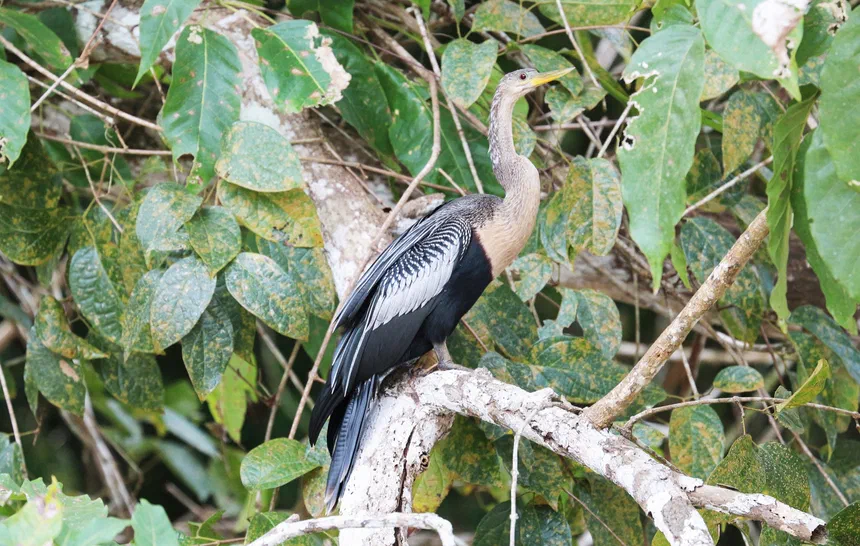
What Is a Anhinga?
The anhinga (Anhinga anhinga) is a slender, long-necked waterbird of warm American wetlands, sometimes called the snakebird because of the way it swims with only its head and sinuous neck above the surface. It belongs to the darter family and is a specialist at hunting fish beneath the water. The species is closely tied to sheltered freshwater habitats across the warmer parts of the Americas.
Appearance and Identification
The anhinga is a large, streamlined bird with a long S-curved neck, a small head, and a straight, sharply pointed bill quite unlike the hooked bill of a cormorant. Adults are largely glossy black, offset by striking silvery-white streaks and spots across the upper wings and back. Males are the darkest, while females and immatures show a warm tan or buff head, neck, and breast that contrasts with the dark body. The tail is long and fan-shaped with a pale band near the tip, giving the bird a distinctive silhouette both perched and in flight. In the air it alternates flapping with long glides, often soaring on broad wings and a spread tail.
Habitat and Range
Anhingas favor calm, warm freshwater wetlands, including swamps, marshes, wooded ponds, slow-moving rivers, and the sheltered edges of lakes and lagoons. They occasionally use brackish coastal waters but generally avoid open ocean and cold climates. The species ranges from the southeastern United States, especially Florida and the Gulf Coast, southward through Mexico, Central America, and much of tropical and subtropical South America east of the Andes. Northern birds may move south in winter, since anhingas depend on water that does not freeze and on ample sunshine for warming themselves.
Diet
The anhinga is a carnivore that feeds chiefly on fish, which it captures underwater. Rather than grabbing prey in its bill, it stalks slowly and then spears a fish with a rapid thrust of its dagger-like beak. It surfaces, flips the fish into the air, and swallows it head first. Small aquatic animals such as crayfish, shrimp, amphibians, and the occasional water insect or small reptile round out the diet. Because its plumage is not fully waterproof, the bird sits low in the water, which reduces buoyancy and helps it move stealthily among submerged vegetation.
Behavior
A familiar sight is the anhinga perched on a branch or snag with its wings held wide open, drying its wettable feathers and warming itself in the sun after a swim. This wing-spreading posture is essential because waterlogged plumage would otherwise leave the bird chilled and unable to fly efficiently. Anhingas are strong underwater swimmers, propelling themselves with their webbed feet, and they can soar to considerable heights on rising warm air. They are often seen singly or in small groups and may roost and nest in loose colonies, sometimes alongside herons, egrets, and cormorants.
Life Cycle and Reproduction
Anhingas typically nest in trees or shrubs standing over or near water, frequently within mixed colonies of other waterbirds. The male gathers sticks and the female builds a bulky platform nest, often lined with greenery. A clutch usually contains around three to five pale eggs, which both parents incubate for roughly four weeks. The young hatch helpless and are fed regurgitated food by both adults, growing quickly and clambering about nearby branches before they are able to fly. Pairs may raise a single brood each year, and adults share duties throughout the breeding effort.
Conservation Status
The anhinga is listed as Least Concern by the IUCN, reflecting its wide distribution and generally stable numbers across the Americas. The species can be locally sensitive to the draining and degradation of wetlands, water pollution, and disturbance at nesting colonies. Maintaining healthy freshwater marshes and swamps benefits the anhinga along with the many other waterbirds that share its habitat.
Frequently Asked Questions
Why is the anhinga called the snakebird? When it swims with its body submerged, only its slim head and long, curving neck show above the water, giving the impression of a snake gliding along the surface.
How is an anhinga different from a cormorant? The anhinga has a straight, pointed bill that it uses to spear fish, along with a longer, fan-shaped tail, whereas cormorants have hooked bills and typically grab prey rather than impaling it.
Why do anhingas spread their wings? Their feathers are not fully waterproof, so after diving they perch with wings outstretched to dry the plumage and warm up in the sun before flying again.
References
The conservation status and key facts in this profile are supported by these sources:
- Animal Diversity Web — Anhinga anhinga (accessed 2026-07-29)
- GBIF — Anhinga anhinga (Linnaeus, 1766) (accessed 2026-07-29)
Found an error, source problem, or image concern? Report this page.