Birds Guide
Andean Condor
What Is a Andean Condor? The Andean condor (Vultur gryphus) is a massive New World vulture native to the mountain ranges and coastlines of western South America. It is among the largest flying birds on Earth and a …
At a glance
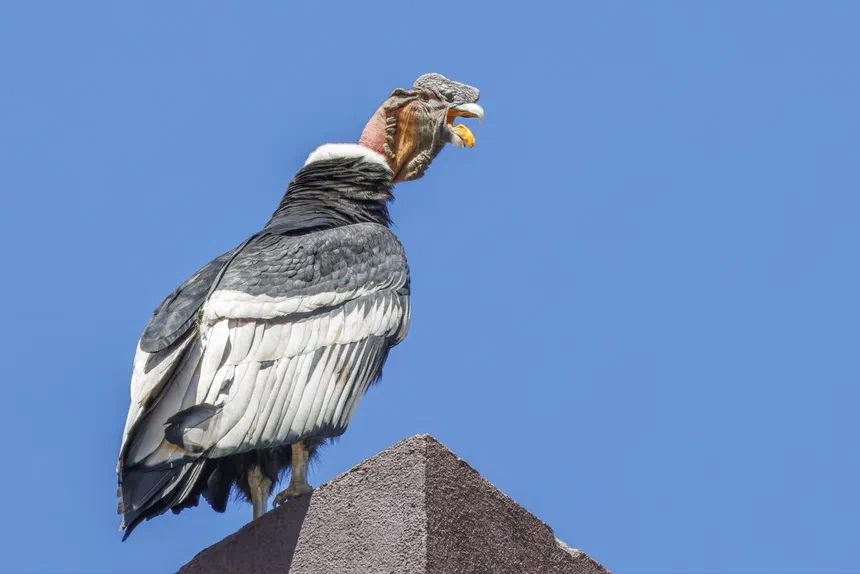
Image: Charles J. Sharp — CC BY-SA 4.0 · source
What Is a Andean Condor?
The Andean condor (Vultur gryphus) is a massive New World vulture native to the mountain ranges and coastlines of western South America. It is among the largest flying birds on Earth and a soaring specialist of the high Andes. For many Andean cultures it stands as a powerful national symbol.
Appearance and Identification
Adults are cloaked in glossy black feathers set off by a broad white ruff of down at the base of the neck and large white patches across the upper wings, which are especially conspicuous in males. The head and neck are largely bare, ranging from dull red to pinkish, an adaptation that helps keep the bird clean while feeding on carcasses. Males are noticeably larger than females and carry a fleshy comb or caruncle on the crown, an unusual trait among vultures where females are often the larger sex. With a wingspan that can approach three meters, the species is unmistakable in flight, riding thermals and mountain updrafts with only occasional wingbeats.
Habitat and Range
The Andean condor occupies the length of the Andes, from Venezuela and Colombia in the north through Ecuador, Peru, and Bolivia, and south along the mountainous spine of Chile and Argentina to Tierra del Fuego. It favors open, windswept country including high-elevation grasslands, paramo, rocky peaks, and steep cliffs, but it also descends to desert coasts and lowland steppe where carrion and reliable air currents are available. Nesting and roosting sites are typically inaccessible ledges and caves on cliff faces.
Diet
As an obligate scavenger, the condor feeds almost entirely on carrion. In the mountains it relies on the carcasses of large mammals such as deer, guanacos, and livestock, while coastal birds exploit stranded marine animals including seals and beached whales, along with seabird colonies. Its keen eyesight and habit of watching other scavengers help it locate food across vast landscapes. A condor can gorge heavily at a single carcass and may then go without eating for several days.
Behavior
Condors are masterful soarers, using rising warm air and deflected winds to travel great distances with minimal effort while searching for food. They are generally social at roosts and feeding sites, where a loose dominance hierarchy governs access to a carcass. Birds spend much of the day perched on cliffs, often sunning with wings spread. Though silent by vulture standards, they produce hisses and grunts during interactions. Individuals may range over enormous areas in a single day in the course of foraging.
Life Cycle and Reproduction
The Andean condor is exceptionally slow to reproduce. Pairs form long-term bonds and nest on sheltered cliff ledges, where the female lays a single egg, only occasionally two, every other year. Both parents share the roughly two-month incubation and then care for the chick for many months. Young birds are dependent well into their second year and do not attain full adult plumage or breeding age until around six to eight years old. This low reproductive rate is balanced by a long life, with wild birds often reaching about fifty years and captive individuals living even longer.
Conservation Status
The IUCN lists the Andean condor as Vulnerable, with populations declining across much of its range. Because it breeds so slowly, the species is highly sensitive to added mortality. Major threats include poisoning, both deliberate and from carcasses laced with pesticides or contaminated with lead ammunition, along with persecution, collisions, and habitat loss. Captive breeding and release programs, together with education and protected areas, have helped bolster numbers in several countries.
Frequently Asked Questions
How big is an Andean condor? It is one of the largest flying birds, with a wingspan that can approach three meters and a weight of roughly 8 to 15 kilograms, males being larger than females.
What does the Andean condor eat? It is a scavenger that feeds on carrion, including dead large mammals in the mountains and marine animals along the coast.
Is the Andean condor endangered? It is classified as Vulnerable by the IUCN and is declining in many areas, largely because of poisoning and its naturally slow rate of reproduction.
References
The conservation status and key facts in this profile are supported by these sources:
- Animal Diversity Web — Vultur gryphus (Andean condor) (accessed 2026-07-29)
- GBIF — Vultur gryphus Linnaeus, 1758 (accessed 2026-07-29)
- ITIS — Vultur gryphus (Andean Condor) (accessed 2026-07-29)
Found an error, source problem, or image concern? Report this page.