Birds Guide
American Robin
What Is a American Robin? The American robin (Turdus migratorius) is a familiar migratory songbird and the largest thrush native to North America. Widely recognized for its warm orange breast and cheerful dawn song, it …
At a glance
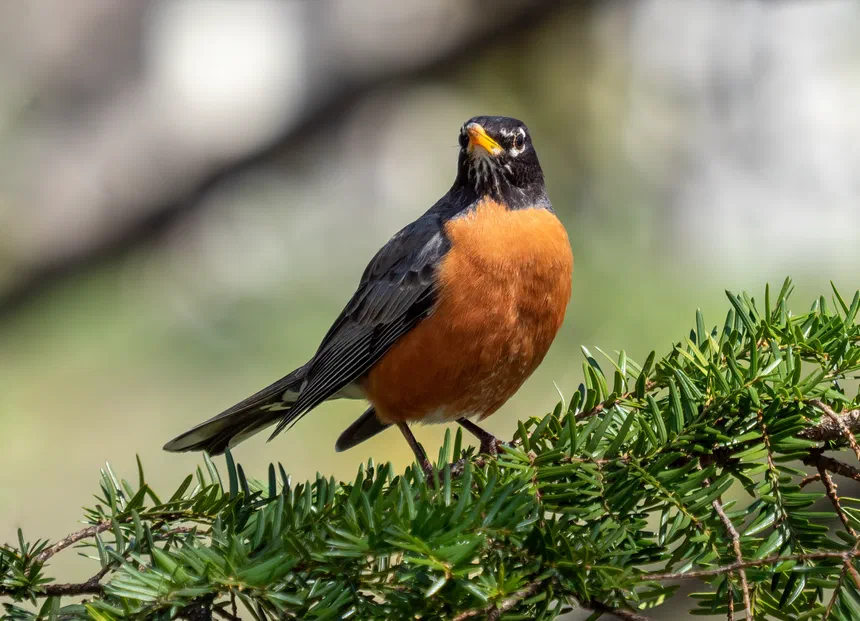
Image: Rhododendrites — CC BY-SA 4.0 · source
What Is a American Robin?
The American robin (Turdus migratorius) is a familiar migratory songbird and the largest thrush native to North America. Widely recognized for its warm orange breast and cheerful dawn song, it is among the most abundant and easily observed birds across the continent. It is the official state bird of Connecticut, Michigan, and Wisconsin.
Appearance and Identification
Adults have a grayish-brown back and wings, a darker head, and a distinctive brick-orange to rusty breast and belly. A broken white ring surrounds each eye, and the throat is streaked black and white. The bill is yellow, often with a dark tip, and the lower belly and undertail are white, which is most visible in flight. Males tend to be more richly colored than females, whose heads and breasts are somewhat paler. Juveniles are heavily spotted below and have a scaly, mottled appearance until their first molt. Adults measure roughly 9 to 11 inches (23 to 28 cm) long with a wingspan around 12 to 16 inches (31 to 41 cm).
Habitat and Range
American robins occupy an enormous range spanning most of North America, breeding from Alaska and across Canada south through the United States into Mexico. They are highly adaptable and thrive in a wide variety of settings, including suburban lawns, city parks, gardens, orchards, farmland, open woodlands, and forest edges. Robins that nest in the far north migrate southward for winter, while populations in milder regions may remain year-round. In colder months, flocks often shift toward areas with abundant fruiting trees and shrubs.
Diet
The robin is an opportunistic omnivore whose diet changes with the seasons. During spring and summer, it feeds heavily on invertebrates, especially earthworms, along with beetles, caterpillars, grasshoppers, and other insects. Robins are often seen hopping across lawns, pausing to cock their heads as they locate prey by sight and sound before pulling worms from the soil. In late summer, fall, and winter, fruit becomes a major food source, including berries from dogwood, juniper, sumac, holly, and many cultivated and wild plants. This dietary flexibility helps the species persist through cold months when insects are scarce.
Behavior
American robins are active by day and are among the earliest birds to sing at dawn. Their clear, warbling song, often described as a series of caroling phrases, is a signature sound of spring mornings. Outside the breeding season, robins frequently gather in large flocks, sometimes numbering in the thousands, that roam in search of fruit and roost communally at night. During the breeding season, however, males become territorial and defend nesting areas. Robins run and hop across open ground and are generally tolerant of human presence, making them a common sight in yards and gardens.
Life Cycle and Reproduction
The breeding season typically runs from spring into late summer, and a pair may raise two or three broods in a single year. The female builds a sturdy cup-shaped nest of grass, twigs, and mud, usually placed in a tree, shrub, or on a sheltered ledge. She lays three to five eggs of a distinctive pale blue color, sometimes called “robin’s egg blue.” Incubation lasts about two weeks, and the young are fed by both parents. Nestlings leave the nest roughly two weeks after hatching but continue to depend on the adults for a time as they learn to forage. Mortality is high in the first year, and while many robins live only a year or two, some individuals survive six years or more in the wild.
Conservation Status
The American robin is listed as Least Concern by the IUCN. It is one of the most numerous landbirds in North America, with a large and generally stable population, and it has adapted well to human-altered landscapes such as lawns and suburbs. The species is protected in the United States and Canada under migratory bird laws. Localized threats include collisions with windows and vehicles, predation by domestic cats, and exposure to pesticides that can contaminate their invertebrate prey.
Frequently Asked Questions
Why are robins associated with spring? In northern regions, robins that migrated south return as the weather warms and sing conspicuously at dawn, so their reappearance and song are long-standing signs of spring, even though many robins actually stay north through winter.
What do robin eggs look like? Robin eggs are a smooth, unmarked pale blue, a shade so recognizable it lent its name to the color “robin’s egg blue.” A typical clutch holds three to five eggs.
Are American robins related to European robins? No. Despite the shared name, they are not closely related. The American robin is a true thrush, while the smaller European robin belongs to a different group of birds; early colonists simply named the American bird for its familiar orange breast.
References
The conservation status and key facts in this profile are supported by these sources:
- Animal Diversity Web — Turdus migratorius (American robin) (accessed 2026-07-29)
- GBIF — Turdus migratorius Linnaeus, 1766 (accessed 2026-07-29)
Found an error, source problem, or image concern? Report this page.