Birds Guide
American Kestrel
What Is a American Kestrel? The American kestrel (Falco sparverius) is the smallest and most widespread falcon in the Americas. Roughly the size of a mourning dove, it is a colorful, agile raptor often seen hovering over …
At a glance
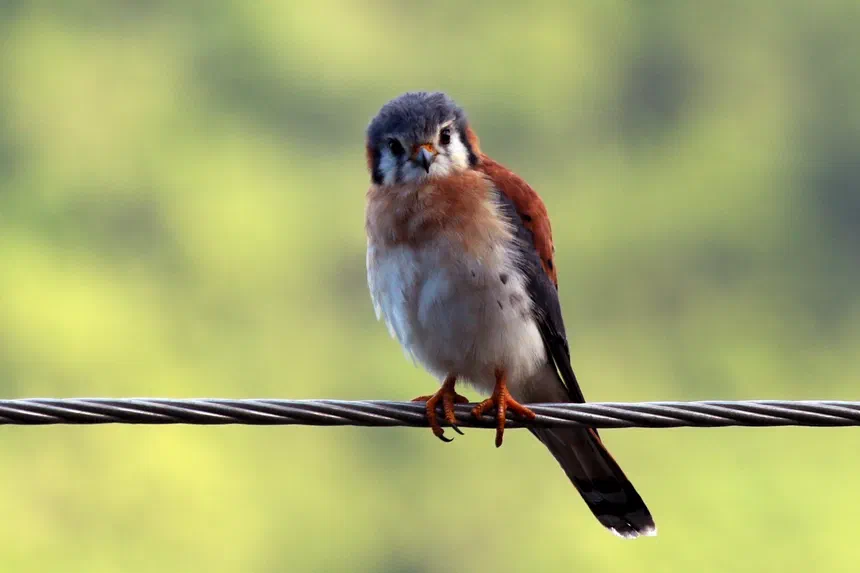
Image: Charles J. Sharp — CC BY-SA 4.0 · source
What Is a American Kestrel?
The American kestrel (Falco sparverius) is the smallest and most widespread falcon in the Americas. Roughly the size of a mourning dove, it is a colorful, agile raptor often seen hovering over fields or perched on wires and fence posts as it scans for prey. Despite its small stature, it is a fierce and efficient hunter.
Appearance and Identification
The American kestrel is a compact falcon with long, pointed wings and a long, square-tipped tail. Both sexes share two distinctive black vertical slashes on a white face and a warm rufous crown patch. Males have blue-grey wings and a rusty back and tail, while females are more uniformly reddish-brown with dark barring across the back, wings, and tail. Two black spots, sometimes called “false eyes,” sit on the back of the head and may help deter predators. Adults typically measure 8 to 12 inches (22 to 31 cm) in length with a wingspan of about 20 to 24 inches (51 to 61 cm), and weigh between roughly 2.8 and 5.8 ounces (80 to 165 g). As in many raptors, females tend to be slightly larger than males.
Habitat and Range
This falcon favors open and semi-open landscapes where it can spot prey from a perch or in flight. Typical habitats include grasslands, meadows, deserts, agricultural fields, forest clearings, and the edges of towns and cities. It readily uses fence posts, telephone wires, and dead snags as hunting perches. The American kestrel has one of the broadest ranges of any New World raptor, breeding from Alaska and Canada south through the United States, Mexico, and Central America, and across much of South America. Northern populations are migratory, moving south for winter, while birds in milder regions are often year-round residents.
Diet
The American kestrel is a carnivore with a varied diet that shifts with the seasons. In warmer months it feeds heavily on large insects such as grasshoppers, crickets, beetles, and dragonflies. It also preys on small mammals like voles and mice, along with lizards, small snakes, spiders, and occasionally small birds. It commonly hunts by hovering in place on rapidly beating wings, then dropping onto prey, or by watching from an elevated perch and swooping down. Kestrels can detect ultraviolet light, which may help them locate rodent urine trails while hunting.
Behavior
American kestrels are active during the day and are often seen alone or in pairs. They frequently bob their heads and pump their tails while perched, behaviors that may aid depth perception. Their flight is buoyant and acrobatic, and their ability to hover into the wind is one of their most recognizable traits. They are vocal birds, giving a sharp, repeated “klee-klee-klee” call, especially when excited or defending territory. Though small, they are bold and will readily chase larger birds away from their nesting areas.
Life Cycle and Reproduction
American kestrels are cavity nesters that do not build their own nests. Instead they use natural tree hollows, old woodpecker holes, cliff crevices, nooks in buildings, and readily accept artificial nest boxes. A female typically lays 4 to 5 eggs, which both parents help incubate for roughly a month. The young are cared for by both adults and usually leave the nest about a month after hatching, remaining dependent on their parents for a while afterward. In favorable climates a pair may raise two broods in a single season. Many kestrels live only a few years in the wild, though some individuals survive considerably longer.
Conservation Status
The American kestrel is listed as Least Concern by the IUCN and remains widespread across its enormous range. However, many regions, particularly in North America, have recorded long-term population declines. Suspected causes include loss of open habitat and nesting cavities, pesticide use that reduces insect prey, and predation. Nest-box programs and continued habitat protection are widely used to support local populations.
Frequently Asked Questions
Is the American kestrel a hawk or a falcon? It is a true falcon, the smallest one found in North America, and is only distantly related to hawks.
Why does the American kestrel hover? Hovering lets the kestrel hold a steady position over open ground so it can carefully watch for insects and small animals before diving to catch them.
Are American kestrels endangered? No. They are classified as Least Concern globally, though some regional populations have been declining and are the focus of conservation efforts.
References
The conservation status and key facts in this profile are supported by these sources:
- Animal Diversity Web — American Kestrel (Falco sparverius) (accessed 2026-07-29)
- GBIF — Falco sparverius Linnaeus, 1758 (accessed 2026-07-29)
- ITIS — Falco sparverius (American Kestrel), TSN 175622 (accessed 2026-07-29)
Found an error, source problem, or image concern? Report this page.