Birds Guide
American Goldfinch
What Is a American Goldfinch? The American goldfinch (Spinus tristis) is a small, seed-eating songbird in the finch family, familiar across much of North America. Breeding males are unmistakable in their canary-yellow …
At a glance
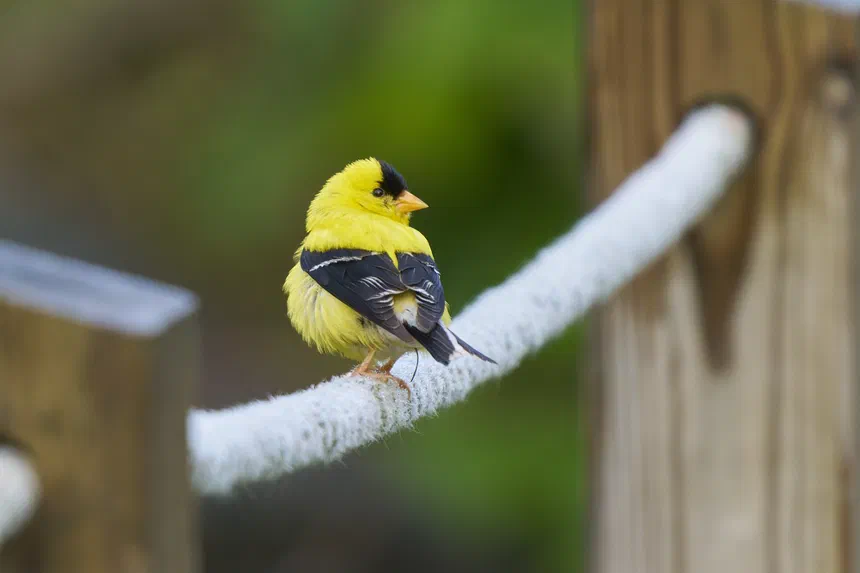
Image: Paul Danese — CC BY-SA 4.0 · source
What Is a American Goldfinch?
The American goldfinch (Spinus tristis) is a small, seed-eating songbird in the finch family, familiar across much of North America. Breeding males are unmistakable in their canary-yellow plumage set off by a black forehead and black-and-white wings, while females wear more muted olive tones. It is a common visitor to backyard feeders and open, weedy landscapes.
Appearance and Identification
The American goldfinch is a compact finch with a short, conical bill, a notched tail, and a rounded head. Adults measure roughly 4.3 to 5.5 inches (11 to 14 cm) long with a wingspan of about 7.5 to 8.7 inches (19 to 22 cm), and they typically weigh between 0.4 and 0.7 ounces (11 to 20 g). The species is strongly seasonal in color. In breeding plumage the male glows bright yellow with a jet-black cap, black wings marked by white bars, and a white rump. Females and nonbreeding males are far plainer, showing olive-brown to grayish upperparts and dull yellow or buff underparts. This twice-yearly molt makes winter birds look like a different species from their summer selves. The pinkish-orange bill of the breeding season fades to a darker, duller tone in colder months.
Habitat and Range
This finch favors open and semi-open country, including weedy fields, floodplains, meadows, roadside verges, orchards, gardens, and the brushy edges of woodlands. It thrives wherever seed-bearing plants such as thistles, sunflowers, and asters grow in abundance. The American goldfinch ranges widely across North America, breeding from southern Canada through much of the United States. Northern populations are migratory, shifting south in winter, while birds in the middle of the range are often year-round residents. In winter the species can be found as far south as Mexico. Its adaptability to human-altered habitats has helped it remain widespread and numerous.
Diet
The American goldfinch is one of the most strictly vegetarian of North American songbirds, feeding almost entirely on seeds. Favorites include the seeds of thistles, sunflowers, dandelions, ragweed, asters, and various grasses, along with buds and occasional tree seeds such as those of birch and alder. Unlike many songbirds, it feeds insects to its young only incidentally, relying instead on regurgitated seed pulp. This seed-heavy diet influences its late breeding season, which is timed to coincide with peak seed availability. At feeders it readily takes nyjer (thistle) seed and sunflower hearts, often clinging acrobatically to feed.
Behavior
Active and sociable, the American goldfinch is frequently seen in loose flocks outside the breeding season, sometimes mixing with other finches and sparrows. Its flight is distinctively undulating, rising and falling in a bouncing pattern, and it often gives a cheerful, twittering “po-ta-to-chip” call in flight. Birds forage nimbly among seed heads, clinging to stalks and even hanging upside down to reach seeds. They are generally not aggressive and are drawn readily to gardens and feeders. Their pleasant, canary-like song is a series of warbles and trills, delivered from perches during the breeding season.
Life Cycle and Reproduction
The American goldfinch nests unusually late in the year, typically from late June into August, when thistle and other seeds are plentiful and downy plant fibers are available for nest lining. The female builds a tidy, cup-shaped nest of plant fibers and spider silk, usually placed in a shrub or small tree. A clutch generally contains four to six pale bluish-white eggs, which the female incubates for roughly 12 to 14 days while the male brings her food. The young are fed regurgitated seeds and leave the nest about 11 to 17 days after hatching. Most pairs raise one brood per season, though a second is possible. In the wild, individuals commonly live around three to six years.
Conservation Status
The American goldfinch is listed as Least Concern by the IUCN, reflecting a large, widespread, and stable population. It benefits from open, disturbed habitats and readily uses gardens and feeders, which has helped keep numbers healthy. Local abundance can shift with the availability of weedy fields and native plants. For now, the species remains one of the most common finches across its range.
Frequently Asked Questions
Why do American goldfinches change color? They undergo two molts each year. In spring, males grow bright yellow breeding feathers with a black cap, then molt into a duller olive plumage for winter, which helps explain why they look so different across the seasons.
What do American goldfinches eat at feeders? They are especially fond of nyjer (thistle) seed and sunflower hearts. Because they eat almost only seeds, offering these foods in a mesh or tube feeder reliably attracts them.
When do American goldfinches nest? They breed later than most songbirds, usually in mid to late summer, timing their nesting to match the peak availability of seeds and soft plant down used to line the nest.
References
The conservation status and key facts in this profile are supported by these sources:
- Animal Diversity Web — American Goldfinch (Spinus tristis) (accessed 2026-07-29)
- GBIF — Spinus tristis (Linnaeus, 1758) (accessed 2026-07-29)
Found an error, source problem, or image concern? Report this page.