Birds Guide
American Crow
What Is a American Crow? The American crow (Corvus brachyrhynchos) is a large, all-black songbird found across much of North America. A member of the corvid family, it is closely related to ravens, jays, and magpies, and …
At a glance
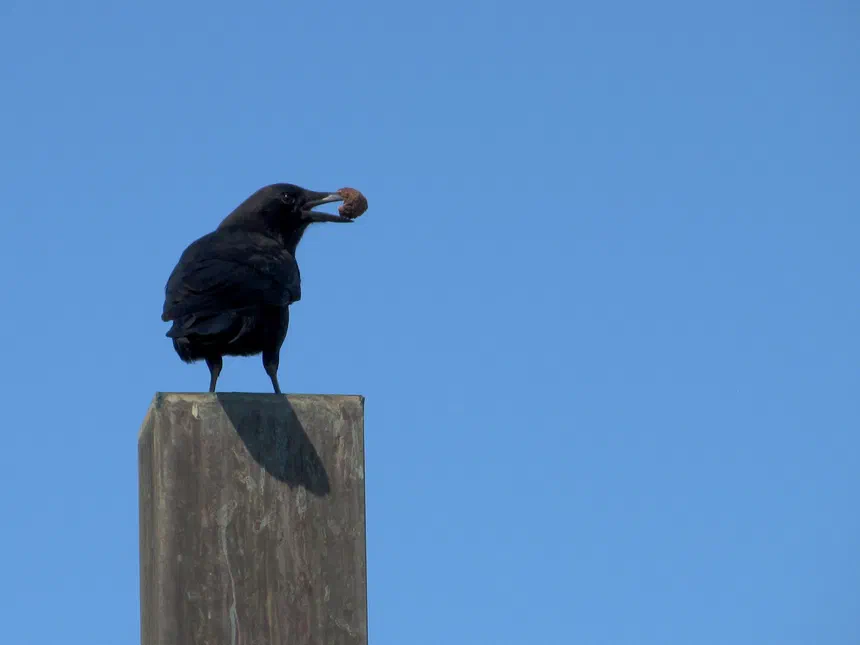
What Is a American Crow?
The American crow (Corvus brachyrhynchos) is a large, all-black songbird found across much of North America. A member of the corvid family, it is closely related to ravens, jays, and magpies, and is widely admired for its intelligence, adaptability, and complex social behavior.
Appearance and Identification
American crows are entirely black, from their sleek feathers to their stout bill, sturdy legs, and dark eyes. In good light, the plumage can show a faint glossy sheen of blue or purple. Adults typically measure about 16 to 21 inches (40 to 53 cm) in length, with a wingspan of roughly 33 to 39 inches (85 to 100 cm), and weigh between 11 and 22 ounces (300 to 620 g). They are often confused with the larger common raven, but crows have a more even, fan-shaped tail, a slimmer bill, and a familiar cawing call rather than the raven’s deep croak. Males and females look alike.
Habitat and Range
This species is highly adaptable and occupies a wide variety of open and semi-open landscapes. It thrives in farmland, woodland edges, river groves, grasslands, and increasingly in suburban and urban settings such as parks, campuses, and city streets. American crows range across most of the United States and Canada, from the Atlantic to the Pacific coasts. Northern populations tend to migrate south for the winter, while birds in milder regions are year-round residents. Their comfort around people has helped them expand alongside human development.
Diet
American crows are true omnivores with an opportunistic, varied diet. They eat insects, worms, spiders, and other invertebrates, along with seeds, grains, nuts, and fruit. They also take small vertebrates such as mice, frogs, and the eggs and nestlings of other birds, and readily feed on carrion and human food waste. This flexibility allows them to forage in farm fields, along roadsides, and in garbage and compost near towns. Crows are known to cache surplus food and to use simple problem-solving, and in some places have learned to drop hard-shelled items onto pavement to crack them open.
Behavior
Crows are among the most intelligent of all birds. They are highly social and often gather in family groups, and outside the breeding season they may form large communal roosts numbering in the thousands. They communicate with a rich repertoire of caws, rattles, and clicks, and can recognize individual human faces, remembering people who have threatened them. American crows have been observed using and even shaping simple tools, and younger birds from previous broods often help their parents raise the next generation, a behavior known as cooperative breeding. Groups will also mob hawks, owls, and other predators to drive them away.
Life Cycle and Reproduction
American crows form long-term pair bonds and breed mainly in spring. The pair builds a bulky nest of sticks lined with softer material, usually placed high in a tree. The female lays a clutch of about three to six pale, blotched eggs and incubates them for roughly 18 days. Both parents, frequently assisted by grown offspring from earlier years, feed the nestlings until they leave the nest at around four to five weeks old. Young crows may remain with their family for a year or more. In the wild, many crows live around seven to eight years, though some individuals survive well into their teens.
Conservation Status
The American crow is listed as Least Concern by the IUCN, reflecting its very large population and broad, stable range. It has adapted well to human-altered environments and remains common and widespread. The species did suffer notable losses in the early 2000s from West Nile virus, to which crows are especially vulnerable, but overall numbers have remained healthy. Because they can damage crops and gather in large, noisy roosts, crows are sometimes viewed as a nuisance, yet they face no significant threat of extinction.
Frequently Asked Questions
How can I tell a crow from a raven? Crows are smaller with a fan-shaped tail and a higher-pitched cawing call, while ravens are larger, have a wedge-shaped tail, shaggier throat feathers, and a deeper croaking voice.
Are American crows really that intelligent? Yes. They can solve puzzles, use simple tools, recognize individual human faces, and remember them for years, making them among the smartest birds studied.
Why do crows gather in such large flocks? Outside the breeding season, crows form big communal roosts that offer safety in numbers, warmth, and opportunities to share information about food sources.
References
The conservation status and key facts in this profile are supported by these sources:
- Animal Diversity Web — Corvus brachyrhynchos (American crow) (accessed 2026-07-29)
- GBIF — Corvus brachyrhynchos C.L.Brehm, 1822 (accessed 2026-07-29)
Found an error, source problem, or image concern? Report this page.