Birds Guide
Wandering Albatross
What Is a Wandering Albatross? The wandering albatross (Diomedea exulans) is a giant seabird of the Southern Ocean and one of the largest flying birds on Earth. It holds the record for the longest wingspan of any living …
At a glance
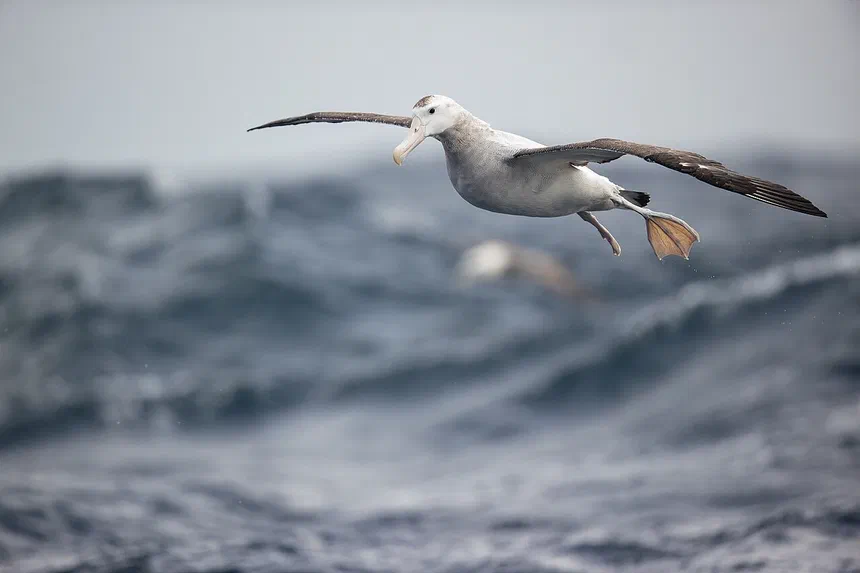
Image: JJ Harrison — CC BY-SA 3.0 · source
What Is a Wandering Albatross?
The wandering albatross (Diomedea exulans) is a giant seabird of the Southern Ocean and one of the largest flying birds on Earth. It holds the record for the longest wingspan of any living bird, stretching more than 11 feet from tip to tip in the largest individuals. Superbly adapted to a life at sea, it spends most of its existence soaring over open water, returning to land only to breed.
Appearance and Identification
Adults are predominantly white with black-tipped upper wings and a heavy, pale pink bill. Younger birds are much browner and gradually whiten over many years, so plumage offers a rough guide to age. The wings are long, narrow, and stiff, ideal for gliding rather than flapping. Males tend to be whiter and slightly larger than females. In flight the bird is unmistakable, holding its enormous wings out flat and covering great distances with barely a wingbeat.
Habitat and Range
The wandering albatross ranges widely across the cold, windy waters of the Southern Ocean, circling the globe at high southern latitudes. It breeds on isolated subantarctic islands such as South Georgia, the Crozet and Kerguelen groups, Prince Edward, and Macquarie. Outside the breeding season, individuals may travel thousands of miles, exploiting the persistent westerly winds that ring the Antarctic continent. Birds tracked by researchers have been recorded circumnavigating the entire Southern Ocean in a matter of weeks.
Diet
This albatross is a carnivore that feeds mainly on squid, fish, and crustaceans taken from at or near the ocean surface. It forages largely by sitting on the water and seizing prey, and it will readily scavenge carrion and offal. The species is well known for following ships, where it feeds on scraps and waste. Unfortunately, this scavenging behavior also draws birds to baited fishing lines, a major source of accidental death.
Behavior
Wandering albatrosses are masters of dynamic soaring, using differences in wind speed at varying heights above the waves to travel enormous distances with very little energy. A single foraging trip during the breeding season can cover many thousands of miles. On land the birds are far less graceful, and they perform elaborate courtship displays involving bill-clapping, calling, and spreading their wings wide. They are generally solitary at sea but gather at breeding colonies.
Life Cycle and Reproduction
The wandering albatross is a slow-breeding, long-lived bird. Pairs form strong, lasting bonds and typically breed only once every two years because raising a single chick takes so long. The female lays one large white egg, which both parents incubate over roughly 11 weeks. The chick is then brooded and fed for many months, remaining in the nest through the harsh subantarctic winter before fledging after about nine to ten months. Young birds spend several years at sea before returning to a colony, and they do not begin breeding until they are several years old.
Conservation Status
The wandering albatross is classified as Vulnerable by the IUCN, and populations of several breeding groups have declined. The greatest threat is bycatch in longline and trawl fisheries, where birds are hooked or entangled and drown. Pollution, including plastic ingestion, and changes in prey availability add further pressure. Because the species reproduces so slowly, even modest losses of adults can cause populations to fall. Conservation measures such as bird-scaring lines, weighted hooks, and setting fishing gear at night have helped reduce deaths in some fisheries.
Frequently Asked Questions
How big is a wandering albatross? It is among the largest flying birds alive, with a wingspan that can exceed 11 feet, though most birds fall in the 8 to 11 foot range.
How long do they live? These birds are notably long-lived, commonly reaching 40 to 50 years and sometimes more in the wild.
Why are they threatened? Their main threat is accidental capture on commercial fishing lines and nets, compounded by a very slow breeding rate that makes recovery difficult.
References
The conservation status and key facts in this profile are supported by these sources:
- Animal Diversity Web — Diomedea exulans (Wandering Albatross) (accessed 2026-07-29)
- GBIF — Diomedea exulans (Wandering Albatross) (accessed 2026-07-29)
Found an error, source problem, or image concern? Report this page.