Birds Guide
African Penguin
What Is a African Penguin? The African penguin (Spheniscus demersus) is a small, banded penguin native to the coasts and islands of southern Africa. It is the only penguin species that breeds on the African continent, …
At a glance
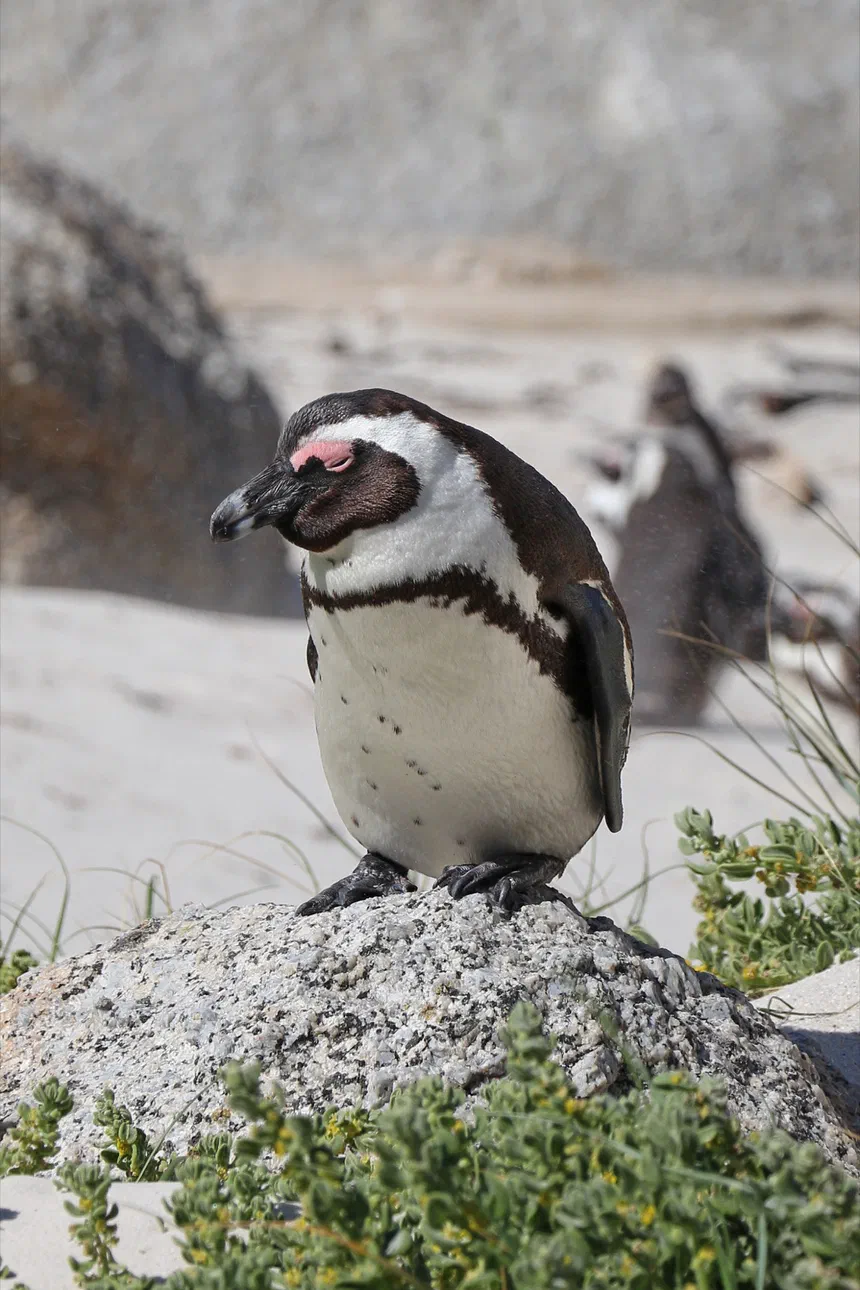
Image: Bernard Gagnon — CC BY-SA 4.0 · source
What Is a African Penguin?
The African penguin (Spheniscus demersus) is a small, banded penguin native to the coasts and islands of southern Africa. It is the only penguin species that breeds on the African continent, and it belongs to the same genus as the Humboldt and Magellanic penguins of South America. Because of its distinctive braying call, it is sometimes nicknamed the “jackass penguin.”
Appearance and Identification
This is a modestly sized penguin, standing roughly 24 to 28 inches (60 to 70 cm) tall and weighing somewhere between about 5.5 and 9 pounds (2.5 to 4 kg). Adults have a sharply defined black-and-white pattern: a black back and head, a white chest and belly, and a single black band that sweeps across the upper breast and down the flanks. A white stripe curves above each eye and around the cheeks. Above the eyes sit patches of bare pink skin that help the bird shed excess heat in warm weather. Each individual carries a unique pattern of small black spots on its white chest, much like a fingerprint. Juveniles are plainer, showing a bluish-gray back and lacking the bold facial markings until they molt into adult plumage.
Habitat and Range
African penguins live along the southwestern and southern coasts of Africa, breeding on offshore islands and a few mainland beaches from Namibia around the Cape to the region near Port Elizabeth in South Africa. On land they favor rocky shorelines, sandy coves, and guano- or vegetation-covered islands where they can find shelter for nesting. At sea they remain in the cool, productive waters of the Benguela Current, generally foraging within reach of their breeding colonies rather than making long ocean migrations.
Diet
The species is a carnivore that feeds almost entirely on small schooling fish, especially anchovies and sardines, supplemented by other fish and occasionally squid or crustaceans. A penguin hunts by pursuit diving, propelling itself underwater with its stiff, flipper-like wings and steering with its feet and tail. Most dives are relatively shallow and brief, though the birds can descend tens of meters when chasing prey. Shifts in the abundance and location of fish stocks have a direct effect on how successfully adults can feed themselves and their chicks.
Behavior
African penguins are social and nest in colonies that can range from a handful of pairs to thousands of birds. They are agile and fast in the water but waddle or hop somewhat awkwardly on land. Vocal communication is important within the crowded colony, and their loud, donkey-like braying is used to attract mates and defend nest sites. During the hottest part of the day, birds may pant, spread their flippers, or retreat to burrows and shade to avoid overheating, while their pink facial patches also help regulate body temperature.
Life Cycle and Reproduction
Pairs are generally monogamous and often return to the same nest site and partner in successive seasons. They nest in burrows dug into guano or sand, or in scrapes sheltered by rocks and vegetation. A typical clutch is two eggs, which both parents take turns incubating for roughly 38 to 42 days. After hatching, the chicks are brooded and guarded before joining loose groups, or creches, as they grow. Youngsters fledge after a couple of months and disperse to sea, returning to breed once they reach maturity at a few years of age.
Conservation Status
The African penguin is classified as Endangered by the IUCN, and its population has fallen steeply over the past century. Key threats include the depletion and shifting of the fish stocks it depends on, historical harvesting of eggs and guano, oil spills, competition with commercial fisheries, predation, and disturbance at breeding sites. Conservation efforts include protected reserves, rehabilitation of oiled and abandoned birds, the creation of artificial nest boxes, and measures to limit fishing near important colonies.
Frequently Asked Questions
Why is it called a “jackass penguin”? The nickname comes from its loud, braying call, which sounds remarkably like the hee-haw of a donkey.
Where can you see African penguins? They breed only in southern Africa; well-known colonies include Boulders Beach near Cape Town and various offshore islands off South Africa and Namibia.
How do they cope with the heat? Bare pink patches of skin above the eyes release heat, and the birds also pant, seek shade, and retreat into cool burrows during hot conditions.
References
The conservation status and key facts in this profile are supported by these sources:
- Animal Diversity Web — Spheniscus demersus (African penguin) (accessed 2026-07-29)
- GBIF — Spheniscus demersus (Linnaeus, 1758) (accessed 2026-07-29)
Found an error, source problem, or image concern? Report this page.