Birds Guide
African Grey Parrot
What Is a African Grey Parrot? The African grey parrot (Psittacus erithacus) is a medium-sized parrot native to the equatorial forests of Central and West Africa. It is widely regarded as one of the most intelligent …
At a glance
What Is a African Grey Parrot?
The African grey parrot (Psittacus erithacus) is a medium-sized parrot native to the equatorial forests of Central and West Africa. It is widely regarded as one of the most intelligent birds in the world and is famous for its ability to mimic human speech and other sounds. In the wild it lives in noisy, highly social flocks that roost together and forage across the forest canopy.
Appearance and Identification
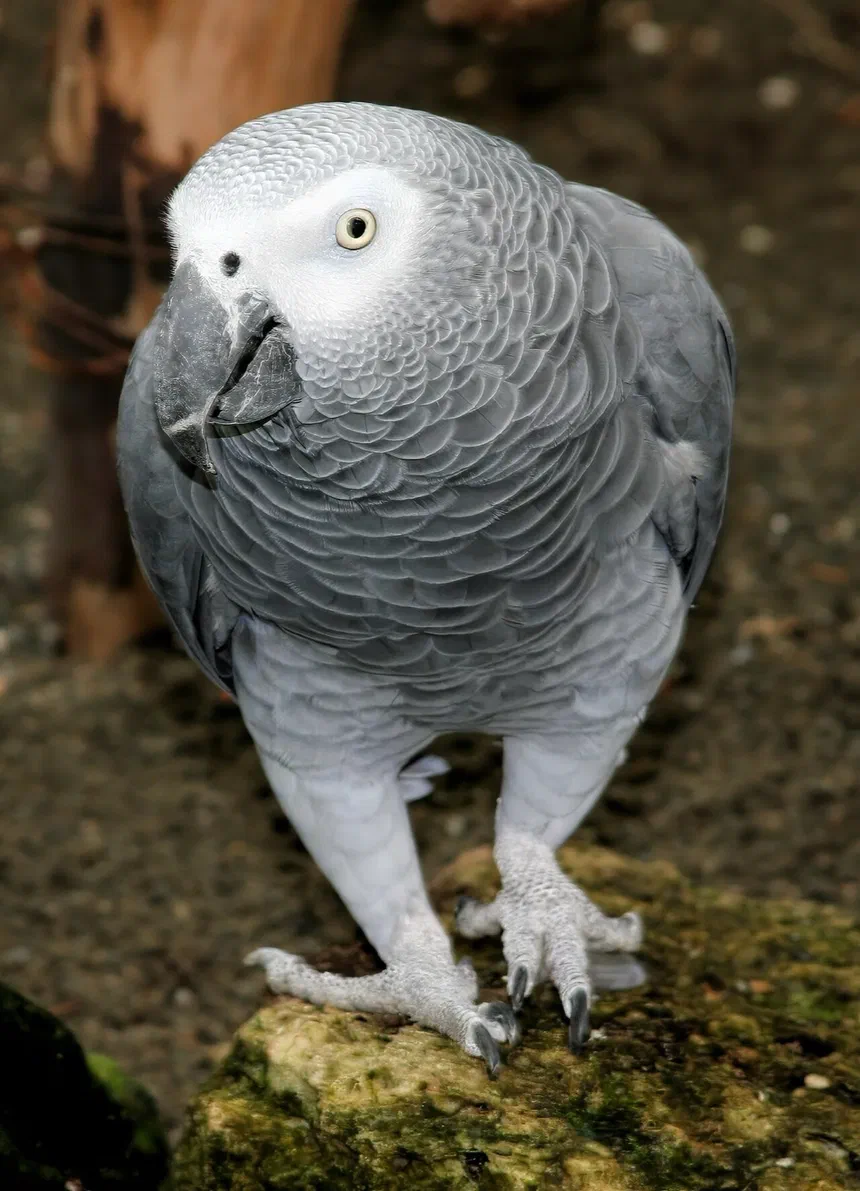
As its name suggests, this parrot is predominantly grey, with feathers ranging from a soft pale grey on the head and underparts to darker charcoal tones on the wings and back. Each feather is often edged with a lighter rim, giving the plumage a subtly scalloped appearance. The most striking feature is the vivid red tail, which contrasts sharply with the muted body. The face carries a bare white patch of skin around each eye, and the heavy black bill is well suited to cracking hard nuts. The eyes of adults are pale yellow, while young birds have darker eyes. Males and females look very similar, making the sexes difficult to tell apart by sight alone.
Habitat and Range
African grey parrots inhabit lowland tropical rainforest, forest edges, gallery forest along rivers, and adjacent wooded savanna and mangroves. Their range stretches across a broad band of Central and West Africa, from countries along the Gulf of Guinea eastward through the Congo Basin. They are most often found in dense, humid forest but will travel to more open areas and cultivated land in search of food. Birds frequently gather at large communal roosts and may fly considerable distances each day between roosting and feeding sites.
Diet
These parrots are primarily herbivorous, feeding on a wide variety of seeds, nuts, fruits, berries, and flowers. The oil palm is an especially important food source across much of their range. Their strong, hooked bill and dexterous feet allow them to manipulate and open tough seed cases and hard-shelled nuts. Flocks often forage in the treetops but will also descend to the ground, particularly at forest clearings and mineral-rich riverbanks where they eat soil or clay, a behavior thought to help neutralize dietary toxins and supplement minerals.
Behavior
African greys are highly social and are usually seen in flocks that can number from a handful of birds to several hundred, particularly around roosts. They are active and vocal during the day, communicating with a wide repertoire of whistles, shrieks, and squawks. The species is renowned for its remarkable cognitive abilities: studies have shown that individuals can associate words with objects, recognize colors and shapes, and grasp simple concepts. In the wild, their famed vocal mimicry is used to contribute to the constant chatter of the flock. They are strong, direct fliers and spend much of the day moving between feeding and resting areas.
Life Cycle and Reproduction
African grey parrots are monogamous and typically form long-lasting pair bonds. They nest in tree cavities, often high above the ground, where the female lays a small clutch of usually three to five eggs. She incubates the eggs for roughly four weeks while the male brings food. The chicks hatch helpless and are cared for by both parents; they remain in the nest for around eleven to twelve weeks before fledging and stay dependent on the adults for some time afterward. These birds are slow to mature, generally not breeding until they are several years old, and they are notably long-lived, with wild individuals reaching several decades of age.
Conservation Status
The African grey parrot is classified as Endangered on the IUCN Red List. Its populations have declined sharply due to intense trapping for the international pet trade, in which it is one of the most heavily traded wild birds, combined with widespread loss of forest habitat. International trade is now tightly restricted under CITES, which lists the species on Appendix I. Ongoing conservation efforts focus on curbing illegal trapping, protecting remaining forest, and monitoring wild populations.
Frequently Asked Questions
Can African grey parrots really talk? Yes. They are considered among the best mimics in the bird world and can learn to reproduce many words and sounds. Some individuals appear to use words in appropriate contexts rather than simply repeating them.
How long do African grey parrots live? In the wild they can live for several decades, often in the range of 40 to 60 years, and captive birds sometimes live even longer with proper care.
Why are they endangered? The main threats are heavy trapping for the pet trade and the loss of the tropical forests they depend on, which together have caused steep population declines across their range.
References
The conservation status and key facts in this profile are supported by these sources:
- Animal Diversity Web — Psittacus erithacus (African Grey Parrot) (accessed 2026-07-29)
- GBIF — Psittacus erithacus (accessed 2026-07-29)
Found an error, source problem, or image concern? Report this page.