Birds Guide
Adelie Penguin
What Is a Adelie Penguin? The Adelie penguin (Pygoscelis adeliae) is a medium-sized penguin that lives along the coast of Antarctica and on nearby islands. It is one of the most southerly breeding of all birds and one of …
At a glance
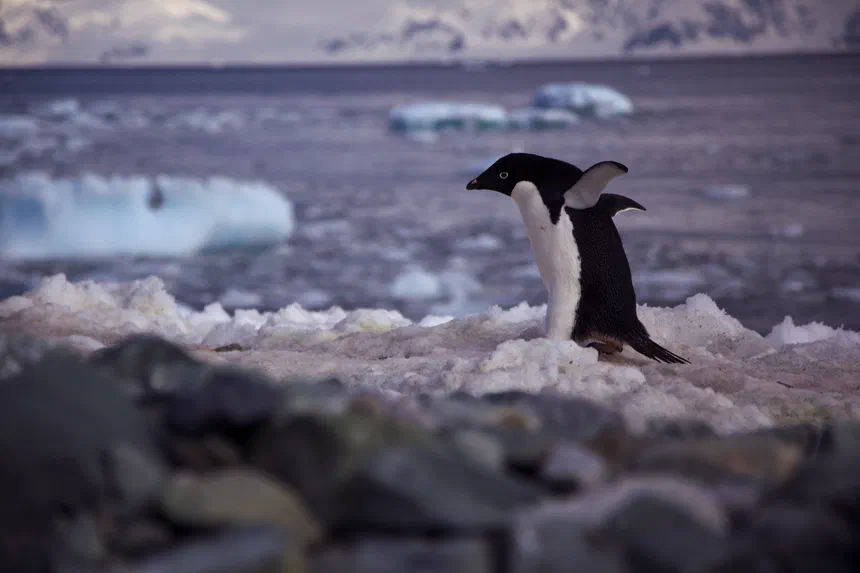
What Is a Adelie Penguin?
The Adelie penguin (Pygoscelis adeliae) is a medium-sized penguin that lives along the coast of Antarctica and on nearby islands. It is one of the most southerly breeding of all birds and one of only two penguin species found on the Antarctic mainland. Named after Adelie Land, the region explored by French navigator Jules Dumont d’Urville and named for his wife, it is instantly recognizable by the white ring circling each eye.
Appearance and Identification
Adelie penguins have a classic “tuxedo” pattern: a blue-black head and back set against a crisp white belly and throat. The most distinctive feature is a narrow white ring around each dark eye, which gives the bird an alert, wide-eyed look. The bill is mostly black but partly covered by feathers, and the feet and short tail help identify the species. Adults stand roughly 18 to 28 inches (46 to 71 cm) tall and typically weigh between 8 and 13 pounds (3.6 to 6 kg). Males and females look very similar, though males average slightly larger. Chicks are covered in gray to sooty-brown down before molting into adult plumage.
Habitat and Range
This species is found around the entire Antarctic coastline and on outlying islands such as the South Shetland and South Orkney groups. Adelie penguins depend on the sea for food and on ice-free or seasonally exposed rocky ground for nesting. They spend much of the non-breeding season at sea among the pack ice, following the shifting edge of the ice as the seasons change. Large breeding colonies form on coastal slopes and headlands where snow clears enough in spring to expose bare rock.
Diet
Adelie penguins are carnivores that feed almost entirely at sea. Their diet is dominated by Antarctic krill, a small shrimp-like crustacean, along with small fish and squid. Diet composition varies by region and by season. These penguins are strong, agile swimmers that pursue prey underwater, often diving to moderate depths and staying submerged for a minute or more per dive. They may travel considerable distances between the colony and productive feeding areas when raising chicks.
Behavior
Adelie penguins are highly social and gather in dense, noisy colonies that can number from hundreds to hundreds of thousands of pairs. On land they walk with an upright waddle and sometimes toboggan across snow and ice by sliding on their bellies while pushing with their flippers and feet. In the water they are swift and acrobatic, sometimes leaping clear of the surface in a motion called porpoising. They are wary of predators such as leopard seals in the water and skuas that target eggs and chicks on land, and they often enter and leave the sea in groups.
Life Cycle and Reproduction
Breeding takes place during the Antarctic summer, when adults return to traditional colonies around October and November. Pairs build simple nests of small stones, which are a prized resource that birds sometimes steal from one another. The female usually lays two eggs, and both parents share incubation over a period of about a month while the other forages at sea. After hatching, chicks are brooded and guarded before gathering into groups called creches that offer some protection while parents fetch food. Chicks fledge and head to sea after roughly seven to nine weeks. Adelie penguins generally reach breeding age at a few years old and can live around 10 to 20 years in the wild.
Conservation Status
The Adelie penguin is currently listed as Least Concern by the IUCN, and its total population numbers in the millions of breeding pairs. Even so, the species is closely tied to sea ice and to the abundance of krill, so it is regarded as an important indicator of change in the Southern Ocean. Regional populations have risen in some areas and fallen in others, and warming, shifting sea ice, and pressure on krill stocks are ongoing concerns for its long-term outlook.
Frequently Asked Questions
Where do Adelie penguins live? They live around the coast of Antarctica and on nearby islands, breeding on ice-free rocky ground in summer and spending the rest of the year at sea among the pack ice.
What do Adelie penguins eat? Their diet is built mainly around Antarctic krill, supplemented with small fish and squid that they catch while diving.
How big is an Adelie penguin? Adults stand roughly 18 to 28 inches (46 to 71 cm) tall and weigh about 8 to 13 pounds (3.6 to 6 kg), making them one of the smaller penguin species.
References
The conservation status and key facts in this profile are supported by these sources:
- Animal Diversity Web — Pygoscelis adeliae (accessed 2026-07-29)
- GBIF — Pygoscelis adeliae (accessed 2026-07-29)
Found an error, source problem, or image concern? Report this page.