Birds Guide
Acorn Woodpecker
What Is a Acorn Woodpecker? The acorn woodpecker (Melanerpes formicivorus) is a medium-sized, highly social woodpecker of oak woodlands in western North America and the highlands of Central America. It is best known for …
At a glance
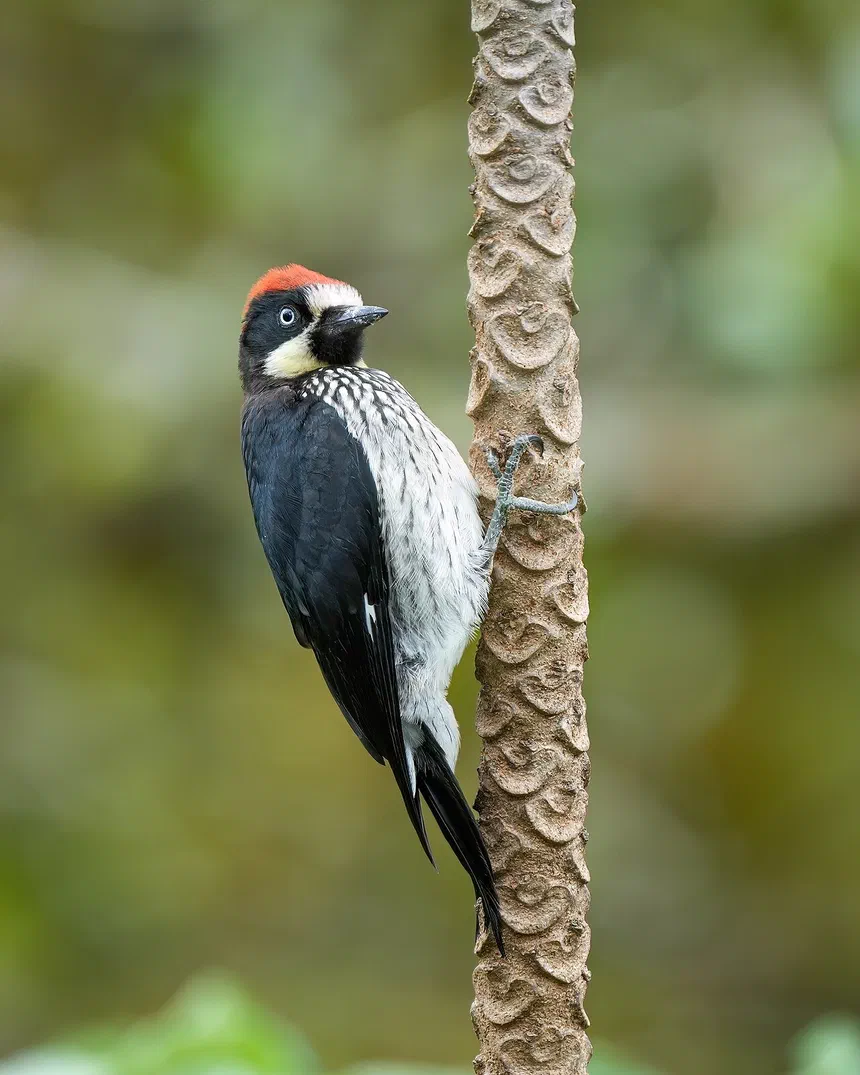
Image: Giles Laurent — CC BY-SA 4.0 · source
What Is a Acorn Woodpecker?
The acorn woodpecker (Melanerpes formicivorus) is a medium-sized, highly social woodpecker of oak woodlands in western North America and the highlands of Central America. It is best known for its habit of drilling thousands of small holes in a single tree and stuffing each hole with an acorn, creating a communal food store called a granary. With its bold facial pattern and noisy, cooperative family groups, it is one of the most recognizable and studied woodpeckers in the Americas.
Appearance and Identification
This woodpecker has a striking, almost comical face. The forehead is white, the crown bears a red cap, and the eyes are pale, set against glossy black plumage that gives it a wide-eyed, clown-like look. The back and wings are black with white wing patches that flash in flight, and the rump is white. Males and females look similar, though males show a larger red crown that reaches the white forehead, while females have a band of black separating the red from the white. Adults measure roughly 8 to 9 inches long, and both sexes share the same bold pattern.
Habitat and Range
The acorn woodpecker is closely tied to oaks. It occupies oak and mixed pine-oak woodlands, forest edges, wooded canyons, and even suburban parks and neighborhoods where mature oaks grow. Its range stretches from Oregon and California through the U.S. Southwest and down through Mexico and Central America to the mountains of Colombia. Because its life depends on acorn supplies, populations are concentrated wherever several oak species grow together, which helps buffer against poor mast years from any single species.
Diet
As its name suggests, acorns are central to this bird’s diet, especially in fall and winter when stored nuts sustain the group. Yet it is an omnivore. During warmer months it catches large numbers of flying insects, often sallying out from a perch to snatch them in midair, and it also eats tree sap, fruit, seeds, and occasionally bird eggs. The species tends and defends its granary trees year-round, and a single well-used granary can hold thousands of acorns wedged tightly into individual holes.
Behavior
Few birds are as social as the acorn woodpecker. It lives in cooperative family groups that may include several breeding adults plus non-breeding helpers from previous broods, all sharing the work of storing food and defending territory. Group members are noisy and animated, giving loud “waka-waka” calls and squabbling over granary rights. The birds spend much of the year maintaining their acorn stores, re-wedging nuts as they dry and shrink to keep them from falling out and being stolen by squirrels or jays.
Life Cycle and Reproduction
Breeding is often cooperative and complex. In many groups, more than one female lays eggs in the same nest cavity, and multiple males may mate with them, so a clutch can have shared parentage. Nests are excavated in tree trunks or large limbs, and clutches typically contain around three to six white eggs. Both breeders and helpers incubate the eggs and feed the nestlings. Young fledge after roughly a month and may remain with the group for one or more years as helpers before dispersing to breed. In favorable conditions, wild birds can live well over a decade.
Conservation Status
The acorn woodpecker is listed as Least Concern by the IUCN, and its overall population is considered stable across much of its range. Its greatest vulnerability is its dependence on oaks. Loss of oak woodlands, removal of dead trees used for granaries and nests, and shifts in oak distribution from climate change and land development can locally reduce numbers. Retaining stands of mature oaks and standing dead wood is the most effective way to keep local populations healthy.
Frequently Asked Questions
Why do acorn woodpeckers store so many acorns? Storing acorns in a shared granary gives a family group a reliable food supply through winter, when insects are scarce. Defending and maintaining this larder is a central part of their year-round social life.
Do acorn woodpeckers really live in groups? Yes. They are among the most social of woodpeckers, living in cooperative family units where several adults and older offspring share breeding, food storage, and territory defense.
Are acorn woodpeckers endangered? No. They are classified as Least Concern, though their reliance on oak woodlands makes local populations sensitive to the loss of oak trees and standing dead wood.
References
The conservation status and key facts in this profile are supported by these sources:
- Animal Diversity Web — Melanerpes formicivorus (accessed 2026-07-29)
- GBIF — Melanerpes formicivorus (accessed 2026-07-29)
Found an error, source problem, or image concern? Report this page.