Arachnids Guide
Jungle Huntsman Spider
What Is a Jungle Huntsman Spider? The jungle huntsman spider (Heteropoda boiei) is a large, fast-moving member of the huntsman family Sparassidae, native to the humid forests of Southeast Asia. Like other huntsmen, it is …
At a glance
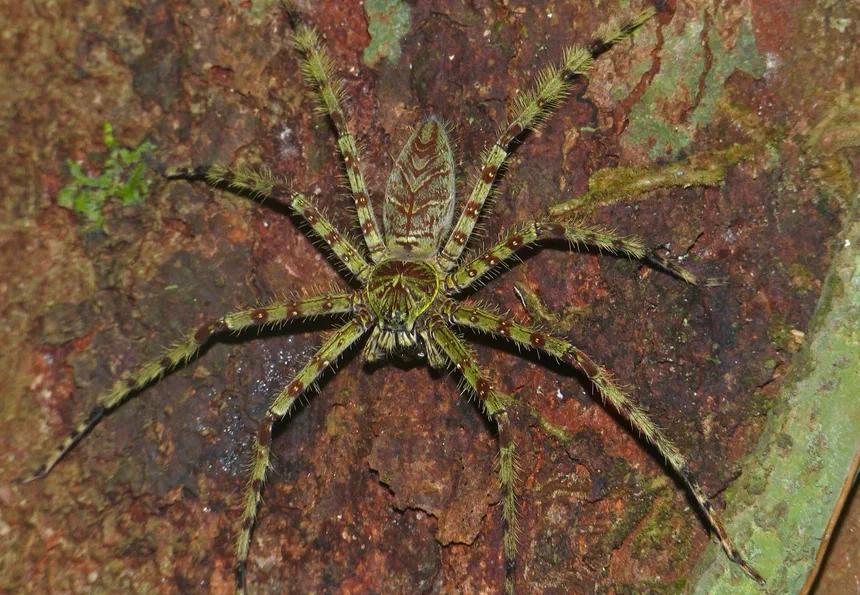
Image: Bernard DUPONT from FRANCE — CC BY-SA 2.0 · source
What Is a Jungle Huntsman Spider?
The jungle huntsman spider (Heteropoda boiei) is a large, fast-moving member of the huntsman family Sparassidae, native to the humid forests of Southeast Asia. Like other huntsmen, it is a wandering, free-living hunter that does not build a snare web to capture prey, relying instead on speed and ambush. Its flattened body and long, laterally held legs are typical of the genus Heteropoda.
Appearance and Identification
This species has the classic huntsman build: a broad, flattened cephalothorax and legs that splay outward to the sides, giving it a crab-like posture and allowing it to slip into narrow crevices under bark. The overall coloration tends toward earthy browns and grays, often with mottled or banded markings on the legs that provide camouflage against tree trunks and leaf litter. Leg span can reach roughly 10-12 cm in larger individuals, while the body itself is a more modest 2-3 cm long. Females are generally larger and more robust than males, and the eight eyes are arranged in two rows across the front of the head. As with many spiders, precise size varies with age, sex, and local conditions.
Habitat and Range
Heteropoda boiei occurs in tropical and subtropical regions of Southeast Asia, where warm temperatures and high humidity persist year-round. It favors forested environments, spending much of its time on tree trunks, among foliage, and beneath loose bark. Because huntsman spiders are strongly associated with wood and vegetation, they sometimes turn up in gardens, plantations, and human dwellings, particularly structures near or within forest edges. The species is most active in sheltered, shaded microhabitats that retain moisture.
Diet
The jungle huntsman is an active predator that feeds on a range of small live prey, chiefly insects such as cockroaches, moths, crickets, and other arthropods, along with occasional small invertebrates. Rather than trapping food in a web, it stalks or ambushes prey and seizes it with a rapid lunge, subduing it with venom delivered through its fangs. The venom is used to immobilize prey and is not considered medically significant to humans, though a defensive bite can be painful. As a generalist predator, it helps regulate populations of insects in its habitat.
Behavior
Huntsman spiders are best known for their speed and their sideways, scuttling gait. Heteropoda boiei is largely nocturnal, hunting under cover of darkness and retreating to crevices or the undersides of bark during the day. It is generally shy and prefers to flee rather than confront a threat, often moving with startling quickness when disturbed. When cornered, an individual may raise its front legs in a defensive display. These spiders are solitary outside of mating.
Life Cycle and Reproduction
After mating, the female produces a flattened, oval egg sac containing many eggs. In typical huntsman fashion, she guards the sac closely, sometimes carrying it or securing it in a sheltered spot, and remains protective until the spiderlings emerge. The young hatch resembling miniature adults and disperse to begin hunting on their own, molting repeatedly as they grow. Maturation takes several months, and adults generally live on the order of one to two years, with females often outliving males.
Conservation Status
Heteropoda boiei has not been formally assessed by the IUCN, so it carries no specific conservation designation. There is no indication that the species is threatened; huntsman spiders as a group are widespread and adaptable. As with many tropical invertebrates, the main long-term pressures would come from deforestation and habitat loss rather than direct exploitation.
Frequently Asked Questions
Is the jungle huntsman spider dangerous to humans? No. While it can deliver a painful defensive bite, its venom is not considered dangerous to people, and the spider generally prefers to flee.
Does this spider build a web to catch prey? No. Like other huntsmen, it is a free-living hunter that chases down or ambushes prey rather than snaring it in a web.
Where is Heteropoda boiei found? It lives in the tropical forests of Southeast Asia, often on tree trunks, in foliage, and under bark.