Arachnids Guide
Jumping Spider
What Is a Jumping Spider? Jumping spiders make up the family family Salticidae, the largest family of spiders with more than 6,000 described species. They are named for their ability to leap many times their own body …
At a glance
What Is a Jumping Spider?
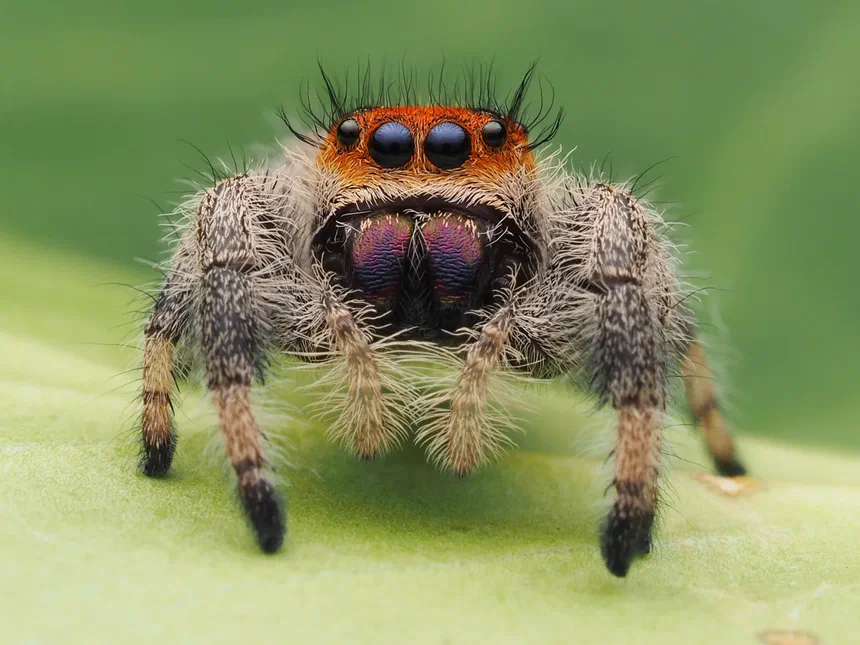
Jumping spiders make up the family family Salticidae, the largest family of spiders with more than 6,000 described species. They are named for their ability to leap many times their own body length to capture prey or cross gaps. Compact, alert, and famously curious, they are among the most easily recognized spiders thanks to their large forward-facing eyes.
Appearance and Identification
Jumping spiders are typically small and stocky, with a short, boxy cephalothorax and comparatively short legs. Their most distinctive feature is a set of eight eyes arranged in three rows, dominated by an enormous central pair on the front of the face that gives them a friendly, big-eyed look. These principal eyes provide sharp, color-capable vision that is exceptional among invertebrates. Body coloration varies enormously across species, ranging from drab grays and browns that blend into bark to brilliant iridescent scales and vivid orange, red, blue, or metallic markings, often most striking in courting males. Fine hairs cover the body and legs, and many species have prominent, sometimes iridescent, chelicerae (jaws).
Habitat and Range
Salticids are found on every continent except Antarctica and thrive in an unusually wide range of habitats. They live in tropical rainforests, temperate woodlands, grasslands, scrub, deserts, and even at high elevations in mountain ranges. They are equally at home in human-altered settings, hunting on garden foliage, fences, tree trunks, and the sunlit exterior walls and window frames of buildings. Because they hunt by sight rather than by web, they favor open, well-lit surfaces where they can spot movement and stalk prey.
Diet
Jumping spiders are active predators and almost entirely carnivorous. They feed on a broad menu of insects and other small arthropods, including flies, moths, crickets, aphids, and other spiders. Rather than spinning a snare, a jumping spider tracks its target visually, creeps within range, and pounces, often anchoring itself first with a silk dragline for safety. A few species show unusual dietary quirks: some in the genus Evarcha will feed on blood-filled mosquitoes, and one species, Bagheera kiplingi, consumes plant material to an extent rare among spiders.
Behavior
These spiders are diurnal and rely on daylight and keen vision for nearly everything they do. They are agile climbers and remarkable jumpers, boosting each leap with a rapid change in body fluid (hemolymph) pressure that extends the legs explosively. Curiosity is a hallmark of the group; a jumping spider will often turn to face and track a person or a moving object, sizing it up. Courtship is elaborate and highly visual, with males performing ritualized dances, waving their legs and colorful mouthparts and, in some species, vibrating the surface to send signals the female can sense. This visual signaling is possible because of their advanced eyesight, which rivals that of much larger animals for detail.
Life Cycle and Reproduction
After successful courtship and mating, the female produces one or more silk egg sacs, frequently placing them in a sheltered nest of silk tucked under bark, leaves, or stones. Many females guard the eggs and newly hatched young until the spiderlings are ready to disperse. The young molt several times as they grow toward adulthood. Most jumping spiders complete their life cycle within one to two years, and in cooler climates they often overwinter as juveniles in silken retreats before maturing the following season.
Conservation Status
As a family, jumping spiders have not been assessed by the IUCN, and the group as a whole is abundant and widespread. However, individual species with small or specialized ranges can be vulnerable to habitat loss, and only a handful have been formally evaluated. Their broad diet and tolerance of disturbed and urban habitats help many species remain common alongside people.
Frequently Asked Questions
Are jumping spiders dangerous to humans? No. They are not aggressive and their venom is used to subdue small prey. A bite is uncommon and typically causes only minor, temporary irritation.
How far can a jumping spider actually jump? Many species can leap several times their body length, and some cover distances far greater than that, using a silk dragline as a safety line during the jump.
Why do jumping spiders seem to look right at you? Their large central eyes give them excellent, detailed vision, so they genuinely turn to track movement and will often orient toward and study a nearby person or object.