Arachnids Guide
Huntsman Spider
What Is a Huntsman Spider? The huntsman spider (Heteropoda venatoria) is a large, fast-moving spider in the family Sparassidae, widely recognized for its long, crab-like legs and flattened body. Often called the giant …
At a glance
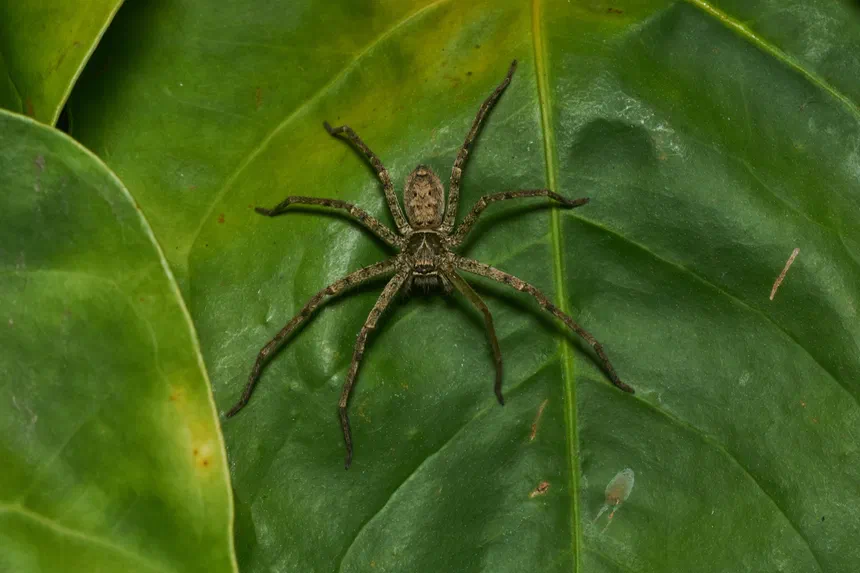
Image: Jeevan Jose, Kerala, India — CC BY-SA 4.0 · source
What Is a Huntsman Spider?
The huntsman spider (Heteropoda venatoria) is a large, fast-moving spider in the family Sparassidae, widely recognized for its long, crab-like legs and flattened body. Often called the giant crab spider or cane spider, it is one of the most cosmopolitan members of its genus, having spread far beyond its native range through commerce. Despite its intimidating size, it is not considered dangerous to people.
Appearance and Identification
Huntsman spiders are built for speed rather than web-spinning. The body is relatively flat, an adaptation that lets them squeeze into narrow crevices under bark, stones, and behind wall fixtures. Coloration is typically brown to grayish-tan, sometimes mottled with darker markings, which provides excellent camouflage against wood and stone. The legs are long and angled forward and to the sides in a crab-like posture, giving the species its “giant crab spider” nickname. Adults commonly reach a body length of about 2 to 3 centimeters, with a leg span that can approach 10 to 12 centimeters in large individuals. Males and females are similar in size, though males often have proportionally longer legs, and mature males may show a pale band across the front of the head region.
Habitat and Range
Originally native to tropical and subtropical Asia, Heteropoda venatoria has become one of the most widely distributed spiders in the world. It is now established across warm regions on nearly every continent, including parts of the southern United States, Central and South America, Africa, and many Pacific and Caribbean islands. Much of this spread is attributed to the species hitching rides in shipments of tropical produce, especially bananas, which has earned it the alternate name “banana spider” in some areas. In the wild it favors humid forests, sheltering under loose bark and among leaf litter. It also adapts readily to human structures, where it is frequently found on walls, in garages, and inside homes.
Diet
The huntsman is an active, ambush-and-pursuit predator that does not build a snare web to capture prey. Instead, it relies on speed, keen touch, and good eyesight to hunt at night. Its diet consists mainly of insects and other invertebrates, including cockroaches, crickets, moths, and other spiders. Because it readily preys on household pests such as cockroaches, many people in tropical regions welcome its presence indoors as a form of natural pest control. It seizes prey with its powerful forelegs and fangs, delivering venom that quickly subdues the target.
Behavior
Huntsman spiders are best known for their remarkable speed and their habit of moving sideways in a crab-like fashion. When startled, they can dart across walls and ceilings with surprising quickness, which often alarms people even though the spiders are simply trying to escape. They are largely nocturnal, spending daylight hours tucked into crevices. While the venom can cause localized pain and swelling in humans, bites are uncommon and the species is not regarded as medically significant. Individuals are generally shy and prefer flight over confrontation, though a cornered spider may rear up defensively.
Life Cycle and Reproduction
After mating, the female produces a flat, oval egg sac that she guards closely. Rather than fixing it permanently to a surface, she often carries the egg sac beneath her body or holds it with her mouthparts and forelegs, moving it as needed. A single sac can contain a couple of hundred eggs. The female becomes notably aggressive in defense of her clutch during this period and remains near the spiderlings for a time after they hatch. The young disperse and go through a series of molts as they grow. In favorable warm conditions, huntsman spiders typically live around two years.
Conservation Status
Heteropoda venatoria has not been formally assessed by the IUCN, and it is not considered to be at risk. As a widespread, adaptable species that thrives alongside humans in tropical and subtropical zones, its populations appear secure. There are no known major threats to the species as a whole.
Frequently Asked Questions
Are huntsman spiders dangerous to humans? No. Although their bite can cause temporary pain, redness, and swelling, huntsman spiders are not considered medically dangerous, and they rarely bite unless handled or trapped against the skin.
Why do huntsman spiders come into houses? They are drawn indoors by shelter and by prey such as cockroaches and other insects. Their flat bodies let them slip through small gaps around doors, windows, and walls.
Do huntsman spiders build webs? No. They are active hunters that chase down prey rather than trapping it. They produce silk mainly for egg sacs and shelter retreats, not for catching food.