Arachnids Guide
Hobo Spider
What Is a Hobo Spider? The hobo spider (Eratigena agrestis) is a medium-sized funnel-weaving spider native to Europe and now well established across the Pacific Northwest of North America. It belongs to the family …
At a glance
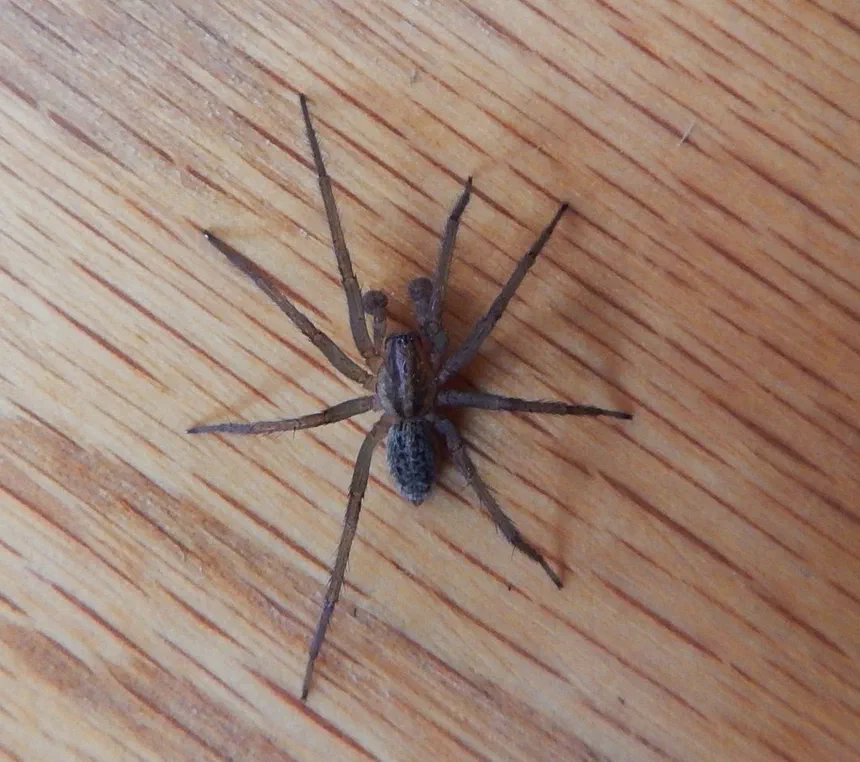
What Is a Hobo Spider?
The hobo spider (Eratigena agrestis) is a medium-sized funnel-weaving spider native to Europe and now well established across the Pacific Northwest of North America. It belongs to the family Agelenidae, the funnel weavers, and is best known for the sheet-like webs it spins in low, sheltered spots. Despite a long-standing reputation for dangerous bites, current evidence indicates it poses little threat to people.
Appearance and Identification
Hobo spiders are brown and fairly nondescript, with a body length of roughly 7 to 14 millimeters and a leg span that can reach around 45 millimeters. The abdomen often shows a series of faint gray or yellowish chevron (V-shaped) markings running down its length, while the legs are uniformly colored without the dark banding seen on some look-alikes. Because so many brown house and grass spiders resemble one another, reliable identification usually requires close microscopic examination of the reproductive structures. Contrary to a common myth, hobo spiders do not have distinct dark bands on their legs, a feature that actually helps rule the species out.
Habitat and Range
Native to Europe and parts of Central Asia, the hobo spider was introduced to the Pacific Northwest, likely through shipping, during the early 20th century. It is now common in Washington, Oregon, Idaho, and neighboring areas. The species favors ground level and low structures, building funnel webs in cracks in soil, along foundations, under rocks and debris, in retaining walls, and in the dim corners of basements, crawl spaces, and window wells. Because it is a poor climber, it is rarely found high on walls or ceilings indoors.
Diet
Like other funnel weavers, the hobo spider is a carnivore that preys on insects and other small invertebrates. It does not use a sticky web to snare prey. Instead, it waits at the narrow end of its funnel-shaped retreat and rushes out across the flat sheet of silk when vibrations signal that an insect has blundered onto it. Common prey includes flies, beetles, ants, and other small arthropods that wander near ground level.
Behavior
The hobo spider is generally shy and not aggressive, retreating quickly when disturbed. Its non-sticky sheet web relies on speed rather than adhesive silk, so the spider must be a fast, capable runner to capture prey. Males wander widely in late summer and autumn in search of mates, which is when people most often encounter them indoors. Once thought to cause serious skin lesions, the hobo spider is no longer considered medically significant by most experts, and verified bites appear to produce only minor, temporary effects.
Life Cycle and Reproduction
Hobo spiders typically live one to two years. Mating peaks from late summer into fall, after which males usually die. Females produce egg sacs, often layered with silk and attached in or near sheltered spots such as under rocks or debris, and may guard them. Each sac can hold dozens of eggs. Spiderlings hatch and disperse to establish their own retreats, maturing over the following seasons. Females generally outlive males and may produce more than one egg sac in a lifetime.
Conservation Status
The hobo spider has not been formally assessed by the IUCN and carries no special conservation designation. As a widespread and adaptable species, often thriving in disturbed and human-altered habitats, it is not considered to be at any risk. In parts of its introduced North American range it is common enough to be treated as a nuisance rather than a species of concern.
Frequently Asked Questions
Is the hobo spider dangerous to humans? Modern research has largely overturned the older view that hobo spider bites cause serious wounds. Bites are uncommon, and the available evidence suggests any effects are minor and short-lived.
How can you tell a hobo spider apart from similar spiders? It is very difficult to do so by eye. Hobo spiders lack banded legs and have faint chevron markings, but confident identification typically requires microscopic examination by a specialist.
Where are hobo spiders usually found? They live at or near ground level, building funnel webs in cracks, foundations, window wells, basements, and crawl spaces, mainly across the Pacific Northwest and their native Europe.