Arachnids Guide
Goliath Birdeater
What Is a Goliath Birdeater? The Goliath birdeater (Theraphosa blondi) is a large tarantula native to the rainforests of northern South America and is widely regarded as the heaviest spider in the world. Despite its …
At a glance
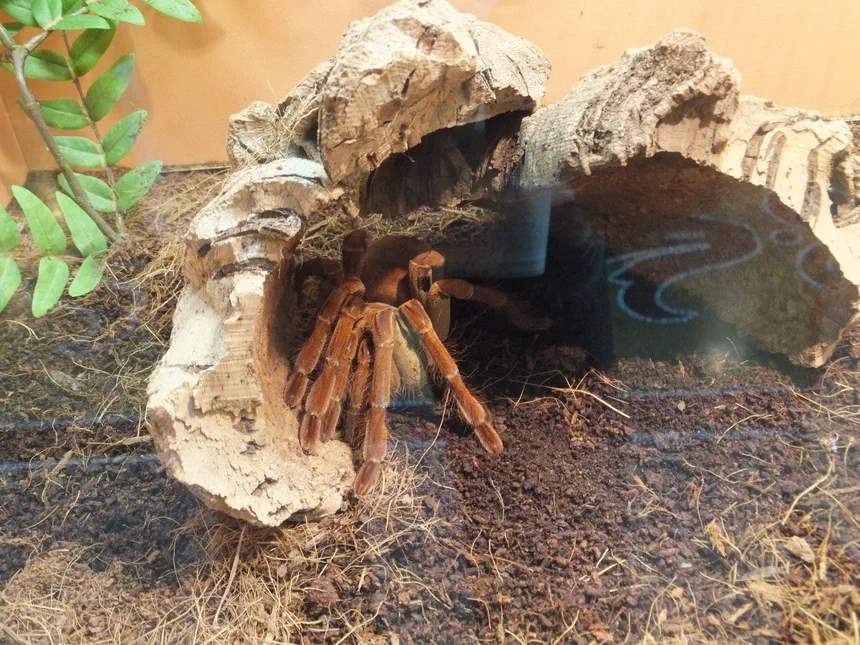
Image: Syrio — CC BY-SA 4.0 · source
What Is a Goliath Birdeater?
The Goliath birdeater (Theraphosa blondi) is a large tarantula native to the rainforests of northern South America and is widely regarded as the heaviest spider in the world. Despite its dramatic common name, it rarely preys on birds, feeding instead on a range of invertebrates and small vertebrates it encounters on the forest floor.
Appearance and Identification
This is a bulky, heavy-bodied tarantula clothed in dense brown to golden hairs. Adults can reach a leg span of around 11 inches (28 cm) and a body length near 4.75 inches (12 cm), with weights approaching 6 ounces (170 g), making it a rival of the giant huntsman spider for the title of largest spider by size and the clear leader by mass. The legs are thick and powerful, and the fangs may exceed three-quarters of an inch (about 2 cm) in length. Like other New World tarantulas, it carries fine urticating hairs on its abdomen that it can flick toward threats. Males tend to be somewhat smaller and more slender than the robust females.
Habitat and Range
The Goliath birdeater lives in the upland rainforests and swampy, marshy regions of the northern Amazon Basin, including parts of Venezuela, Guyana, Suriname, French Guiana, and northern Brazil. It is a ground-dwelling species that shelters in deep burrows, often taking over abandoned rodent tunnels or excavating its own beneath logs and roots. These humid, shaded retreats help the spider conserve moisture and avoid the heat of the day, and it typically lines the burrow entrance with silk.
Diet
As an ambush predator, the Goliath birdeater does not build a snare web to catch prey. Instead it waits near its burrow and seizes animals that wander close. Its diet is dominated by large insects, earthworms, and other invertebrates, but it will also take amphibians such as frogs, along with small reptiles, rodents, and occasionally other spiders. The spider immobilizes prey with venom delivered through its large fangs, then secretes digestive fluids to liquefy the tissues before consuming the meal. While the name suggests bird predation, encounters with birds are rare and probably involved nestlings or eggs.
Behavior
Goliath birdeaters are mostly solitary and nocturnal, emerging from their burrows under cover of darkness. When disturbed, they can be defensive rather than aggressive: a threatened spider may rear up to display its fangs, flick clouds of irritating urticating hairs from its abdomen, or produce a hissing sound called stridulation by rubbing bristles on its legs together. Their venom is not considered dangerous to healthy humans, generally causing effects comparable to a wasp sting, but the urticating hairs can irritate skin, eyes, and airways.
Life Cycle and Reproduction
Females deposit a large egg sac containing roughly 50 to 200 eggs, which they guard within the burrow. The urticating hairs are sometimes woven into the silk of the sac for added protection. Spiderlings hatch and disperse to lead independent lives, molting repeatedly as they grow. Growth is slow, and females may take two to three years to reach maturity. There is a striking difference in longevity between the sexes: females can live for 15 to 25 years, while males typically survive only a few years and usually die not long after reaching maturity and mating.
Conservation Status
The Goliath birdeater has not been formally assessed by the IUCN and is not currently listed as threatened. It remains reasonably widespread across suitable rainforest habitat in its range. Nonetheless, ongoing deforestation and habitat loss in the Amazon Basin, together with collection for the exotic pet trade, are potential pressures on local populations. In some parts of its range the spider is also harvested as food by Indigenous communities.
Frequently Asked Questions
Does the Goliath birdeater actually eat birds? Only rarely. The name dates to an early illustration of a related tarantula eating a hummingbird. In practice its diet is mostly invertebrates, amphibians, and other small ground animals.
Is the Goliath birdeater dangerous to humans? Its bite is painful but its venom is mild for people, roughly comparable to a wasp sting. The bigger nuisance is its urticating hairs, which can cause itching and irritation to skin and eyes.
How big can a Goliath birdeater get? It can reach a leg span of around 11 inches (28 cm) and weigh up to about 6 ounces (170 g), making it the heaviest known spider in the world.