Arachnids Guide
Golden Silk Orb-Weaver
What Is a Golden Silk Orb-Weaver? The golden silk orb-weaver (Trichonephila clavipes) is a large, striking spider famous for the rich golden sheen of its silk. It is the only member of its group native to the Americas, …
At a glance
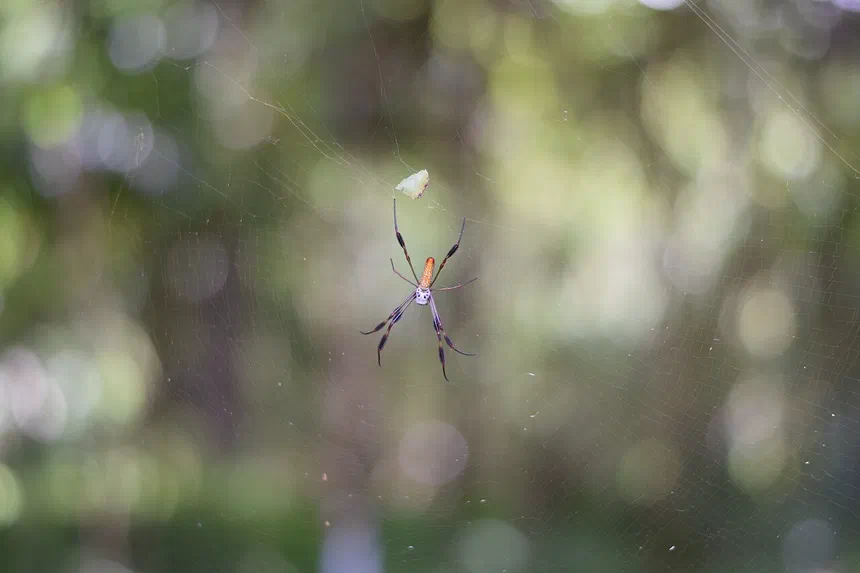
Image: P,TO 19104 — CC BY-SA 4.0 · source
What Is a Golden Silk Orb-Weaver?
The golden silk orb-weaver (Trichonephila clavipes) is a large, striking spider famous for the rich golden sheen of its silk. It is the only member of its group native to the Americas, where it spins some of the biggest and strongest orb webs of any North American spider.
Appearance and Identification
This species shows dramatic size differences between the sexes. Females are large, with an elongated silvery-yellow body reaching roughly 1 to 1.5 inches (24-40 mm) in length, not counting the legs. Their long legs are banded in brown and yellow and carry distinctive tufts or “gaiters” of dark hair near the joints on several pairs. Males are tiny by comparison, often under a quarter inch (6 mm), and are slender and reddish-brown, so small that they are easily overlooked at the edge of a female’s web. The common name refers to the yellow-gold color of the silk, which appears especially vivid when backlit by sunlight.
Habitat and Range
The golden silk orb-weaver favors warm, humid environments. It is found across the southeastern United States, particularly along the Gulf Coast and in Florida, and its range extends south through Mexico and Central America into much of South America. It builds webs in forests, along woodland edges, in citrus groves, and in gardens, usually choosing open sunlit gaps between trees or shrubs where flying insects travel. Warm climate is important, and populations thrive where winters are mild.
Diet
Like other orb-weavers, this spider is a carnivore that feeds on insects captured in its web. Its diet consists mainly of flying prey such as flies, small moths, wasps, beetles, and grasshoppers. The large, resilient web can occasionally trap surprisingly big insects. Once prey strikes the sticky spiral, the spider rushes over, subdues it with a bite, and wraps it in silk to eat immediately or store for later.
Behavior
The most remarkable behavior of this species is web construction. Females build large, semi-permanent orb webs that can span two feet or more, suspended within a complex network of supporting and barrier threads. The golden silk is notably strong and elastic, and the spider often repairs sections rather than rebuilding the whole web each day. Females typically sit head-down at the hub, waiting for vibrations that signal trapped prey. Tiny males live at the margins of the web, and the webs of several individuals may cluster together in loose colonies. Small “dewdrop” spiders and other kleptoparasites frequently steal food from the edges.
Life Cycle and Reproduction
The life cycle spans roughly a single year. After maturing in late summer, males cautiously approach females to mate, often waiting until a female is feeding or freshly molted to reduce the risk of being attacked. A mated female produces one or more silk-wrapped egg sacs, each containing hundreds of eggs, which she attaches to vegetation and camouflages with plant debris. The spiderlings hatch and disperse, sometimes by “ballooning” on strands of silk carried by the wind. They grow through a series of molts over the warm months, and adults generally die off as cold weather arrives, leaving the next generation to overwinter as eggs or young.
Conservation Status
The golden silk orb-weaver has not been formally assessed by the IUCN, but it is common and widespread throughout its range and faces no known threats. It adapts well to gardens and disturbed habitats, and healthy populations are easy to find in suitable climates. Because it helps control insect numbers, it is regarded as a beneficial part of local ecosystems.
Frequently Asked Questions
Is the golden silk orb-weaver dangerous to people? No. Its venom is used on insect prey and is not medically significant to humans. A bite is possible if the spider is squeezed, but it is uncommon and generally produces only mild, localized discomfort.
Why is the silk golden? The silk contains natural pigments that give it a yellow-gold color. This hue may help the web blend into sunlit backgrounds while remaining attractive to certain insects.
How big can the females get? Including their long legs, large females can span several inches, though the body itself is usually about 1 to 1.5 inches long. Males are dramatically smaller.