Arachnids Guide
Giant House Spider
What Is a Giant House Spider? The giant house spider (Eratigena atrica) is a large, fast-moving funnel-weaver spider common in and around human dwellings across much of Europe. It belongs to the family Agelenidae and is …
At a glance
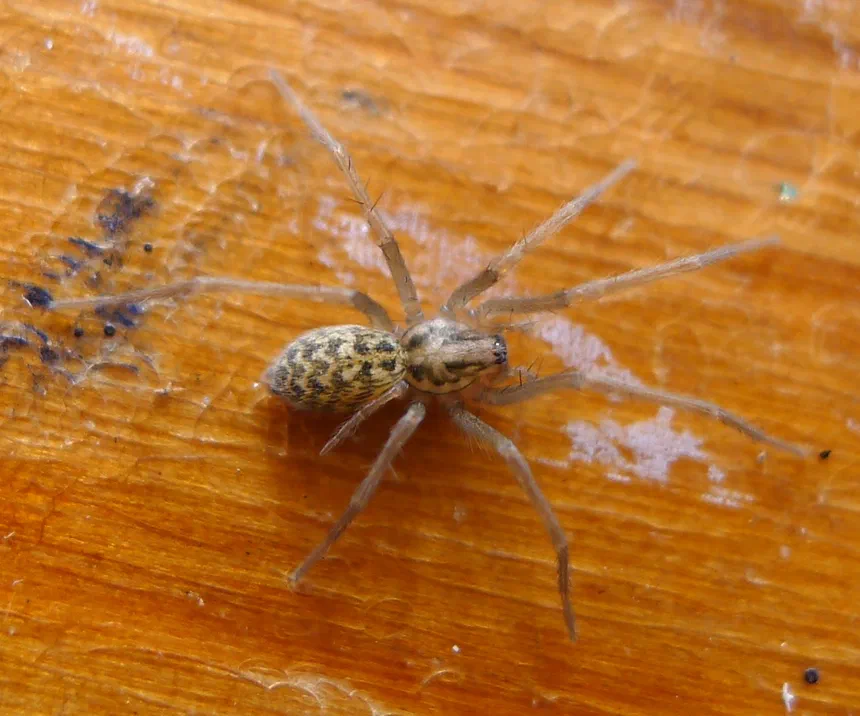
What Is a Giant House Spider?
The giant house spider (Eratigena atrica) is a large, fast-moving funnel-weaver spider common in and around human dwellings across much of Europe. It belongs to the family Agelenidae and is closely related to the domestic house spiders once grouped under the genus Tegenaria. Despite its formidable size and speed, it is harmless to people and plays a useful role by preying on household insects.
Appearance and Identification
This is one of the largest spiders regularly found indoors in its range. The body is usually brown to grayish-brown, with a slightly paler, mottled or chevron-patterned abdomen and a marked cephalothorax bearing faint darker streaks. Its most striking feature is its long, hairy legs, which give mature males an impressive leg span of several centimeters. Females have noticeably bulkier bodies than males, while males are recognizable by their smaller abdomens, longer legs, and the swollen pedipalps used in mating. The overall coloration helps the spider blend into corners, brickwork, and dim interior spaces.
Habitat and Range
The giant house spider is strongly associated with human structures, sheltering in quiet, undisturbed spots such as behind furniture, in cellars, garages, sheds, lofts, and along the bases of walls. Outdoors it occupies crevices in stone, wood piles, and dense vegetation. It is native to western and central Europe and has been introduced to parts of North America, where it is well established in the Pacific Northwest of the United States and Canada. The species tolerates cool, damp conditions well, which partly explains its success in temperate climates and buildings.
Diet
As an ambush predator, the giant house spider is carnivorous and feeds on a wide range of small invertebrates. Typical prey includes flies, moths, beetles, ants, and other spiders that wander into its web. It spins a distinctive flat, sheet-like web ending in a funnel-shaped retreat, where the spider waits out of sight. When vibrations signal that prey has blundered onto the sheet, the spider rushes out with remarkable speed, seizes the victim, and drags it back into the funnel to feed.
Behavior
This species is best known for its speed; it can sprint quickly across floors and walls, which is why it is so often noticed by householders. It is largely nocturnal and generally shy, retreating to its funnel at the first sign of disturbance. Males become far more conspicuous in late summer and autumn when they abandon their webs to roam in search of mates, frequently ending up trapped in sinks and bathtubs because they cannot climb the smooth sides. Although the spider can bite if handled roughly, its venom is not medically significant to humans, and encounters rarely result in anything more than a startle.
Life Cycle and Reproduction
Mating typically occurs in late summer and fall. After a cautious courtship, a male may remain with a female for a period before she eventually produces one or more silk egg sacs, which she guards within or near her retreat. The spiderlings hatch and disperse to establish their own webs. Giant house spiders are relatively long-lived among spiders: individuals may survive two to three years, and some females live longer under favorable indoor conditions. Growth proceeds through a series of molts until the spider reaches maturity.
Conservation Status
The giant house spider has not been formally assessed by the IUCN and is not considered to be at any conservation risk. It is widespread, abundant, and adaptable, thriving alongside humans throughout its native and introduced ranges. Its close association with buildings means that, if anything, human activity has expanded rather than reduced its distribution.
Frequently Asked Questions
Is the giant house spider dangerous? No. It can deliver a bite if provoked, but its venom is harmless to humans and bites are rare and minor.
Why do I see them most in autumn? Mature males wander widely in late summer and fall looking for mates, making them far more visible indoors during those months.
How can I tell it apart from similar spiders? Look for its large size, long hairy legs, mottled brownish body, and the flat, funnel-shaped web it builds in corners and sheltered spaces.