Arachnids Guide
Funnel-Web Spider
What Is a Funnel-Web Spider? The funnel-web spider is a stout, dark-bodied arachnid best known from the Sydney funnel-web, Atrax robustus, of southeastern Australia. It belongs to a group of mygalomorph spiders that …
At a glance
What Is a Funnel-Web Spider?
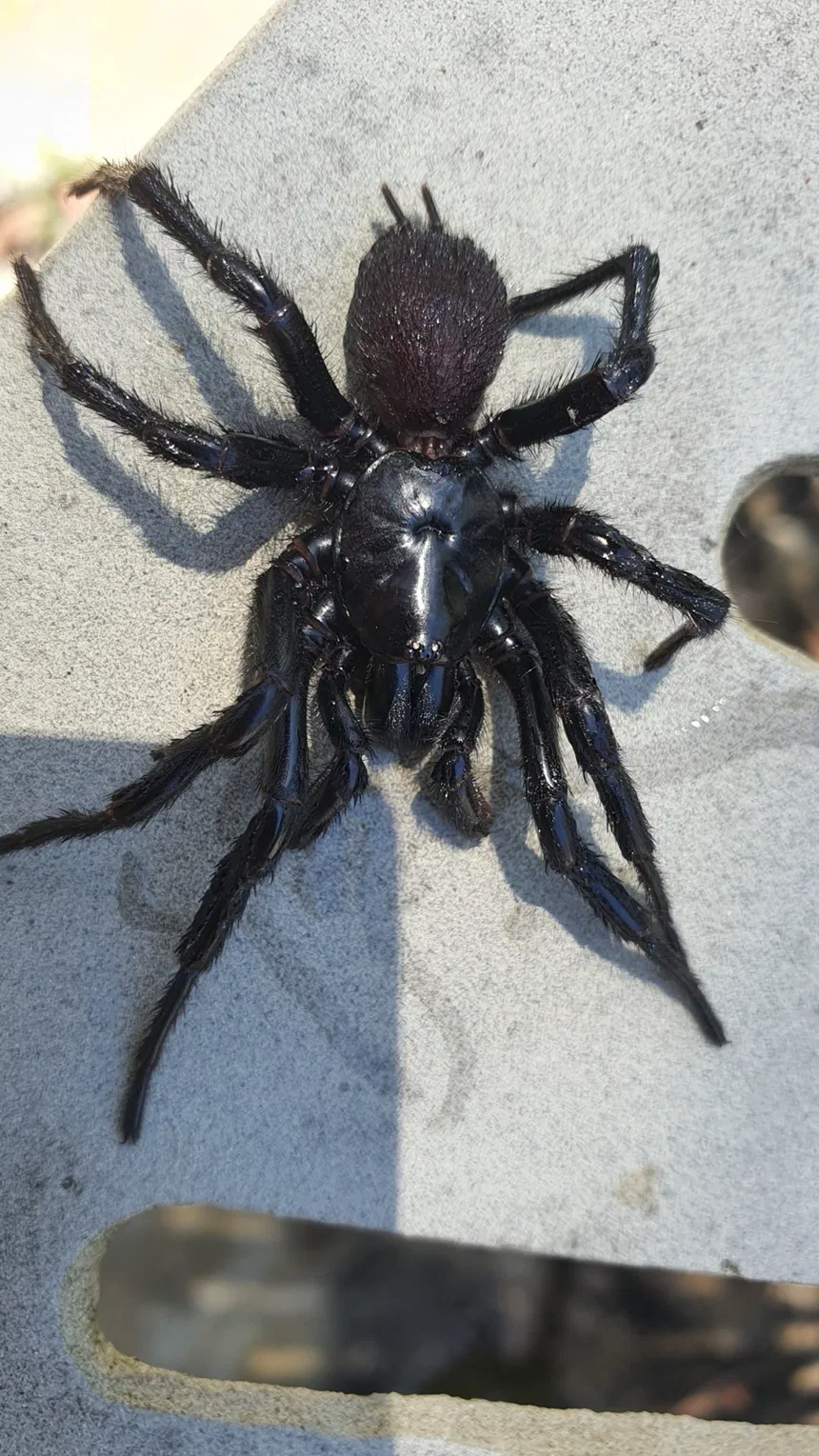
The funnel-web spider is a stout, dark-bodied arachnid best known from the Sydney funnel-web, Atrax robustus, of southeastern Australia. It belongs to a group of mygalomorph spiders that build silk-lined burrows with a distinctive funnel- or tube-shaped entrance, and it is widely regarded as one of the most medically significant spiders in the world.
Appearance and Identification
Funnel-web spiders are robust and heavily built, with a glossy, nearly hairless carapace that ranges from deep black to dark brown. Body length typically falls between about 1 and 5 centimeters depending on species and sex, with the leg span noticeably wider. They have powerful, forward-pointing fangs that strike downward, prominent spinnerets at the rear of the abdomen, and stout legs. Males are generally slimmer and longer-legged than the bulkier females, and mature males carry a distinctive mating spur on the second pair of legs.
Habitat and Range
The group is centered on eastern Australia, from Queensland south through New South Wales and into Victoria and Tasmania, with the well-known Sydney funnel-web concentrated around the greater Sydney region. These spiders favor moist, sheltered environments such as humid forests, leaf litter, rock crevices, and shaded gardens. They dig or occupy burrows in soft, damp soil or beneath logs and stones, lining the retreat with silk and extending irregular trip-line threads from the entrance. Humid conditions are important because the spiders are vulnerable to drying out.
Diet
Funnel-web spiders are ambush predators that feed almost entirely on live prey. Their diet consists largely of insects such as beetles, cockroaches, and crickets, along with other invertebrates like millipedes, snails, and small arthropods. Larger individuals occasionally take small vertebrates such as frogs or lizards. The spider waits at the mouth of its burrow, detecting vibrations transmitted along its silk trip-lines, then rushes out to seize and subdue prey with its fangs.
Behavior
These spiders are largely nocturnal and spend most of their lives within or close to the burrow. Females are strongly sedentary and may remain in a single retreat for years. Males, by contrast, leave their burrows during warm, humid periods of the year to wander in search of mates, which is when encounters with people most often occur, sometimes after a male falls into a swimming pool or shelters in footwear left outdoors. When threatened, a funnel-web may rear up, raise its front legs, and display its fangs. The venom of males, in particular Atrax robustus, is potent to humans, and any suspected bite is treated as a medical emergency, though effective antivenom has greatly reduced the danger.
Life Cycle and Reproduction
After a wandering male locates a female’s burrow, mating takes place at the entrance, with the male using his leg spurs to hold the female’s fangs clear. The female later produces a silk egg sac containing dozens to more than a hundred eggs, which she guards inside the burrow. Spiderlings hatch and remain with the mother for a period before dispersing to establish their own burrows nearby. Growth is slow, and females can be long-lived, sometimes reaching around a decade, while males typically die within a year or two of maturing, often shortly after their mating season.
Conservation Status
Funnel-web spiders have not been formally assessed by the IUCN, and most species are not considered threatened across their ranges. Some populations with very restricted distributions may be more sensitive to habitat loss, urban development, and drying conditions. As predators of insects and other invertebrates, they play a useful role in local ecosystems, and their venom is also of considerable scientific interest for research into pain, pest control, and medicine.
Frequently Asked Questions
Are funnel-web spiders dangerous to humans? Yes, several species have venom that can be dangerous, and the Sydney funnel-web is among the most medically important spiders in the world. However, antivenom is highly effective, and deaths have become very rare since its introduction.
Where do funnel-web spiders live? They are native to eastern Australia, favoring moist forests, gardens, and other humid, sheltered spots where they build silk-lined burrows in soft soil or under logs and rocks.
What do funnel-web spiders eat? They are carnivores that ambush live prey, feeding mainly on insects and other invertebrates, and occasionally taking small vertebrates such as frogs or lizards.