Arachnids Guide
Flat Rock Scorpion
What Is a Flat Rock Scorpion? The flat rock scorpion (Hadogenes troglodytes) is a large, strikingly flattened arachnid native to the rocky landscapes of southern Africa. It belongs to the genus Hadogenes, a group of …
At a glance
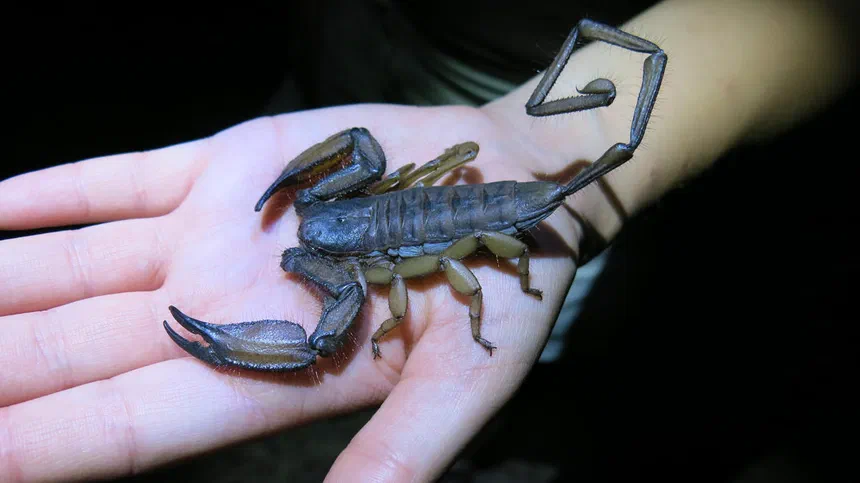
Image: Ryan van Huyssteen — CC BY-SA 4.0 · source
What Is a Flat Rock Scorpion?
The flat rock scorpion (Hadogenes troglodytes) is a large, strikingly flattened arachnid native to the rocky landscapes of southern Africa. It belongs to the genus Hadogenes, a group of scorpions specialized for life within the narrow cracks of stone outcrops. Among the longest scorpions in the world by body length, it is renowned for its slender build, extreme flatness, and remarkably gentle disposition.
Appearance and Identification
This species is instantly recognizable by its extraordinarily depressed, ribbon-like body, an adaptation that lets it squeeze into gaps only a few millimeters wide. Adults are typically glossy dark brown to nearly black, sometimes with lighter reddish or tan legs. Total length can reach around 8 inches (20 cm), making it one of the longest scorpions on Earth, though it is far more slender and lighter than bulky species of comparable length. Males are especially notable for their exceptionally long, thin tails (metasoma), which greatly exceed those of females. The pincers (pedipalps) are elongated and relatively slim rather than heavy and crushing. The legs end in specialized, recurved claws that grip rough rock surfaces with impressive strength.
Habitat and Range
Hadogenes troglodytes is found across parts of southern Africa, including regions of Zimbabwe, Mozambique, and neighboring areas. It is a strict rock-dwelling (lithophilous) specialist, living almost exclusively in the crevices of granite and other rocky outcrops within arid to semi-arid savanna and hilly terrain. Unlike burrowing scorpions, it does not dig into soil; instead it wedges itself deep inside stone fissures, where temperature and humidity remain more stable than on the exposed surface. Its flattened body and clinging claws are perfectly suited to this vertical, crevice-bound existence.
Diet
Like all scorpions, the flat rock scorpion is a carnivore. It preys on a variety of small invertebrates, including insects such as crickets, beetles, cockroaches, and moths, as well as spiders and other arthropods that wander near its rocky refuge. It is a patient ambush predator, waiting near the mouth of a crevice and seizing prey with its slender pincers. It relies far more on its powerful grip than on its venom, and its sting is used only weakly, if at all, during feeding.
Behavior
The flat rock scorpion is largely nocturnal and secretive, emerging at night or resting near crevice openings to sense passing prey and detect vibrations. It is famously docile and reluctant to sting, preferring to flee deeper into rock cracks or pinch defensively rather than use its stinger. Its venom is considered mild and of little medical concern to humans, comparable to a bee sting at most. When threatened, it wedges its body into crevices with such force, using its clawed legs and flattened form, that it becomes extremely difficult to extract.
Life Cycle and Reproduction
Scorpions in this genus are notably slow to mature and long-lived. Like other scorpions, the flat rock scorpion reproduces via internal fertilization following a courtship “dance,” in which the male grasps the female and guides her over a deposited packet of sperm (spermatophore). Females give live birth to a brood of young (scorplings) rather than laying eggs. The newborns climb onto the mother’s back, where they remain protected until their first molt. Growth is gradual, and individuals may take several years to reach maturity. Reported lifespans are long for an invertebrate, frequently in the range of 10 to 25 years or more.
Conservation Status
The flat rock scorpion has not been formally assessed by the IUCN Red List. While it is not currently considered globally threatened, its specialized dependence on rocky outcrop habitats makes local populations sensitive to habitat disturbance. The genus is also popular in the exotic pet trade, and heavy collection can put pressure on slow-growing, long-lived populations in certain areas.
Frequently Asked Questions
Is the flat rock scorpion dangerous to humans? No. It is regarded as one of the most docile scorpions, and its venom is mild, generally comparable to a bee sting. It rarely stings and prefers to hide rather than defend itself.
Why is its body so flat? The extreme flattening lets it slip into and cling within very narrow rock crevices, where it shelters from predators and harsh surface conditions.
How long can it live? It is unusually long-lived for an invertebrate, with individuals often surviving well over a decade and sometimes reaching 25 years or more.