Arachnids Guide
Fishing Spider
What Is a Fishing Spider? The fishing spider (Dolomedes tenebrosus) is a large, semi-aquatic hunting spider belonging to the nursery web spider family, Pisauridae. Named for the genus’s remarkable ability to walk on …
At a glance
What Is a Fishing Spider?
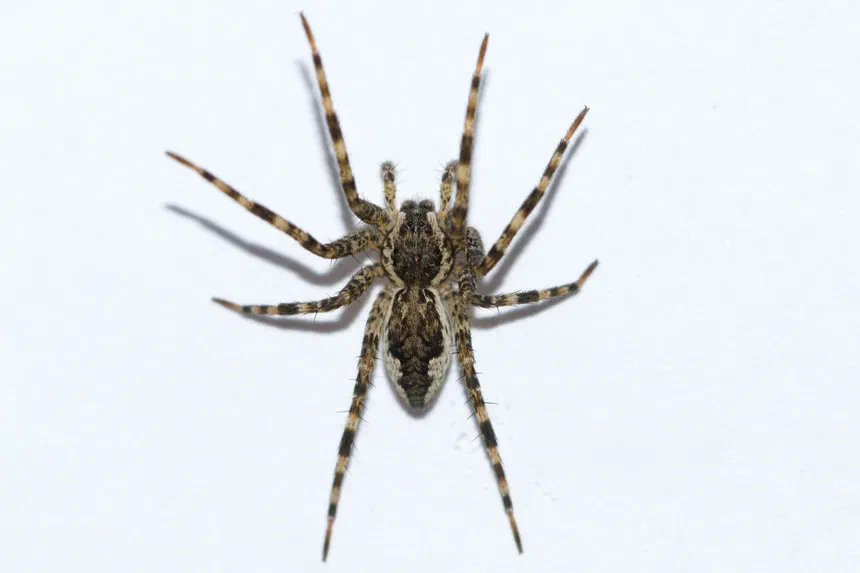
The fishing spider (Dolomedes tenebrosus) is a large, semi-aquatic hunting spider belonging to the nursery web spider family, Pisauridae. Named for the genus’s remarkable ability to walk on water and hunt aquatic prey, it is one of the biggest spiders found in eastern North America. Despite its imposing size, it poses little threat to people.
Appearance and Identification
This is a robust, long-legged spider with a leg span that can reach roughly 3 inches (about 75 mm), while the body itself measures around 0.6 to 1 inch (15 to 26 mm), with females noticeably larger than males. The coloration is generally brown to grayish, patterned with darker bands, chevrons, and mottled markings that provide excellent camouflage against tree bark and leaf litter. The legs often show alternating light and dark rings. This cryptic patterning distinguishes Dolomedes tenebrosus from the similar-looking wolf spiders, and its eight eyes are arranged in two rows rather than the wolf spider’s distinctive large-eyed layout.
Habitat and Range
The fishing spider ranges across eastern and central North America, from southern Canada through much of the United States. Although it belongs to a genus tied to water, D. tenebrosus is the most terrestrial of its relatives and is frequently found some distance from the nearest pond or stream. It favors wooded and forested habitats, where it rests on tree trunks, logs, and rock faces, often near slow-moving water. It also turns up on the outside walls of houses and outbuildings, which occasionally brings it into contact with people.
Diet
As an ambush predator, the fishing spider does not build a web to capture prey. Instead it waits motionless, often with its front legs resting on the water’s surface or on bark, detecting the vibrations of nearby movement. Its diet is dominated by insects, including both terrestrial and aquatic species, but larger individuals are capable of taking tadpoles, small fish, and aquatic invertebrates. When hunting on water, the spider can sense ripples made by struggling prey, dash across the surface, and even dive briefly beneath it, trapping a film of air against its body.
Behavior
The fishing spider is largely nocturnal and relies on stealth rather than speed alone. Fine, water-repellent hairs covering its body and legs allow it to stand on the surface tension of water and to submerge without becoming waterlogged. When threatened, it typically flees or presses itself flat against bark, using camouflage to disappear. Bites of humans are rare and, while the spider does possess venom to subdue prey, the effects on people are generally mild and comparable to a bee sting.
Life Cycle and Reproduction
Reproduction follows the pattern typical of nursery web spiders. After mating, the female produces a large, round egg sac, which she carries with her chelicerae (jaws) and pedipalps rather than attaching it to a web or her spinnerets. Shortly before the eggs hatch, she builds a tented nursery web among vegetation and stands guard over it while the spiderlings emerge and go through their first molt. The young disperse after leaving the nursery. Individuals generally live about one to two years, with much of the population overwintering as immatures before maturing the following season.
Conservation Status
Dolomedes tenebrosus has not been formally assessed by the IUCN and carries no special conservation designation. It remains widespread and common throughout its range, and its adaptability to both waterside and drier wooded habitats helps keep populations stable. As with many spiders, its main value lies in controlling insect populations.
Frequently Asked Questions
Is the fishing spider dangerous to humans? No. It is not considered medically significant. It may bite if handled or trapped against skin, but the venom is weak toward humans and the bite is usually no worse than a bee sting.
Can fishing spiders really walk on water? Yes. Water-repellent hairs and the water’s surface tension let them stand, run, and even sail across the surface, and they can dive underwater for short periods to escape danger or catch prey.
How big do they get? Females are the larger sex, with a body up to about an inch long and a leg span that can approach three inches, making this one of the largest spiders in eastern North America.