Arachnids Guide
Noble False Widow
What Is a Noble False Widow? The noble false widow (Steatoda nobilis) is a comb-footed spider in the family Theridiidae, the same family that includes the true widow spiders of the genus Latrodectus. Despite the alarming …
At a glance
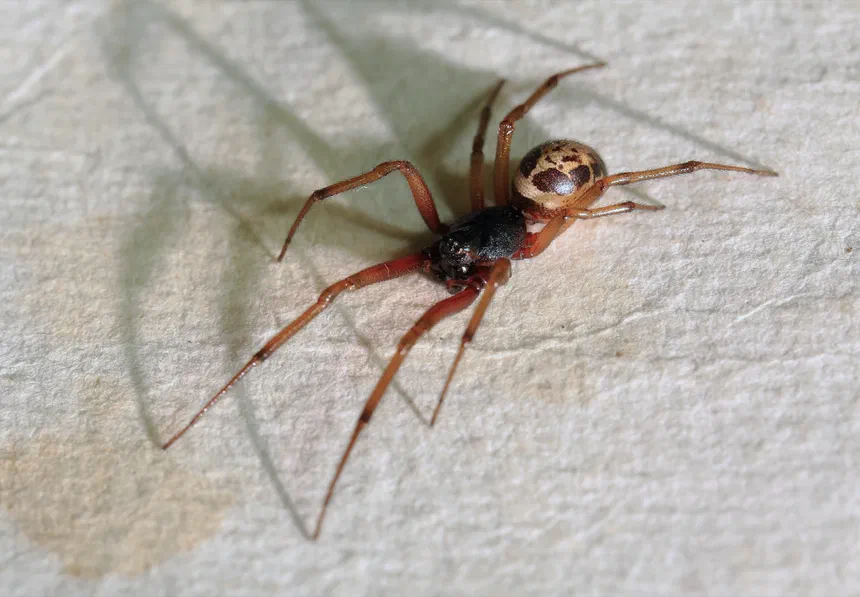
Image: Stu's Images — CC BY-SA 4.0 · source
What Is a Noble False Widow?
The noble false widow (Steatoda nobilis) is a comb-footed spider in the family Theridiidae, the same family that includes the true widow spiders of the genus Latrodectus. Despite the alarming nickname, it is a distinct species that is far less dangerous than its true widow relatives. It has become one of the most talked-about spiders in Europe because of its rapid spread and its habit of living close to people.
Appearance and Identification
Adults have a bulbous, glossy abdomen that ranges from dark brown to nearly black, usually marked with a pattern of pale cream or yellowish patches. Many individuals show a lighter band near the front of the abdomen and a series of markings that some observers liken to a skull shape. Females are noticeably larger than males, with a rounded body roughly 8–14 mm long, while males are more slender and long-legged. The legs are reddish-brown to orange. The species is often confused with true black widows, but false widows lack the bright red hourglass and have a browner overall tone.
Habitat and Range
Steatoda nobilis is native to the islands of Madeira and the Canary Islands off the coast of northwest Africa. Over the past century it has spread widely, becoming well established across much of Britain and continental Europe, and it has been recorded in parts of North and South America, North Africa, and western Asia. It thrives in and around human structures, favoring sheltered spots such as the corners of window frames, the underside of eaves, garden walls, fences, sheds, and outdoor light fixtures. Warm, sheltered microclimates near buildings help it survive cooler climates than its origins might suggest.
Diet
Like other theridiids, the noble false widow is a carnivore that feeds on insects and other small invertebrates. It builds a tangled, irregular three-dimensional web with sticky gumfoot lines anchored to a surface. When prey blunders into these lines, the tension pulls it off the ground and the spider quickly rushes out to bite and wrap it in silk. Common prey includes flies, beetles, woodlice, and other spiders, and larger individuals have occasionally been reported subduing small vertebrates.
Behavior
The noble false widow is generally shy and not aggressive toward people, preferring to retreat into a crevice when disturbed. It is largely nocturnal, sitting in or near its web at night to intercept prey. Bites to humans do occur, most often when a spider is trapped against skin, and they can cause pain, localized swelling, and redness, sometimes compared to a bee or wasp sting. Serious complications are uncommon and are usually linked to secondary bacterial infection rather than the venom itself. It is the medically most significant of Britain’s resident spiders, but dangerous reactions remain rare.
Life Cycle and Reproduction
After mating, the female produces one or more rounded, off-white egg sacs, which she guards within her web. Each sac may hold dozens of eggs, and spiderlings emerge and disperse after hatching, sometimes traveling on air currents by releasing silk threads. The spiders grow through a series of molts before reaching maturity. Females are long-lived by spider standards and may survive for several years under favorable conditions, continuing to produce egg sacs, while males typically live less than a year and often die not long after mating.
Conservation Status
The noble false widow has not been evaluated by the IUCN and is not considered to be at any risk. On the contrary, it is an expanding species whose range continues to grow, aided by global trade and warming climates. In many newly colonized regions it is treated as an introduced or invasive species, and researchers monitor its spread partly because it can compete with or prey upon native spiders.
Frequently Asked Questions
Is the noble false widow dangerous? It can bite and its venom may cause pain and swelling, but bites are uncommon and serious reactions are rare. It is far less dangerous than a true black widow.
How can I tell it apart from a black widow? False widows are brown and glossy with cream markings and lack the bright red hourglass found on the underside of true widows.
Why is it spreading so quickly? It travels easily in shipped goods, tolerates life around buildings, and benefits from milder winters, all of which help it colonize new areas.