Arachnids Guide
European Garden Spider
What Is a European Garden Spider? The European garden spider (Araneus diadematus) is one of the most familiar orb-weaving spiders across Europe. It is easily recognized by the pale, cross-shaped pattern of spots on its …
At a glance
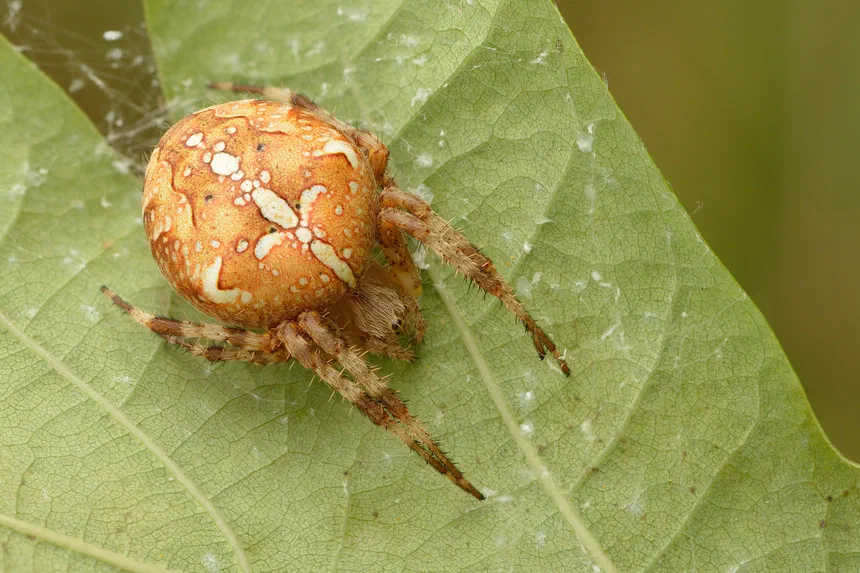
Image: Ivar Leidus — CC BY-SA 4.0 · source
What Is a European Garden Spider?
The European garden spider (Araneus diadematus) is one of the most familiar orb-weaving spiders across Europe. It is easily recognized by the pale, cross-shaped pattern of spots on its abdomen, which has earned it common names such as the cross spider and diadem spider. This harmless spider is best known for the large, wheel-shaped webs it spins in gardens, hedgerows, and woodland.
Appearance and Identification
The garden spider’s abdomen is rounded and marked with a distinctive arrangement of white or cream spots that form a cross, set against a background that ranges from pale tan to deep reddish-brown. Individuals vary considerably in color, so the cross-shaped marking is the most reliable identifying feature. Females are much larger than males, with body lengths of roughly 10 to 20 millimeters, while males typically measure about 6 to 13 millimeters. The eight legs are banded with lighter and darker segments, and like other orb-weavers the spider has eight eyes arranged in two rows. Its overall weight is well under a gram.
Habitat and Range
This species is widespread throughout Europe and has also become established across much of temperate North America, where it is sometimes called the cross orb-weaver. It thrives in gardens, parks, hedgerows, woodland edges, and around the walls, fences, and eaves of buildings. Garden spiders favor spots where flying insects are plentiful and where there is enough structure to anchor a web, so they are common in both rural and suburban settings. They are most conspicuous in late summer and autumn, when adults reach full size.
Diet
The European garden spider is a carnivore that preys almost entirely on flying and crawling insects, including flies, moths, wasps, beetles, and aphids. It catches prey in the sticky spiral of its orb web, then rushes out to bite and wrap the victim in silk before feeding. Like most spiders, it injects digestive enzymes to liquefy the internal tissues of its prey and then sucks up the resulting fluid. The spider will readily consume prey much larger than itself and often eats and rebuilds its web daily to keep it effective.
Behavior
Garden spiders are solitary and are best known for building near-vertical orb webs that can span a foot or more across. The spider often sits head-downward at the hub of the web, or hides in a nearby retreat connected to the hub by a signal thread that alerts it to vibrations when prey strikes. When disturbed by a potential threat, the spider may drop from the web on a dragline, retreat to cover, or vibrate the web rapidly to blur its outline. Despite their intimidating appearance, these spiders are not aggressive toward people, and a bite—rarely delivered—produces only mild, short-lived irritation.
Life Cycle and Reproduction
Mating takes place in late summer and early autumn. The smaller male approaches the female cautiously, using careful signals on the web to avoid being mistaken for prey. After mating, the female produces a rounded egg sac containing several hundred eggs, which she wraps in silk and hides in a sheltered spot such as a crevice or under bark. The female typically dies in autumn, and the eggs overwinter. Spiderlings hatch in spring, often clustering together in a bright yellow ball before dispersing on strands of silk carried by the wind, a behavior known as ballooning. They mature over the course of the summer, giving the species a life cycle of about one year.
Conservation Status
The European garden spider has not been formally assessed by the IUCN, but it is an abundant and widespread species with no known conservation concerns. It adapts well to human-altered landscapes and remains common throughout its range. As a natural predator of many garden pests, it is generally regarded as beneficial in gardens and green spaces.
Frequently Asked Questions
Is the European garden spider dangerous to humans? No. It is not aggressive and rarely bites; when it does, the effect is comparable to a mild insect sting and fades quickly.
Why does it have a cross on its back? The pale, cross-shaped pattern is formed by clusters of specialized cells in the abdomen and gives the species its common names, though the exact markings vary between individuals.
How long does a garden spider live? Most live for about a year, maturing over the summer, reproducing in autumn, and dying before winter while their eggs overwinter to hatch in spring.