Arachnids Guide
Emperor Scorpion
What Is a Emperor Scorpion? The emperor scorpion (Pandinus imperator) is one of the largest scorpions in the world and among the most recognizable, prized for its imposing size and gentle disposition. Native to the warm, …
At a glance
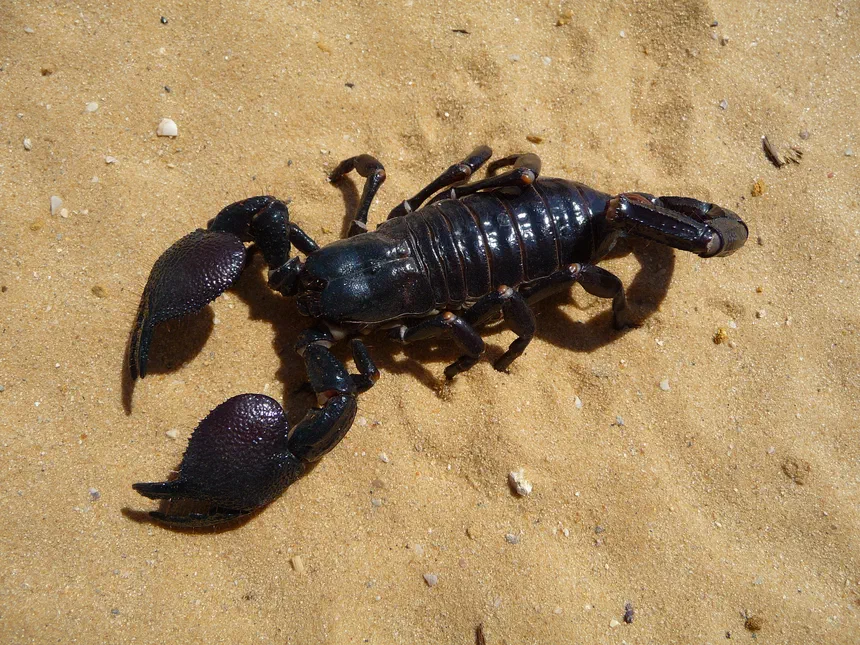
Image: George Chernilevsky — Public domain · source
What Is a Emperor Scorpion?
The emperor scorpion (Pandinus imperator) is one of the largest scorpions in the world and among the most recognizable, prized for its imposing size and gentle disposition. Native to the warm, humid forests of West and Central Africa, it belongs to the family Scorpionidae. Despite its fearsome appearance and massive pincers, its venom is comparatively mild.
Appearance and Identification
This is a heavy-bodied, glossy black scorpion that frequently shows a deep greenish or bluish sheen under bright light. Adults typically measure about 5 to 8 inches (13 to 20 centimeters) from the front of the body to the tip of the tail, making it one of the bulkiest scorpion species. Its most striking features are the large, robust pincers (pedipalps), which are used for grasping and crushing prey rather than for stinging. The tail (metasoma) ends in a curved stinger, and the body is covered in sensory hairs that detect vibrations and air movement. Under ultraviolet light, the exoskeleton fluoresces a bright blue-green, a trait shared across scorpions. Females and males are broadly similar, though males often have slightly slimmer bodies and longer tails.
Habitat and Range
Emperor scorpions are found across the tropical belt of West and Central Africa, including countries such as Nigeria, Ghana, Togo, Benin, and the Congo Basin. They favor hot, humid environments, particularly rainforest floors and moist savanna, where they shelter in burrows, under leaf litter, beneath logs, and inside termite mounds. High humidity is essential to their survival, and they tend to avoid open, dry ground. During the day they usually remain hidden in cool, moist retreats, emerging at night to hunt.
Diet
As nocturnal predators, emperor scorpions are carnivores that feed mainly on insects and other arthropods, including termites, crickets, beetles, and spiders. Larger individuals may occasionally take small vertebrates such as lizards or tiny rodents. They rely on their powerful pincers to seize and crush prey, reserving the sting for larger or more resistant animals. Juveniles depend more heavily on their venom, while big adults can often subdue prey through sheer crushing force alone.
Behavior
Emperor scorpions are largely solitary and nocturnal, spending daylight hours concealed in humid shelters. They are notable among scorpions for being relatively docile and tolerant of others of their kind, and groups sometimes share burrows, especially family units. When threatened, they are more likely to brandish their pincers and retreat than to sting. Their venom is weak by scorpion standards and produces effects in most people no worse than a bee sting, though individual reactions vary. They locate prey and detect danger through fine sensory hairs and specialized comb-like organs called pectines on the underside of the body.
Life Cycle and Reproduction
Reproduction begins with a courtship “dance,” during which the male grasps the female’s pincers and guides her over a deposited packet of sperm (a spermatophore). Like all scorpions, emperor scorpions give birth to live young rather than laying eggs, following a gestation that can last several months to over a year. A female may produce a dozen to more than thirty offspring in a single brood. The newborns, called scorplings, are pale and soft, and they climb onto the mother’s back, where she carries and protects them until their first molt. They gradually darken and become independent as they grow, reaching maturity after roughly four years.
Conservation Status
The emperor scorpion has not been formally assessed on the IUCN Red List. However, because of heavy collection for the international pet trade and for use in traditional practices, it is listed on Appendix II of CITES, which regulates its export and commercial trade. Habitat loss from deforestation adds further pressure. Captive breeding has helped reduce reliance on wild-caught animals, but sustainable management of wild populations remains a concern.
Frequently Asked Questions
Is the emperor scorpion dangerous to humans? Not seriously. Its venom is mild, and a sting is usually compared to a bee sting. It prefers to threaten with its large pincers and flee rather than attack.
Why does it glow under UV light? Compounds in the scorpion’s cuticle fluoresce under ultraviolet light, causing a bright blue-green glow. This trait is common to nearly all scorpions, though its exact function is still debated.
How big do emperor scorpions get? Adults commonly reach about 5 to 8 inches (13 to 20 centimeters) in length, making them one of the largest scorpion species and a heavy, bulky animal by scorpion standards.