Arachnids Guide
Desert Hairy Scorpion
What Is a Desert Hairy Scorpion? The desert hairy scorpion (Hadrurus arizonensis) is the largest scorpion native to North America and a signature resident of the southwestern deserts. It takes its name from the dense …
At a glance
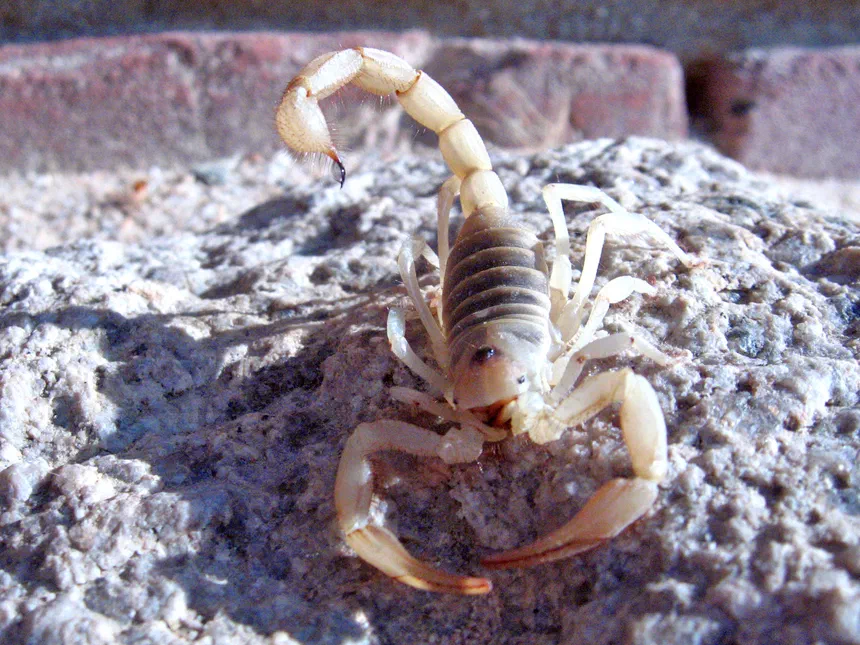
Image: Robb Hannawacker, while working for Joshua Tree National Park — Public domain · source
What Is a Desert Hairy Scorpion?
The desert hairy scorpion (Hadrurus arizonensis) is the largest scorpion native to North America and a signature resident of the southwestern deserts. It takes its name from the dense covering of fine, brownish sensory hairs on its legs, tail, and pincers, which help it detect vibrations in the sand.
Appearance and Identification
This is a bulky, impressive arachnid, with large adults reaching roughly 4 to 6 inches (10 to 15 cm) from the front of the body to the tip of the stinger. Its coloring is well suited to desert camouflage: the legs and pincers are typically pale yellow or olive, while the back plates (tergites) are darker, giving a two-toned look. The signature feature is the coat of fine hairs, most visible on the tail and pedipalps. Like all scorpions, it carries a pair of grasping pincers (pedipalps) at the front and a segmented tail tipped with a venom-bearing stinger. Its bulk and hairy appearance make it hard to confuse with the smaller, smoother bark scorpions that share its range.
Habitat and Range
The desert hairy scorpion is found across the hot, arid regions of the southwestern United States, including parts of Arizona, California, Nevada, Utah, and New Mexico, and extends south into northern Mexico. It favors low desert environments such as the Sonoran and Mojave deserts, where it occupies sandy flats, rocky slopes, and washes. To escape the intense daytime heat and conserve moisture, it digs deep, spiraling burrows, sometimes more than 3 feet (about 1 meter) down, where temperature and humidity stay more stable. It may also shelter under rocks and debris.
Diet
As a nocturnal predator, the desert hairy scorpion is an ambush and active hunter that feeds on a wide range of prey. Its diet includes insects such as beetles, crickets, and roaches, along with spiders, centipedes, and other scorpions. Large adults are capable of taking small lizards and other small vertebrates. It seizes prey with its powerful pincers and, for tougher or more active victims, delivers a sting from its tail to subdue them before feeding.
Behavior
This scorpion is mostly active at night, emerging from its burrow after dark to hunt and, during the warm season, to seek mates. During the hottest and driest stretches of the year it may become far less active, remaining sealed in its burrow. Despite its intimidating size, the desert hairy scorpion’s venom is relatively weak; a sting to a person is generally compared to a bee or wasp sting, causing localized pain and swelling rather than serious harm, though reactions vary between individuals. When threatened, it may raise its pincers and arch its tail in a defensive posture. Like many scorpions, it glows a blue-green color under ultraviolet light, a trait researchers use to locate them at night.
Life Cycle and Reproduction
Reproduction typically follows a courtship in which the male and female grasp pincers and perform a back-and-forth “dance” while the male positions a sperm packet for the female to take up. Scorpions give live birth rather than laying eggs. After a gestation that can last several months, the female produces a brood of young, often numbering a couple dozen or more. The pale, soft newborns climb onto the mother’s back and remain there through their first molt, gaining protection until they can fend for themselves. Growth is slow, with individuals molting several times over a few years to reach adulthood, and the species is notably long-lived for an invertebrate.
Conservation Status
The desert hairy scorpion has not been formally assessed by the IUCN and is not considered threatened. It remains widespread and locally common across suitable desert habitat. Collection for the pet trade and general habitat disturbance are minor pressures, but the species is not currently regarded as being at risk.
Frequently Asked Questions
Is the desert hairy scorpion dangerous to humans? Not seriously. Its venom is mild, and a sting is usually likened to that of a bee or wasp. Anyone with a known allergy or an unusually strong reaction should seek medical care, but healthy adults rarely experience more than temporary pain and swelling.
How big do they get? Large adults commonly measure about 4 to 6 inches (10 to 15 cm) in total length, making this the biggest scorpion in North America.
Why does it glow under UV light? Compounds in the scorpion’s outer cuticle fluoresce under ultraviolet light, causing it to glow blue-green. The exact purpose is debated, but the trait is very useful to researchers surveying scorpions in the dark.