Arachnids Guide
Deathstalker Scorpion
What Is a Deathstalker Scorpion? The deathstalker (Leiurus quinquestriatus) is a small, pale desert scorpion widely regarded as one of the most venomous scorpions on Earth. Despite its modest size, it carries a potent …
At a glance
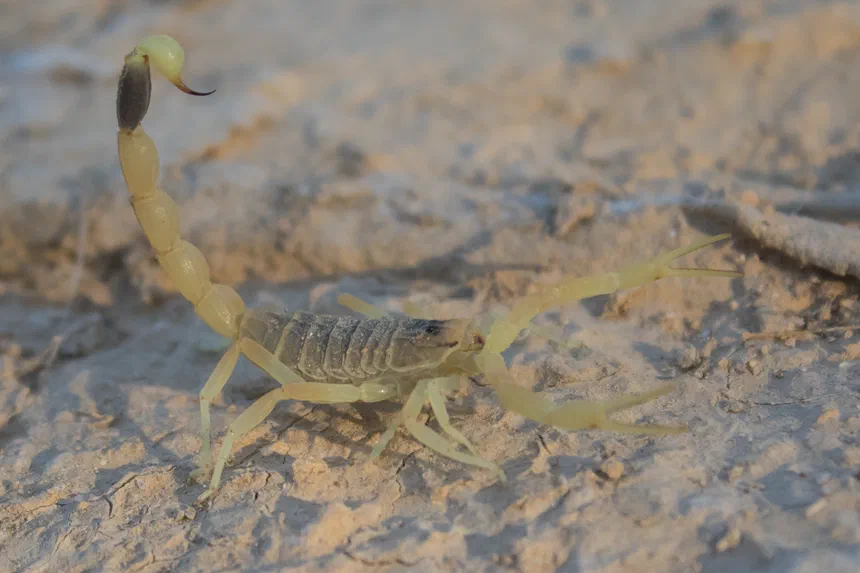
Image: מינוזיג — CC BY-SA 4.0 · source
What Is a Deathstalker Scorpion?
The deathstalker (Leiurus quinquestriatus) is a small, pale desert scorpion widely regarded as one of the most venomous scorpions on Earth. Despite its modest size, it carries a potent neurotoxic sting, and it ranges across the dry lands of North Africa and Southwest Asia. Its dramatic common name reflects both its reputation and the genuine medical seriousness of its venom.
Appearance and Identification
The deathstalker is a slender, lightly built scorpion, typically measuring about 2 to 3 inches (5 to 7.5 cm) from head to the tip of the tail. Its coloration is usually a pale yellow to sandy tan that blends almost perfectly with the desert sand and pale rock of its habitat, though some individuals show faint darker striping or shading on the body. Compared with bulkier scorpion species, it has notably thin, delicate pincers (pedipalps) and a relatively slender tail (metasoma). In scorpions, thin pincers often signal a reliance on venom rather than brute strength to subdue prey, and the deathstalker fits this pattern. The final tail segment carries the stinger, or telson, tipped with a sharp barb used to deliver venom.
Habitat and Range
The deathstalker is a desert specialist. It occurs across arid and semi-arid regions of North Africa and the Middle East, including parts of Egypt, Libya, Sudan, the Arabian Peninsula, and areas of the Levant. Within these dry landscapes it favors sandy deserts, gravel plains, dry scrub, and rocky terrain. Being highly sensitive to heat and moisture loss, it spends the scorching daylight hours sheltering in burrows, under stones, or in natural crevices, emerging to hunt after dark when temperatures drop.
Diet
As a carnivore, the deathstalker feeds on a variety of small invertebrates. Common prey includes insects such as crickets and beetles, along with spiders and other arthropods. It typically ambushes or grabs prey with its slender pincers and then injects venom through its stinger to immobilize the victim. Like most scorpions, it can survive long periods between meals, an adaptation well suited to the boom-and-bust food availability of desert environments.
Behavior
The deathstalker is primarily nocturnal, avoiding the extreme daytime heat by remaining hidden in shelter. It is often described as fast-moving and quick to defend itself, and it will readily sting when threatened or cornered. Like other scorpions, it fluoresces a blue-green glow under ultraviolet light, a property researchers exploit to locate the animals at night. Its venom is a complex mixture of neurotoxins, and it has drawn considerable scientific interest: certain components are being studied for potential medical uses, including tumor imaging and pain research. For most healthy adults a sting is intensely painful but rarely fatal, though it can pose a serious risk to children, the elderly, and those with underlying health conditions.
Life Cycle and Reproduction
Like all scorpions, the deathstalker gives birth to live young rather than laying eggs. After mating, which involves an elaborate courtship “dance” in which the pair grips pincers and maneuvers together, the female carries developing embryos internally for several months. She then gives birth to a brood of pale, soft-bodied young. The newborns climb onto the mother’s back, where they remain protected until their first molt hardens their exoskeletons. After this stage they disperse to live independently, growing through a series of molts before reaching maturity. In the wild, deathstalkers generally live around 4 to 6 years.
Conservation Status
The deathstalker has not been formally assessed by the IUCN, so it carries no official conservation ranking. It remains widespread and reasonably common across its arid range and is not considered threatened. It is, however, heavily collected for venom, which is among the most valuable animal-derived substances by weight because of its research applications. Habitat disturbance and over-collection are potential local concerns, but there is currently no evidence of a broad population decline.
Frequently Asked Questions
Is the deathstalker scorpion deadly to humans? Its venom is highly potent and its sting is medically significant, but healthy adults usually survive with prompt care. The greatest danger is to children, the elderly, and people with weak immune or cardiovascular systems.
Why is deathstalker venom so valuable? The venom contains specialized peptides being researched for uses such as cancer imaging and pain treatment, making purified venom extraordinarily expensive by weight.
Where do deathstalkers live? They inhabit deserts and dry, rocky regions across North Africa and the Middle East, sheltering by day and hunting at night.