Arachnids Guide
Daddy Longlegs Spider
What Is a Daddy Longlegs Spider? The daddy longlegs spider (Pholcus phalangioides) is a slender, long-legged spider best known for the tangled, irregular webs it spins in the corners of cellars, garages, and quiet rooms. …
At a glance
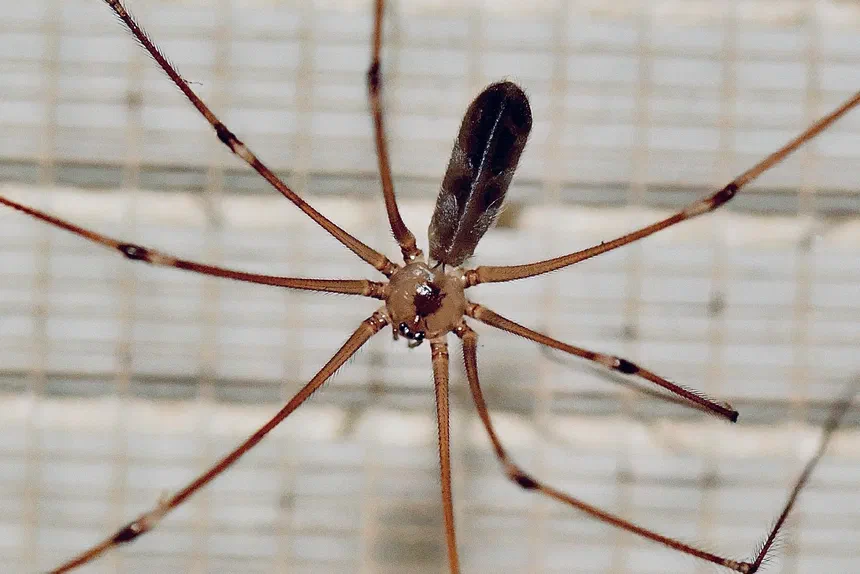
What Is a Daddy Longlegs Spider?
The daddy longlegs spider (Pholcus phalangioides) is a slender, long-legged spider best known for the tangled, irregular webs it spins in the corners of cellars, garages, and quiet rooms. It belongs to the family Pholcidae, often called cellar spiders, and is one of the most familiar household spiders across much of the world. Despite persistent myths, it is a harmless spider that poses no meaningful danger to people.
Appearance and Identification
This spider is easy to recognize by its extremely long, thin legs paired with a small, delicate body. The body typically measures around 8 to 10 millimeters, while the leg span can reach 50 to 70 millimeters, making the legs many times longer than the trunk. The overall color is pale, ranging from translucent tan to light gray, sometimes with a faint gray marking on the elongated, cylindrical abdomen. The legs are so fine that the spider can look almost ghostly against a wall. When disturbed, it often bounces or vibrates rapidly in its web, becoming a blur that is hard for a predator to grab.
It is important not to confuse this true spider with harvestmen, which are also nicknamed “daddy longlegs.” Harvestmen are not spiders at all; they have a single fused body region and no silk glands, whereas the cellar spider has the two clear body sections and spinnerets typical of true spiders.
Habitat and Range
Originally native to Europe, the daddy longlegs spider has spread with human activity to nearly every continent and is now cosmopolitan. It thrives in and around human structures, favoring undisturbed indoor spaces such as basements, cellars, closets, attics, sheds, and the upper corners of ceilings. In warmer regions it can also live in caves, rock crevices, and other naturally sheltered spots. Because it is sensitive to cold, it depends heavily on the mild, stable conditions that buildings provide in temperate climates, which is why it is so often an indoor resident.
Diet
The daddy longlegs spider is a carnivore that feeds on insects and other small arthropods it catches in its web. Its prey includes flies, mosquitoes, moths, ants, and other spiders. It is a capable predator of larger and potentially dangerous spiders; it will invade the webs of other species, lure or ambush the resident, and subdue prey by throwing silk over it with its long legs before biting. This habit of eating other spiders, including some considered household pests, gives it a useful role in controlling indoor arthropod populations.
Behavior
This species builds a loose, tangled web without a sticky spiral, relying instead on the messy structure to trap and slow prey. The spider usually hangs upside down beneath the web, waiting for vibrations. Its signature defense is whirling: when threatened, it spins its body in rapid circles while anchored to the web, blurring its outline so that predators struggle to strike it. It is generally sedentary, often remaining in the same corner for long periods, and multiple individuals may live near one another in favorable spots.
Life Cycle and Reproduction
After mating, the female produces a small clutch of eggs, usually a few dozen, which she wraps loosely in a thin layer of silk. Rather than fixing the egg sac to the web, she carries the bundle in her jaws, guarding it until the young hatch. The spiderlings resemble tiny, translucent versions of the adults and gradually molt as they grow, extending their legs with each stage. Development to maturity takes several months to about a year depending on temperature and food, and adults can live for two to three years, which is relatively long for such a small spider.
Conservation Status
The daddy longlegs spider has not been evaluated by the IUCN, and it faces no known conservation concern. As a widespread, adaptable species that benefits from human dwellings, it is common and secure throughout its expanding range.
Frequently Asked Questions
Is the daddy longlegs spider venomous or dangerous to humans? It has venom to subdue prey, like nearly all spiders, but its tiny fangs and mild venom make it harmless to people. The claim that it is the most venomous spider in the world is a myth.
Why do these spiders shake in their webs? Rapid whirling or bouncing is a defense. By blurring its body, the spider makes itself a difficult target for predators and can also help repel intruders.
Are they helpful to have around the house? Yes. They quietly hunt flies, mosquitoes, and even other spiders, acting as a natural form of indoor pest control.