Arachnids Guide
Brazilian Wandering Spider
What Is a Brazilian Wandering Spider? The Brazilian wandering spider (Phoneutria fera) is a large, ground-dwelling spider native to the tropical forests of South America. It belongs to the genus Phoneutria, a group …
At a glance
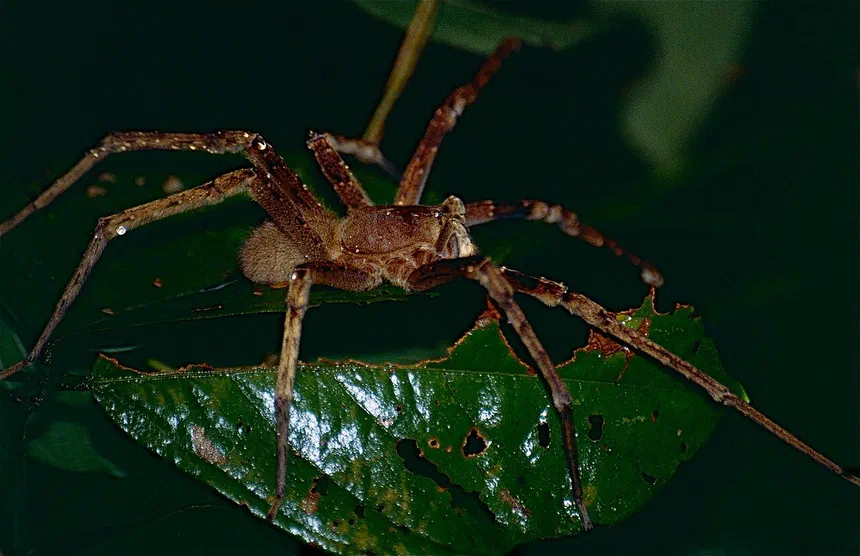
Image: Bernard DUPONT from FRANCE — CC BY-SA 2.0 · source
What Is a Brazilian Wandering Spider?
The Brazilian wandering spider (Phoneutria fera) is a large, ground-dwelling spider native to the tropical forests of South America. It belongs to the genus Phoneutria, a group renowned for potent venom and an active, roaming hunting style rather than reliance on a web. Its name reflects its habit of wandering the forest floor at night in search of prey.
Appearance and Identification
This is a robust spider with a body length that can reach roughly 4 to 5 centimeters and a leg span that may span up to about 13 to 15 centimeters, making it one of the larger wandering spiders. Coloration is generally brown to grayish, often with darker markings and faint banding on the long, spiny legs. The species has a dense covering of fine hairs and prominent forward-facing eyes arranged in a pattern typical of the family Ctenidae. When threatened, individuals often adopt a distinctive defensive posture, raising the front pairs of legs high and rocking from side to side, exposing the reddish hairs near the fangs.
Habitat and Range
Phoneutria fera inhabits humid tropical rainforest, particularly in the Amazon Basin of northern South America, including parts of Brazil and neighboring countries. It favors the leaf litter and lower vegetation of the forest floor, sheltering by day in crevices, under logs, among fallen leaves, or inside bromeliads and banana plants. Because it seeks out dark, enclosed spaces, it sometimes ends up near or inside human dwellings, sheds, and shipments of produce, which has contributed to its fearsome reputation.
Diet
As an active nocturnal hunter, this spider does not build a capture web. Instead it roams in search of food, relying on speed, ambush, and touch-sensitive hairs to detect prey. Its diet consists mainly of insects such as crickets and cockroaches, along with other spiders. Larger individuals are capable of overpowering small vertebrates, including tiny frogs, lizards, and occasionally mice. Prey is subdued with a rapid bite that delivers venom, after which the spider consumes the liquefied tissues.
Behavior
The Brazilian wandering spider is primarily nocturnal, spending daylight hours hidden and emerging after dark to hunt. It is notable for its alert, defensive temperament; rather than fleeing, it may stand its ground and display a warning posture when disturbed. The venom of Phoneutria spiders is medically significant and can cause pain, sweating, and other systemic effects in humans, though serious envenomation is relatively uncommon and effective antivenom exists in the region. Despite the alarming reputation, bites to people are usually the result of the spider being accidentally cornered.
Life Cycle and Reproduction
Reproduction begins with a courtship in which the male carefully approaches the larger female, using leg movements and vibrations to signal his intent and avoid being mistaken for prey. After mating, the female produces a silk egg sac that can contain a large number of eggs, often numbering in the hundreds. She may guard the egg sac until the spiderlings emerge. The young disperse to live independently and grow through a series of molts. Wild individuals typically live on the order of one to two years, with females generally longer-lived than males.
Conservation Status
Phoneutria fera has not been formally assessed by the IUCN, so it carries no official conservation designation. It is widespread within suitable rainforest habitat and is not considered threatened at present. As with many forest invertebrates, the primary long-term concern is habitat loss from deforestation, though the species itself remains locally common across much of its range.
Frequently Asked Questions
Is the Brazilian wandering spider dangerous to humans? Its venom is medically significant and can cause painful, sometimes serious symptoms, but bites are relatively rare, antivenom is available, and fatalities are uncommon.
Does this spider build a web to catch prey? No. It is an active hunter that wanders the forest floor at night, capturing prey directly rather than trapping it in a web.
Where is the Brazilian wandering spider found? It lives in humid tropical rainforest across northern South America, especially the Amazon Basin, sheltering in leaf litter, logs, and dense vegetation.
References
The conservation status and key facts in this profile are supported by these sources:
- Animal Diversity Web — Phoneutria fera (accessed 2026-07-29)
- GBIF — Phoneutria fera Perty, 1833 (accessed 2026-07-29)
Found an error, source problem, or image concern? Report this page.