Arachnids Guide
Bold Jumping Spider
What Is a Bold Jumping Spider? The bold jumping spider (Phidippus audax) is a common North American member of the jumping spider family, Salticidae. It is best known for its compact, fuzzy body, its habit of leaping to …
At a glance
What Is a Bold Jumping Spider?
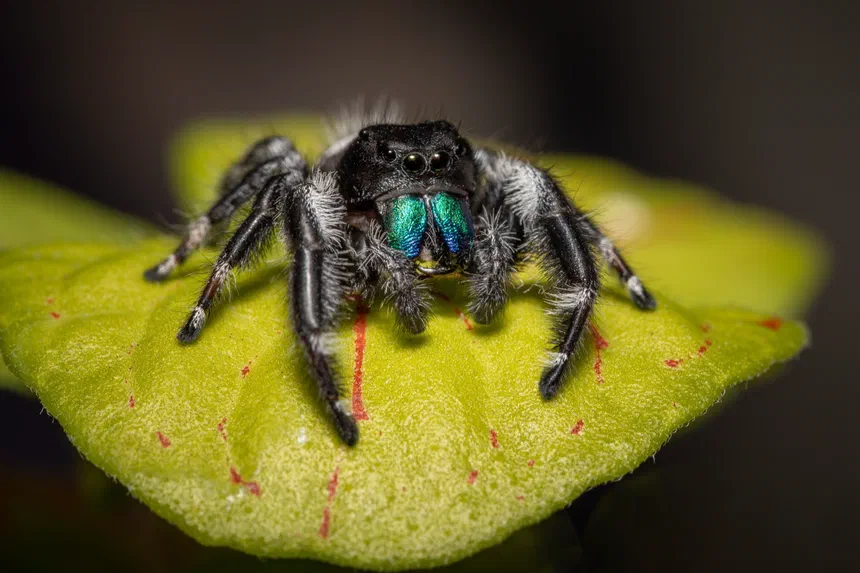
The bold jumping spider (Phidippus audax) is a common North American member of the jumping spider family, Salticidae. It is best known for its compact, fuzzy body, its habit of leaping to capture prey, and the pair of large forward-facing eyes that give jumping spiders their famously alert appearance.
Appearance and Identification
Bold jumping spiders are small and stocky, with adults typically measuring around 8 to 19 millimeters in body length. Females are generally larger and bulkier than males. The body is usually black or very dark, often covered in short hairs that give it a velvety look. A distinctive triangular or spot-shaped patch of white, cream, or pale markings sits on the top of the abdomen, along with smaller paired spots. Many individuals have chelicerae (the jaw structures) that shine with a bright metallic green, blue, or violet iridescence. Like all salticids, they carry four pairs of eyes, with the central pair enlarged for sharp, color-capable vision.
Habitat and Range
This species is widespread across much of the United States and southern Canada, and it has been introduced to some other regions. It favors open and semi-open environments such as grasslands, meadows, agricultural fields, gardens, and the edges of woodlands. Bold jumping spiders are also frequent around human structures, where they hunt on fences, exterior walls, wooden decks, and window frames. They do not build snares to trap prey and instead roam actively over surfaces during the day.
Diet
The bold jumping spider is a carnivore and an active daytime hunter. Rather than spinning a web to catch food, it stalks and ambushes prey, relying on its excellent eyesight to judge distance before pouncing. Its diet consists mainly of insects such as flies, bugs, caterpillars, and small beetles, along with other spiders. Prey is often similar in size to the spider itself. Before leaping, the spider anchors a silk dragline to the surface, which acts as a safety tether if the jump misses.
Behavior
These spiders are diurnal and rely heavily on vision, turning to face movement and even appearing to watch observers. When they move over a surface, they continuously lay down a silk line for security. At night or during poor weather, they retreat into silken shelters spun in crevices, under bark, or beneath leaves. Males perform elaborate courtship displays, waving their front legs and vibrating their bodies to signal to females. Bold jumping spiders are not aggressive toward people; although they can deliver a mild bite if handled roughly, it is of little medical concern.
Life Cycle and Reproduction
After mating, the female produces one or more silk egg sacs, each holding dozens to a few hundred eggs, and guards them within a protected retreat. The spiderlings hatch and remain near the nest briefly before dispersing, sometimes by releasing silk threads to catch the breeze in a process called ballooning. Young spiders grow through a series of molts, shedding their exoskeleton as they increase in size. Most individuals complete their life cycle within about a year, with overwintering typically occurring in an immature stage before maturity is reached the following season.
Conservation Status
The bold jumping spider has not been formally assessed by the IUCN. However, it is an abundant and adaptable species across its range and shows no signs of decline. Its comfort around gardens, farms, and buildings means it often lives close to people, and it is generally regarded as a beneficial predator that helps control populations of insect pests.
Frequently Asked Questions
Are bold jumping spiders dangerous to humans? No. They are shy and non-aggressive, and while a bite may cause brief localized irritation, they are not considered medically significant.
How can I recognize a bold jumping spider? Look for a small, dark, fuzzy spider with a white or pale triangular mark on its back, oversized front eyes, and sometimes iridescent green jaws.
Do bold jumping spiders build webs? They do not build capture webs. They hunt actively by day and use silk only for draglines, shelters, and egg sacs.
References
The conservation status and key facts in this profile are supported by these sources:
- Animal Diversity Web — Phidippus audax (accessed 2026-07-29)
- GBIF — Phidippus audax (Hentz, 1845) (accessed 2026-07-29)
Found an error, source problem, or image concern? Report this page.