Arachnids Guide
Arizona Bark Scorpion
What Is a Arizona Bark Scorpion? The Arizona bark scorpion (Centruroides sculpturatus) is a small, slender scorpion native to the deserts of the American Southwest. It is best known as the most venomous scorpion in the …
At a glance
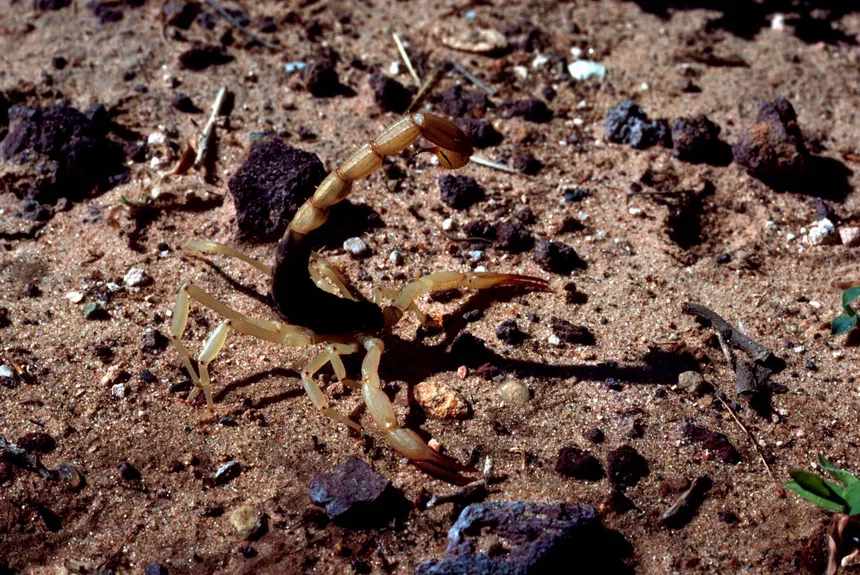
Image: Gary M. Stolz, U.S. Fish and Wildlife Service — Public domain · source
What Is a Arizona Bark Scorpion?
The Arizona bark scorpion (Centruroides sculpturatus) is a small, slender scorpion native to the deserts of the American Southwest. It is best known as the most venomous scorpion in the United States, and the only species in the region whose sting is considered a serious medical concern. Despite its reputation, it is a shy, nocturnal animal that plays an important role in controlling insect populations.
Appearance and Identification
Arizona bark scorpions are modest in size, with adults typically measuring two to three inches from the front of the body to the tip of the tail. Their coloring is usually a pale tan to light yellow-brown, and their bodies often appear slightly translucent, which helps them blend against sun-bleached rock and wood.
Compared with other desert scorpions, this species is notably slim. It has thin, delicate pincers and a narrow tail, rather than the thick claws and heavy tail seen in many larger scorpions. This slender build is a useful field clue for telling it apart from the bulkier desert hairy scorpion and stripe-tailed scorpion. Like all scorpions, it carries a stinger at the tip of its curved tail and glows a striking blue-green under ultraviolet light, a trait people often use to find them after dark.
Habitat and Range
The species ranges across the southwestern United States, particularly Arizona, and extends into parts of neighboring states and northwestern Mexico. It is well adapted to hot, dry country but depends on shade and shelter to avoid the harshest daytime heat.
Arizona bark scorpions live in deserts, rocky hillsides, and dry woodland, and they are strongly associated with cover such as loose bark, fallen wood, rock crevices, and leaf litter. They are also one of the few scorpions that readily climb, which brings them into trees, block walls, and homes. Inside buildings they often turn up in cool, damp spots such as bathrooms, closets, and crawl spaces.
Diet
This scorpion is a carnivore that feeds on a range of small invertebrates. Common prey includes crickets, roaches, beetles, spiders, and other insects that share its nocturnal habits.
It hunts largely by ambush, waiting in a sheltered spot and using fine sensory hairs to detect the vibrations of passing prey. When a target comes close, the scorpion seizes it with its pincers and, if needed, delivers a venomous sting to subdue it before feeding. Scorpions can go remarkably long between meals, an ability that suits the unpredictable food supply of the desert.
Behavior
Arizona bark scorpions are active at night and spend the hot daylight hours hidden in cool, protected retreats. Their ability to climb sets them apart from many relatives, and they will scale walls and cling upside down to ceilings or the underside of objects.
They are not aggressive and prefer to flee or hide rather than confront a threat, stinging mainly when trapped or accidentally pressed against skin. During cooler months, groups sometimes gather together in shared shelters to wait out the winter, a behavior unusual among otherwise solitary scorpions. Their venom is potent enough to cause intense pain, numbness, and, in vulnerable people, more serious symptoms, though an effective antivenom is available.
Life Cycle and Reproduction
Like other scorpions, the Arizona bark scorpion gives birth to live young rather than laying eggs. Courtship involves a distinctive “dance” in which the male grasps the female’s pincers and guides her over a packet of sperm that he deposits on the ground.
After a gestation of several months, the female produces a brood of young, often numbering in the dozens. The tiny offspring climb onto their mother’s back and remain there through their first molt, gaining protection until they are ready to disperse and fend for themselves. The young grow through a series of molts and reach maturity over a year or more, with adults living several years under good conditions.
Conservation Status
The Arizona bark scorpion has not been formally assessed on the IUCN Red List, and no specific conservation status has been assigned to it. It is a widespread and locally common species across its desert range, and it faces no known broad threats.
Because it adapts readily to gardens, walls, and homes, it often thrives in areas where people live, and it is far more likely to be treated as a household pest than as an animal in need of protection. Its populations appear secure throughout the Southwest.
Frequently Asked Questions
Is the Arizona bark scorpion dangerous to people? Its sting is very painful and can cause numbness, tingling, and, in young children or sensitive individuals, more severe reactions. Serious outcomes are now rare because an effective antivenom exists, but a sting should still be taken seriously.
Why do bark scorpions glow under UV light? Their outer shell contains compounds that fluoresce blue-green when exposed to ultraviolet light. People often use handheld UV flashlights at night to spot and avoid them.
How can I tell a bark scorpion from other desert scorpions? Look for a small, slender body with thin pincers and a narrow tail, and note its habit of climbing walls. Bulkier scorpions with thick claws and heavy tails are usually different species.
References
The conservation status and key facts in this profile are supported by these sources:
- GBIF — Centruroides sculpturatus Ewing, 1928 (accessed 2026-07-29)
- ITIS — Centruroides sculpturatus (TSN 1210619) (accessed 2026-07-29)
Found an error, source problem, or image concern? Report this page.