Army Ant Facts & Information
Identification
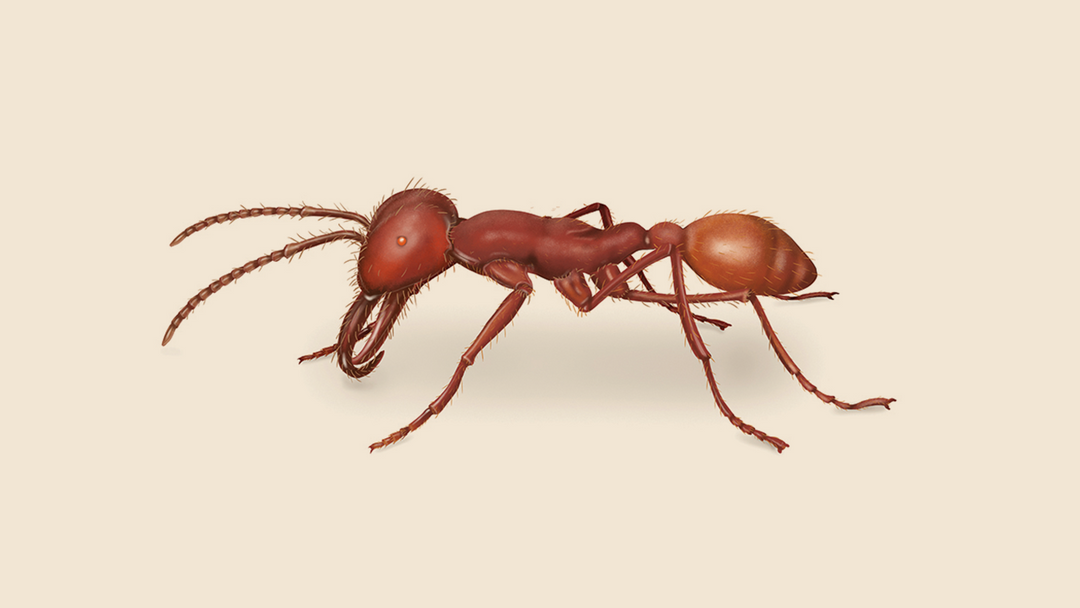
Appearance
- Abdomen: Their abdomens are oval-shaped, and the stinger is located in this body segment.
- Head: Army ant heads consist of eyes, mouthparts, and antennae. They use their antennae to smell, touch, and communicate with each other.
- Mouth: Mouths consist of two jaws, or mandibles, which resemble scissors.
- Thorax: An army ant’s thorax is located between the head and abdomen, and is connected to the abdomen by joints known as nodes.
Behavior
Army ants are carnivorous, nomadic, and aggressive. They attack freely, eat without discrimination, migrate to locate food sources, and maintain a complex social hierarchy.
Diet
Their primary food source is other species of ants . Adult army ants are unable to eat solid items and ingest only liquids.
Colonies
Colonies of army ants consist of a queen , workers, and soldiers. Workers are infertile females and are unable to establish their own colonies. Instead, they forage for food, bringing prey into their nests. Smaller army ant workers also tend to the queen’s eggs, while the soldier ants defend the nest. A single colony can contain up to 24 million individual ants.
Nests
Army ants typically nest in trees above the ground but also can form a bivouac, creating a nest from the bodies of the ants themselves. During this process, they use their claws and mandibles to attach themselves to one another, forming protecting walls to safeguard their queen and larvae. This structure is temporary and disassembles when the army ants mobilize.
Habitat
Unlike other ant species, army ants are known to be nomadic, making temporary nests while traveling from one location to the next. During the nomadic stage, they march at night and stop to rest in daylight. This nomadic stage may last several days.
Geographic Range
There are over 200 species of army ants that exist worldwide. They are found in the southern United States, but are more common in Central America, South America, Africa, and parts of Asia. Army ants thrive primarily in tropical areas and are common in:
- Deserts
- Mountain heights
- Lowland tropical forests
- Rainforests
- Scrub forests
- Swamp areas
- Volcanic islands
Queen’s Role
Reproduction is the role of the colony’s queen who produces a cyclic brood of immatures. Queens are large, without wings, and never leave the colony. Queen army ants will mate with multiple males and may produce up to 4 million eggs per month in a healthy colony
Egg Laying
The queen’s reproductive cycle controls both migratory and stationary stages of the army ants. When they have collected enough food, they begin their stationary phase and create temporary nests. They remain stationary for two to four weeks, during which time the fertilized queen lays up to 30,000 eggs each day.
Larvae
At this point, larvae from the previous stationary stage begin to spin cocoons, becoming pupae, and then adults. As the population of the colony increases, army ants once again enter the migratory stage.
Lifespan
The army ant queen and her colony can survive up to 20 years. However, male drones will die soon after mating with the queen, and workers survive only one year.