Amphibians Guide
Poison Dart Frog
What Is a Poison Dart Frog? Poison dart frogs are small, brightly colored amphibians of the family Dendrobatidae, native to the tropical forests of Central and South America. The group contains roughly 200 described …
At a glance
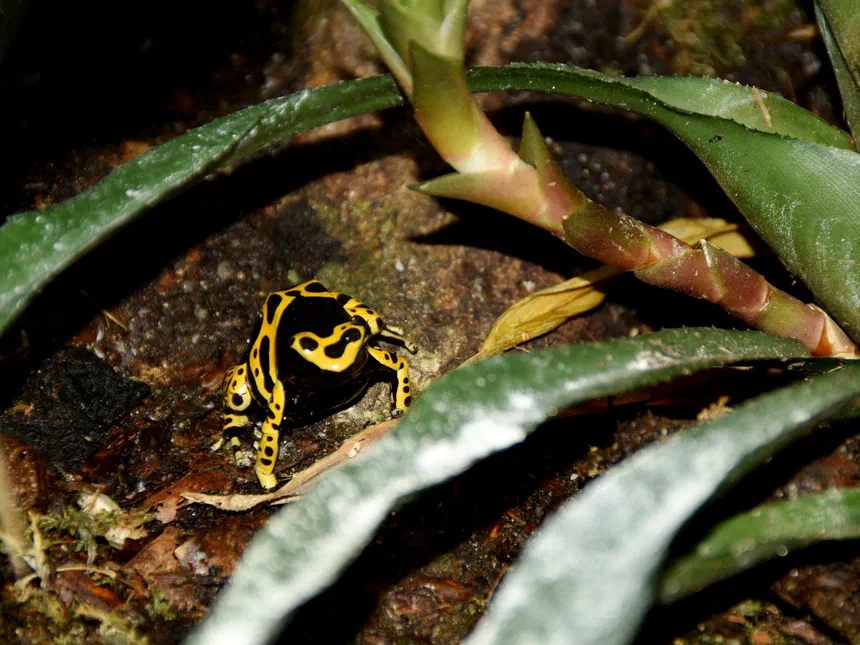
Image: NasserHalaweh — CC BY-SA 4.0 · source
What Is a Poison Dart Frog?
Poison dart frogs are small, brightly colored amphibians of the family Dendrobatidae, native to the tropical forests of Central and South America. The group contains roughly 200 described species, many famous for the potent skin toxins that give them their common name. Their brilliant coloring is a form of warning signal, advertising to predators that they are dangerous to eat.
Appearance and Identification
Most poison dart frogs are tiny, measuring only about half an inch to two and a half inches from snout to vent. Their standout feature is aposematic (warning) coloration: bold patterns of yellow, orange, scarlet, cobalt blue, or metallic green, often laid over a dark background. These colors advertise toxicity to would-be predators. Individual species can be strikingly variable—some populations of a single species display several distinct color forms. Their skin is smooth and moist, their bodies are compact, and their toe tips bear small adhesive disks that help them grip leaves and climb.
Habitat and Range
Poison dart frogs live in warm, humid environments, chiefly the leaf litter and understory of lowland tropical rainforests, though some occur in montane cloud forests. Their range stretches from Nicaragua and Costa Rica in Central America south through Colombia, Ecuador, Peru, Brazil, and the Guianas. They depend on consistently high humidity and are usually found near streams, seeps, or pools of water that their developing young require.
Diet
These frogs are carnivorous and feed almost entirely on small invertebrates, hunting by day across the forest floor. Ants and mites make up a large share of the diet, supplemented by termites, tiny beetles, springtails, and other small arthropods. This ant- and mite-heavy diet is closely tied to their toxicity: many species acquire the chemical building blocks for their skin alkaloids from the prey they eat. Captive frogs raised on a different diet generally lose their potency, which supports the idea that the poison is largely diet-derived rather than produced from scratch.
Behavior
Unlike many amphibians, poison dart frogs are active during the day, relying on their conspicuous colors rather than camouflage for protection. Many species are notably territorial, and males defend patches of ground with distinctive calls—buzzes, trills, or chirps depending on the species. Their toxins, secreted through the skin, deter most predators; the most potent species carry enough alkaloid to sicken or kill would-be attackers. A handful of Indigenous groups in western Colombia historically used the secretions of a few especially toxic species to tip blowgun darts, the practice behind the frogs’ name.
Life Cycle and Reproduction
Reproduction in this family is unusually elaborate for amphibians and often involves extended parental care. After courtship, females typically lay small clutches of eggs on land—on leaves, in leaf litter, or in sheltered moist spots—rather than directly in water. A parent, frequently the male, guards the eggs and keeps them moist. Once the tadpoles hatch, an adult carries them piggyback to water, often to tiny pools that collect in bromeliad leaves or tree holes. In some species the mother returns repeatedly to deposit unfertilized eggs as food for her growing tadpoles. The tadpoles eventually metamorphose into froglets, and individuals may live several years to well over a decade.
Conservation Status
Conservation status varies widely across the family. Some poison dart frogs remain locally common, while others are classified as threatened or endangered on the IUCN Red List. The main pressures are habitat loss from deforestation and agriculture, along with pollution, disease—including the amphibian chytrid fungus—and collection for the pet trade. Because many species occupy very small, specialized ranges, they can be especially vulnerable to habitat disturbance.
Frequently Asked Questions
Are poison dart frogs dangerous to humans? Only a few species are dangerously toxic to people, and the frogs are not aggressive—poisoning would require handling a highly toxic wild frog and transferring its secretions to a wound or mucous membrane. Captive-bred frogs are essentially non-toxic because they lack the wild diet that fuels their poison.
Why are they so brightly colored? Their vivid colors are a warning signal. Bold, high-contrast patterns tell predators that the frog is toxic and not worth eating, a strategy biologists call aposematism.
Do poison dart frogs make their own poison? Mostly no. Most species obtain the chemical precursors for their toxins from their diet of ants, mites, and other small invertebrates, then concentrate them in their skin.