Amphibians Guide
Jordan's Salamander
What Is a Jordan’s Salamander? The Jordan’s salamander (Plethodon jordani) is a small, lungless woodland amphibian found only in the high forests of the southern Appalachian Mountains. It belongs to the family …
At a glance
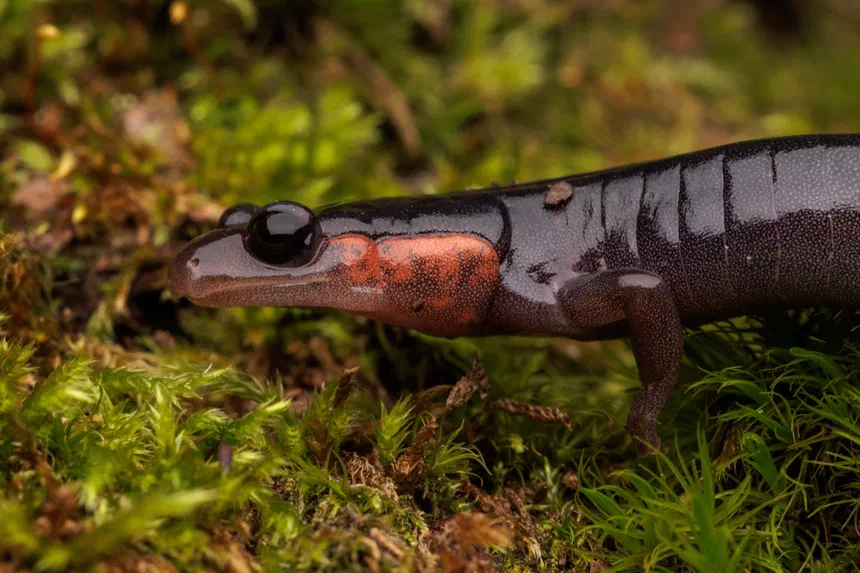
Image: Rstanton13 (Wikimedia Commons) — CC BY-SA 4.0 · source
What Is a Jordan’s Salamander?
The Jordan’s salamander (Plethodon jordani) is a small, lungless woodland amphibian found only in the high forests of the southern Appalachian Mountains. It belongs to the family Plethodontidae, the lungless salamanders, and is often called the red-cheeked salamander for the vivid crimson patches that mark the sides of its head.
Appearance and Identification
This is a slender, medium-sized salamander that typically measures about 3.5 to 7 inches (9 to 18 cm) from snout to tail tip. The body is usually slate-gray to nearly black, sometimes with a faint scattering of pale flecks, and the belly is dark. The most striking feature is a pair of bright red or reddish-orange cheek patches just behind the eyes, which give the animal its common name. Like other members of its genus, it has a slim build, well-developed limbs, and a rounded tail. There is no external gill or lung; instead, a groove-like line called the costal groove runs along each side of the trunk.
Habitat and Range
Jordan’s salamander is a narrow-range endemic, restricted mainly to the Great Smoky Mountains and nearby ranges along the border of North Carolina and Tennessee. It favors cool, damp, high-elevation forests, particularly moist hardwood and spruce-fir woodlands. During the day it shelters under rocks, rotting logs, bark, and moist leaf litter, emerging at night or during rainy, humid weather to forage on the forest floor. Because it breathes entirely through its moist skin and the lining of its mouth, it depends on consistently damp, shaded conditions and rarely strays far from cover.
Diet
This salamander is a carnivore that hunts a wide range of small forest-floor invertebrates. Typical prey includes ants, beetles, mites, springtails, small flies, spiders, and other tiny arthropods, along with the occasional worm or soft-bodied insect larva. It captures prey with a quick projection of its tongue and is most active in feeding on wet nights when invertebrates are abundant near the surface.
Behavior
Jordan’s salamander is largely nocturnal and secretive, spending dry or cold periods hidden underground or beneath cover. Adults can be territorial, defending small patches of ground that offer good shelter and foraging. When threatened, it may hold still, flee toward cover, or assume a defensive posture; skin secretions help deter some predators. Its activity closely tracks moisture and temperature, so surface sightings peak during mild, rainy stretches of spring, summer, and fall.
Life Cycle and Reproduction
Like other woodland salamanders in its genus, Jordan’s salamander is a terrestrial breeder that skips the free-swimming larval stage entirely. Courtship takes place on land, and the female lays a small clutch of eggs in a hidden, moist chamber such as inside a rotting log or beneath a stone. The eggs undergo direct development, so the young hatch as tiny, fully formed salamanders rather than aquatic larvae. Females often remain with the clutch to guard it. Growth is slow, and these salamanders are long-lived for their size, with many individuals living a decade or more.
Conservation Status
The Jordan’s salamander is currently listed as Least Concern by the IUCN, and it can be locally common within its limited range, including inside protected areas such as Great Smoky Mountains National Park. However, its narrow distribution and dependence on cool, moist mountain forest make it sensitive to habitat loss, warming and drying trends, and disturbance of the leaf-litter layer. Ongoing protection of high-elevation Appalachian forests is important for its long-term security.
Frequently Asked Questions
Why is it called the red-cheeked salamander? Because of the bright red or orange patches on the sides of its head, just behind the eyes, which are its most recognizable field mark.
Does Jordan’s salamander have lungs? No. It is a lungless salamander and breathes through its moist skin and the lining of its mouth, which is why it needs damp habitats.
Where can it be found? It lives only in the southern Appalachians, chiefly in the Great Smoky Mountains along the North Carolina and Tennessee border.