Amphibians Guide
Japanese Giant Salamander
What Is a Japanese Giant Salamander? The Japanese giant salamander (Andrias japonicus) is one of the largest amphibians on Earth, a fully aquatic salamander endemic to the cool mountain streams of Japan. Belonging to the …
At a glance
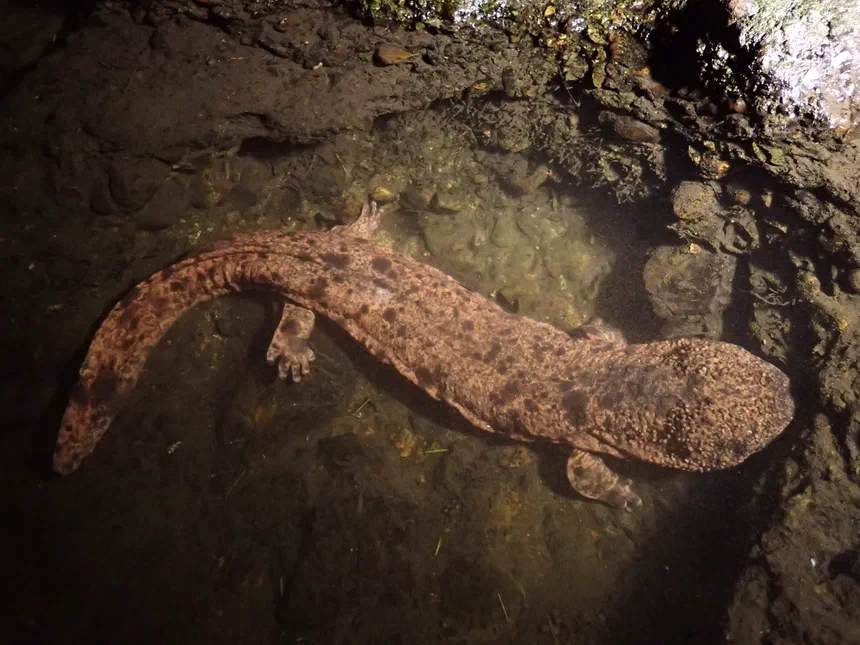
Image: Salamandra2021 — CC BY-SA 4.0 · source
What Is a Japanese Giant Salamander?
The Japanese giant salamander (Andrias japonicus) is one of the largest amphibians on Earth, a fully aquatic salamander endemic to the cool mountain streams of Japan. Belonging to the ancient family Cryptobranchidae, it is a living relative of forms that have changed little over tens of millions of years, earning it a reputation as a “living fossil.”
Appearance and Identification
This salamander has a broad, flattened head, tiny eyes set far apart, and a long, laterally compressed tail that powers its slow swimming. Its loose, wrinkled skin hangs in folds along the flanks, dramatically increasing surface area for absorbing oxygen directly from the water. Coloration is a mottled brown to grayish tone with darker blotches, providing excellent camouflage against the rocky riverbeds it inhabits. Adults commonly reach 3 to 4 feet in length, and exceptional individuals may approach 5 feet, making this species second in size only to its close Chinese relative.
Habitat and Range
The species is restricted to southwestern Japan, occurring on the islands of Honshu, Shikoku, and Kyushu. It favors clear, cold, well-oxygenated rivers and streams at low to moderate elevations, typically with rocky bottoms and stable banks that offer crevices and undercut hollows for shelter. Because it breathes largely through its skin, it depends on clean, oxygen-rich water and is highly sensitive to pollution and habitat disturbance.
Diet
An opportunistic carnivore, the Japanese giant salamander feeds on whatever aquatic prey it can capture, including fish, crayfish and other crustaceans, aquatic insects, worms, and smaller amphibians. With poor eyesight, it relies on sensory pores along its head and body to detect vibrations and movement in the water. It hunts by ambush, remaining motionless until prey drifts close, then suddenly opening its wide mouth to draw in the victim with a rapid gulp of water.
Behavior
Largely nocturnal, the salamander spends daylight hours hidden beneath rocks or in riverbank burrows, emerging after dark to forage. It is slow-moving and sedentary, often occupying the same stretch of river for long periods. Adults are territorial, and males in particular may defend prime shelter sites, especially around the breeding season. When threatened or handled, the animal can secrete a sticky, milky substance from its skin that may deter predators.
Life Cycle and Reproduction
Breeding takes place in late summer to early autumn. Females deposit long strings containing hundreds of eggs inside nesting burrows, which are guarded by a dominant male sometimes called a “den-master.” The male fertilizes the eggs externally and then tends the clutch, fanning the eggs to keep them oxygenated and defending them until they hatch. Larvae hatch with external gills and remain gilled for several years before gradually transitioning toward the adult form, though the species never fully leaves the water. Growth is slow, and individuals are remarkably long-lived, with wild animals thought to survive many decades and captive specimens exceeding half a century.
Conservation Status
The Japanese giant salamander is listed as Near Threatened by the IUCN and is legally protected in Japan as a Special Natural Monument. Key threats include habitat loss and fragmentation from dam and weir construction, which blocks movement and degrades stream conditions, as well as water pollution and siltation. Hybridization with the introduced Chinese giant salamander is an emerging concern in some rivers. Conservation efforts focus on protecting waterways, installing fish ladders and passages suitable for the salamanders, and captive breeding programs.
Frequently Asked Questions
How big can a Japanese giant salamander get? Adults usually measure 3 to 4 feet long, and exceptional individuals may approach 5 feet, ranking the species among the largest living amphibians.
How does it breathe underwater? It absorbs oxygen mainly through its skin, particularly the wrinkled folds along its sides, which is why it depends on cold, fast-flowing, well-oxygenated water.
Is the Japanese giant salamander endangered? It is currently classified as Near Threatened. While not yet endangered, it faces ongoing pressure from habitat degradation, dams, pollution, and hybridization with introduced salamanders.