Amphibians Guide
Japanese Fire-Bellied Newt
What Is a Japanese Fire-Bellied Newt? The Japanese fire-bellied newt (Cynops pyrrhogaster) is a small, semi-aquatic salamander endemic to Japan. It is named for the vivid red-to-orange coloring on its underside, a …
At a glance
What Is a Japanese Fire-Bellied Newt?
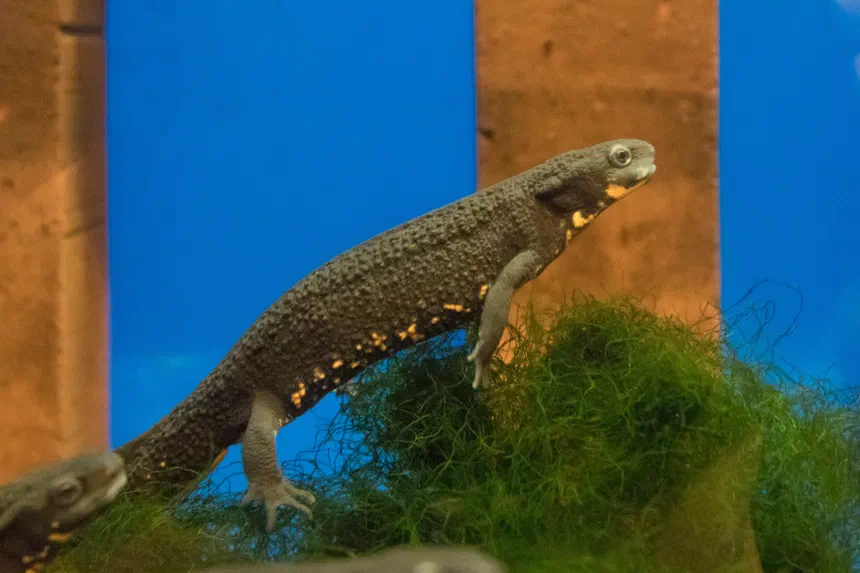
The Japanese fire-bellied newt (Cynops pyrrhogaster) is a small, semi-aquatic salamander endemic to Japan. It is named for the vivid red-to-orange coloring on its underside, a warning signal to predators that its skin carries potent toxins. Long popular in the aquarium and biology-teaching trades, it is one of the most familiar newts of East Asia.
Appearance and Identification
This newt has a fairly stout body with a rough, granular skin texture rather than the smooth, slick surface of many aquatic salamanders. The back and sides range from dark chocolate brown to nearly black, which helps the animal blend into pond bottoms and leaf litter. In sharp contrast, the belly is a striking red or orange, usually marked with irregular black blotches; the exact pattern varies between individuals and regional populations. Adults typically reach about 3.5 to 5 inches (9 to 13 centimeters) in total length, with females tending to be slightly larger and heavier than males. The tail is laterally flattened to aid swimming, and during the breeding season males develop a bluish-white sheen along the tail.
Habitat and Range
Cynops pyrrhogaster is found across much of Japan, including the main islands of Honshu, Shikoku, and Kyushu, from lowlands up into hilly and mountainous areas. It favors cool, still or slow-moving water such as ponds, marshes, irrigation ditches, roadside pools, and flooded rice paddies. These habitats often have abundant aquatic vegetation, which provides cover and egg-laying sites. Because the species has a wide distribution and several genetically distinct regional forms, populations can look and behave somewhat differently from one part of Japan to another.
Diet
The Japanese fire-bellied newt is an opportunistic carnivore. In the water it hunts insect larvae, small crustaceans, worms, tadpoles, and the eggs of other amphibians. On land, adults take small invertebrates such as insects and their larvae. Newts rely heavily on smell and movement to detect prey, striking with a quick forward lunge and gulp. Their slow metabolism means they can go for extended periods between meals, especially in cooler weather.
Behavior
Adults spend much of the year in water but will move overland, particularly in humid or rainy conditions, to reach new pools or to overwinter on land. The species is largely active in cooler parts of the day and becomes less active during cold winter months, when individuals may shelter under logs, stones, or in mud. Its most important defense is chemical: the skin contains tetrodotoxin, the same class of poison found in pufferfish. When threatened, a newt may arch its body and tail to flash its red belly, a display known as the unken reflex that advertises its toxicity to would-be predators.
Life Cycle and Reproduction
Breeding generally takes place in spring and early summer. Males court females with tail-fanning displays and deposit a packet of sperm, called a spermatophore, which the female picks up to fertilize her eggs internally. Females then lay eggs one at a time, carefully folding each egg into the leaf of an aquatic plant with their hind limbs to hide and protect it. The eggs hatch into aquatic larvae with feathery external gills. Over several months the larvae grow, absorb their gills, and metamorphose into terrestrial juveniles known as efts before eventually returning to water as adults. Individuals mature slowly and are notably long-lived, with captive animals commonly reaching 20 to 30 years.
Conservation Status
The IUCN lists the Japanese fire-bellied newt as Near Threatened. Although it remains locally common in some areas, its numbers have declined due to habitat loss from development, the draining and modernization of rice paddies, water pollution, and collection for the pet trade. The potential spread of the amphibian fungal disease chytridiomycosis is an additional concern for newts across their range. Protecting clean, vegetated wetlands and traditional paddy landscapes is important for the species’ long-term survival.
Frequently Asked Questions
Are Japanese fire-bellied newts poisonous? Yes. Their skin secretes tetrodotoxin, a powerful nerve toxin. They are not dangerous if left alone, but handlers should wash their hands and avoid touching their eyes or mouth afterward.
How long do they live? They are remarkably long-lived amphibians. In captivity they frequently live 20 to 30 years with proper care, and some individuals live even longer.
Where are they found in the wild? They are endemic to Japan, occurring on Honshu, Shikoku, and Kyushu in cool ponds, ditches, streams, and rice paddies.