Amphibians Guide
Italian Crested Newt
What Is a Italian Crested Newt? The Italian crested newt (Triturus carnifex) is a large, robust newt belonging to the salamander order (Caudata). It is one of several closely related crested newt species found across …
At a glance
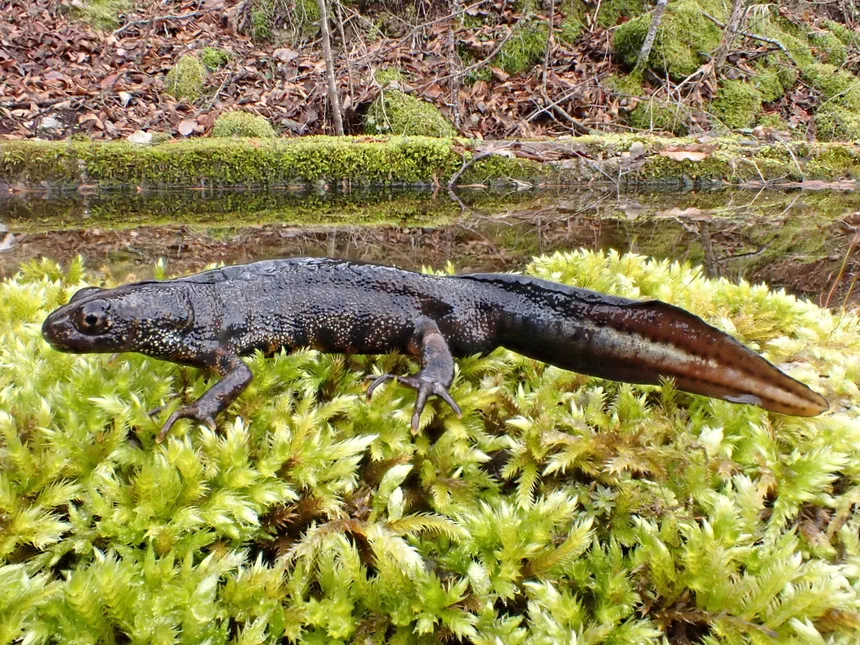
Image: Elena Regina — CC BY-SA 4.0 · source
What Is a Italian Crested Newt?
The Italian crested newt (Triturus carnifex) is a large, robust newt belonging to the salamander order (Caudata). It is one of several closely related crested newt species found across Europe, and is best known for the tall, jagged crest that males develop along the back and tail during the spring breeding season.
Appearance and Identification
This is a stout, sizeable newt, with adults typically reaching about 5 to 7 inches (13 to 18 cm) in total length, and females often growing slightly larger than males. The upper body ranges from dark brown to nearly black, sometimes with a granular, warty texture and scattered dark markings. The most distinctive feature is the bright orange to yellow belly, boldly marked with irregular black blotches, a pattern unique enough to identify individuals. Breeding males sport a high, deeply toothed crest that runs along the back and continues, without a break at the tail base, into a smoother tail fin. Many individuals also show fine white flecking along the flanks and tail.
Habitat and Range
The Italian crested newt is native to Italy, extending into parts of the western Balkans, Austria, Switzerland, and neighboring regions of central and southeastern Europe. It has also been introduced to a few areas outside its natural range, including the Azores. During the breeding season it favors still or slow-moving water such as ponds, ditches, flooded meadows, and the quiet margins of lakes, ideally with abundant submerged vegetation. Outside of breeding, adults live on land in cool, damp habitats including woodland, hedgerows, and grassland, where they shelter under logs, stones, and leaf litter.
Diet
Italian crested newts are opportunistic carnivores. In the water they hunt aquatic insect larvae, small crustaceans, worms, snails, and the tadpoles and eggs of frogs and other amphibians, including smaller newts. On land they take earthworms, slugs, insects, and other small invertebrates. Larvae feed on tiny aquatic organisms such as water fleas and insect larvae, gradually taking larger prey as they grow.
Behavior
For much of the year this newt leads a secretive, largely nocturnal life on land, emerging on damp nights to forage and remaining hidden by day. It returns to water in spring to breed and may stay aquatic for several weeks or months. Like other crested newts, it can secrete distasteful skin toxins as a defense against predators, and the vivid orange belly likely serves as a warning signal. In colder parts of its range the species hibernates on land through winter, often in communal shelters below the frost line.
Life Cycle and Reproduction
Breeding occurs in spring after adults migrate to water. Males perform an elaborate courtship display, arching the body and fanning the tail to waft pheromones toward a female, then deposit a packet of sperm (a spermatophore) that she picks up to fertilize her eggs internally. A female may lay several hundred eggs over the season, carefully folding each one individually into the leaf of an aquatic plant for protection. Eggs hatch after two to three weeks into gilled, aquatic larvae. The larvae grow through the summer before undergoing metamorphosis, losing their external gills and moving onto land as juveniles. Sexual maturity is typically reached after two to three years.
Conservation Status
The Italian crested newt is currently listed as Least Concern by the IUCN, reflecting a relatively wide range and stable populations in many areas. Even so, it faces pressures from the loss and pollution of breeding ponds, agricultural intensification, road mortality during migrations, and the introduction of predatory fish. It receives legal protection across much of Europe, and the conservation of small ponds and wetland corridors is important to keeping local populations healthy.
Frequently Asked Questions
Is the Italian crested newt poisonous? It is not dangerous to handle briefly, but its skin produces mild toxins that make it unpalatable to many predators. As with any amphibian, hands should be clean and wet before handling, and washed afterward.
How can you tell it apart from other crested newts? Range is a strong clue, since it is the crested newt of Italy and nearby regions. The bold orange belly with black blotches and the tall, jagged breeding crest of males are also key features.
Where does it spend most of the year? Despite the name “newt,” it is mainly terrestrial outside the spring breeding season, living hidden in damp woodland and grassland and returning to water only to breed.