Amphibians Guide
Hourglass Tree Frog
What Is a Hourglass Tree Frog? The hourglass tree frog (Dendropsophus ebraccatus) is a small, brightly patterned amphibian of the New World treefrog family Hylidae. It takes its name from the dark, hourglass-shaped …
At a glance
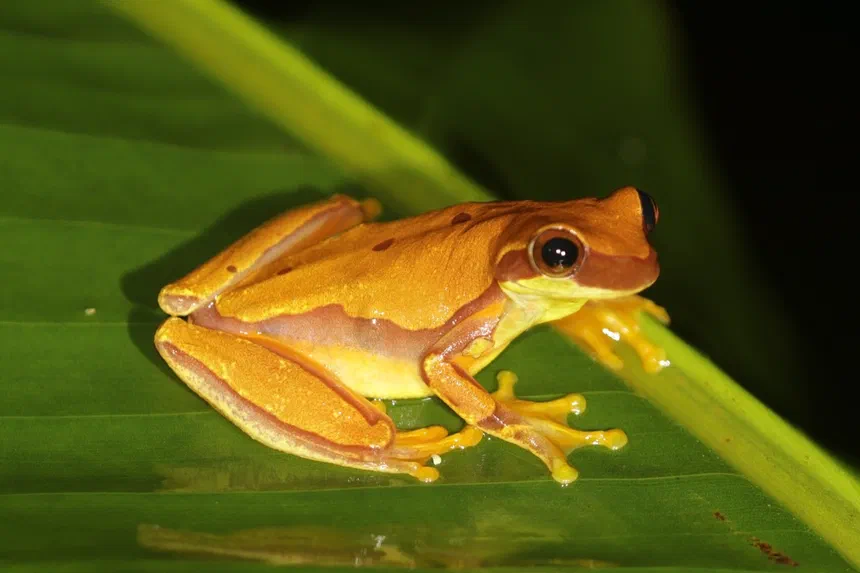
Image: Charles J. Sharp — CC BY-SA 4.0 · source
What Is a Hourglass Tree Frog?
The hourglass tree frog (Dendropsophus ebraccatus) is a small, brightly patterned amphibian of the New World treefrog family Hylidae. It takes its name from the dark, hourglass-shaped blotch that usually marks its back, and it is well known to biologists for its unusually flexible reproductive habits.
Appearance and Identification
This is a petite frog, with adults generally measuring about 2.5 to 3.5 centimeters (1 to 1.4 inches) from snout to vent; females tend to be slightly larger than males. The ground color ranges from tan and pale yellow to golden brown, overlaid with darker brown markings that frequently form the characteristic hourglass shape along the back. The hidden surfaces of the thighs and flanks often flush yellow or orange, and the belly is pale. Its scientific name, meaning roughly “without trousers,” refers to the fact that the legs lack the dense mottling seen in some relatives. Like other treefrogs, it has expanded adhesive toe pads and large, forward-set eyes suited to a life spent climbing vegetation.
Habitat and Range
The hourglass tree frog occupies humid lowland and lower montane environments, generally below about 1,600 meters in elevation. It favors the margins of ponds, swamps, ditches, flooded meadows, and slow marshes surrounded by forest or dense secondary growth. Its range stretches from southern Mexico southward through Belize, Guatemala, Honduras, Nicaragua, Costa Rica, and Panama, and into parts of Colombia and Ecuador. The species tolerates some habitat disturbance and can persist near agricultural edges and settled areas, which helps explain its broad distribution.
Diet
Adults are insectivorous, feeding on a variety of small invertebrates such as flies, beetles, ants, and other arthropods that they capture among leaves and stems at night. Like most frogs, they are sit-and-wait predators, snapping up prey that comes within striking range. The aquatic tadpoles feed differently, grazing on algae, suspended particles, and organic detritus in the still water where they develop.
Behavior
The hourglass tree frog is primarily nocturnal, sheltering by day among foliage and becoming active after dark to forage and, in the breeding season, to call. Males produce a short, clicking or rasping advertisement call to attract females and to space themselves from rival males. Being small and largely arboreal, these frogs rely on their cryptic coloration and their ability to stay motionless to avoid the many predators of the tropical night, including snakes, birds, and larger frogs.
Life Cycle and Reproduction
This species is famous among researchers for its remarkable reproductive plasticity. Depending on conditions, females can lay eggs either on leaves overhanging water, in the manner of many treefrogs, or directly in the water itself, a flexibility that is very unusual among amphibians. Terrestrial clutches gain protection from aquatic predators such as fish and tadpoles, while aquatic eggs are shielded from drying out. Breeding is tied to the rainy season, when temporary and permanent pools fill. After hatching, the tadpoles complete their development in the water before metamorphosing into tiny froglets. This dual strategy is thought to represent a snapshot of how amphibians may shift between land and water laying in response to environmental pressure.
Conservation Status
The hourglass tree frog is currently listed as Least Concern by the IUCN, reflecting its wide range, large overall population, and tolerance of moderately disturbed habitats. It is not considered to face major threats at present, though like all amphibians it is potentially vulnerable to habitat loss, water pollution, and the fungal disease chytridiomycosis. Its adaptability gives it a better outlook than many tropical amphibians whose ranges are far more restricted.
Frequently Asked Questions
Why is it called an hourglass tree frog? The common name comes from the dark, hourglass-shaped mark that typically appears on the frog’s back, formed by its brown dorsal pattern against a paler background.
What makes its breeding unusual? Females can lay their eggs either on leaves above water or directly in the water, one of the few amphibians known to switch flexibly between these two strategies depending on local conditions.
Is the hourglass tree frog endangered? No. It is classified as Least Concern, thanks to its broad geographic range and its ability to live in disturbed as well as pristine habitats.