Amphibians Guide
Argentine Horned Frog
What Is a Argentine Horned Frog? The Argentine horned frog (Ceratophrys ornata) is a large, round-bodied amphibian native to the grasslands of South America. It is famous for its enormous mouth and voracious appetite, …
At a glance
What Is a Argentine Horned Frog?
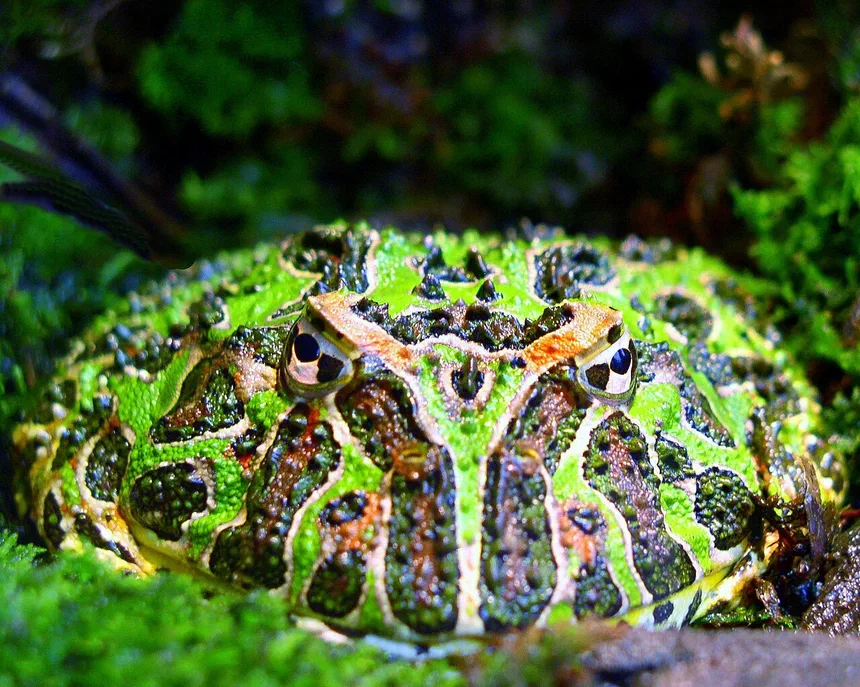
The Argentine horned frog (Ceratophrys ornata) is a large, round-bodied amphibian native to the grasslands of South America. It is famous for its enormous mouth and voracious appetite, traits that have earned it the nickname “Pacman frog.” Squat and almost comically wide, it is one of the most recognizable frogs of the South American pampas.
Appearance and Identification
This is a stout, disc-shaped frog dominated by an oversized head and a mouth that can span nearly the full width of its body. Adults typically reach about 4.5 to 6.5 inches (11 to 16.5 centimeters) in body length, with females noticeably larger and heavier than males. The skin is a bold mosaic of green blotches edged in dark brown, often accented with red, yellow, or orange markings. Above each eye sits a small, fleshy horn-like projection of skin, the source of the “horned frog” name. Short, powerful limbs and a broad, flattened body give it a squat, almost inflated appearance. This coloration works as excellent camouflage among the grasses and leaf litter where the frog waits in ambush.
Habitat and Range
Ceratophrys ornata inhabits the humid subtropical grasslands and pampas of eastern Argentina, Uruguay, and the extreme south of Brazil. It favors low-lying areas near temporary ponds, marshes, flooded meadows, and slow ditches that fill during the rainy season. For much of the year the frog stays close to soft, moist soil in which it can burrow. These wetlands and seasonal pools are essential both for the adults’ cover and for breeding, making the species tightly linked to intact grassland habitats.
Diet
The Argentine horned frog is an aggressive sit-and-wait predator with an appetite that is legendary for its size. It eats a wide range of prey, including insects, spiders, worms, other frogs, small lizards, snakes, rodents, and even small birds. Its huge mouth and strong jaws, lined with tooth-like projections, allow it to seize and swallow animals nearly as large as itself. The frog buries itself with only its eyes and mouth exposed, then lunges to engulf anything that ventures too close. Its ambition sometimes exceeds its ability, and individuals have been known to choke on prey too large to swallow.
Behavior
For most of its life this frog is sedentary and cryptic, spending long periods partly buried in soil or leaf litter waiting for a meal to pass. It is not a strong hopper and relies on camouflage rather than speed. When threatened, it inflates its body, opens its cavernous mouth, and may lunge or even bite in defense, and it can produce a loud, croaking call. During dry spells it burrows underground and forms a protective cocoon of shed skin, entering a dormant state called estivation until rains return. This ability lets it survive the seasonal droughts of the pampas.
Life Cycle and Reproduction
Breeding is triggered by the heavy rains of spring and summer, which flood the temporary pools the frogs depend on. Males call from the water to attract females, who lay large clutches of hundreds to a few thousand eggs attached to submerged vegetation. The eggs hatch quickly into aquatic tadpoles that grow rapidly and are notably carnivorous, sometimes preying on other tadpoles. Because their nursery pools can dry out, the tadpoles develop and metamorphose into froglets within a matter of weeks. Once transformed, the young frogs leave the water to begin their burrowing, ambush lifestyle on land.
Conservation Status
The IUCN lists the Argentine horned frog as Near Threatened. Its populations have declined because of the conversion of native grassland to agriculture, wetland drainage, pesticide use, and collection for the international pet trade, where the species is popular. Road mortality and habitat fragmentation add further pressure. Protecting the seasonal wetlands and grasslands it depends on is central to keeping wild populations stable.
Frequently Asked Questions
Why is it called a Pacman frog? Its nearly circular body and enormous mouth resemble the arcade character, and like the game character it seems willing to swallow almost anything in its path.
Are Argentine horned frogs dangerous to people? They are not venomous, but a large adult can deliver a surprisingly firm bite with its strong jaws if handled carelessly. The bite is not medically serious.
Do they really eat animals as big as themselves? Yes. Their wide gape and powerful jaws let them tackle prey close to their own size, though they occasionally overreach and injure themselves trying to swallow oversized meals.