Amphibians Guide
Hellbender
What Is a Hellbender? The hellbender (Cryptobranchus alleganiensis) is a large, fully aquatic salamander native to the streams and rivers of the eastern and central United States. It is one of the biggest salamanders in …
At a glance
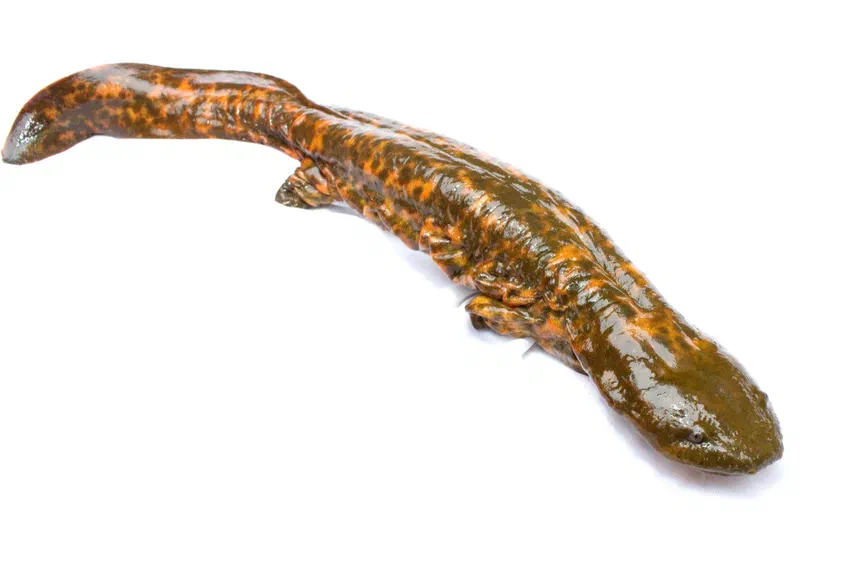
What Is a Hellbender?
The hellbender (Cryptobranchus alleganiensis) is a large, fully aquatic salamander native to the streams and rivers of the eastern and central United States. It is one of the biggest salamanders in North America and belongs to the giant salamander family, the Cryptobranchidae. Locals have long given it colorful nicknames such as “snot otter,” “devil dog,” and “mud puppy,” though it is harmless to people.
Appearance and Identification
Hellbenders have a flattened, broad head and a stout, wrinkled body that ends in a paddle-like tail well suited to life in moving water. Their skin hangs in loose, fleshy folds along the sides, which greatly increases surface area for absorbing oxygen directly from the water. Coloration is typically mottled brown, gray, or olive with scattered darker blotches, providing excellent camouflage against a streambed of rocks and gravel. Adults commonly measure around 12 to 29 inches (30 to 74 cm) in total length, with a few individuals reaching the upper end of that range. Unlike many salamanders, adult hellbenders keep a single pair of gill openings but rely mostly on skin respiration rather than external gills.
Habitat and Range
Hellbenders live in clear, cool, well-oxygenated streams and rivers with rocky bottoms and swift currents. They shelter beneath large, flat rocks and in crevices, which they use as retreats and nesting sites. Because they breathe primarily through their skin, they are highly sensitive to water quality and require unpolluted, sediment-free water to survive. Their range covers portions of the eastern and central United States, from parts of New York and Pennsylvania south through the Appalachian region to Georgia and Alabama, and westward into the Ozark and Ouachita highlands of Missouri and Arkansas. The Ozark population is recognized as a distinct subspecies.
Diet
Hellbenders are carnivores and opportunistic ambush predators. Crayfish make up the bulk of their diet, but they also take small fish, aquatic insects, worms, and occasionally other amphibians. They hunt mostly at night, using their sense of smell and sensitivity to water movement to locate prey rather than relying heavily on eyesight. A hellbender feeds by suddenly opening its wide mouth to create suction that pulls prey inside.
Behavior
Hellbenders are secretive and largely nocturnal, spending daylight hours hidden beneath rocks. They are solitary and can be territorial, defending prime shelter sites from other hellbenders. Rather than swimming long distances, they usually crawl along the streambed. Their loose skin folds are often held out and gently rocked to boost oxygen uptake when water oxygen levels drop. Despite their fearsome nicknames, they are not venomous, do not bite people under normal circumstances, and pose no danger to swimmers or anglers.
Life Cycle and Reproduction
Breeding takes place in late summer and early autumn. Unlike most salamanders, hellbenders use external fertilization: a male excavates and guards a nest cavity under a large rock, and a female deposits several hundred eggs in long strands, which the male then fertilizes. The male remains with the clutch, guarding the eggs and fanning them with fresh, oxygenated water until they hatch after a couple of months. Larvae emerge with external gills and are fully aquatic; they gradually lose the external gills as they mature. Hellbenders grow slowly and may take five to eight years to reach breeding age, and they can live around 25 to 30 years in the wild.
Conservation Status
The hellbender is listed as Near Threatened by the IUCN, and many local populations have declined sharply. The Ozark subspecies is federally endangered in the United States. Major threats include water pollution, siltation from erosion and development, dam construction, and the loss of the large flat rocks they depend on for shelter and nesting. Because their permeable skin makes them so dependent on clean water, hellbenders are considered valuable indicators of stream health. Conservation efforts include captive rearing and release programs, habitat protection, and the placement of artificial nest boxes.
Frequently Asked Questions
Are hellbenders dangerous or venomous? No. Hellbenders are harmless to humans. They are not venomous and rarely bite, despite intimidating nicknames like “devil dog” and “snot otter.”
Why are hellbenders important to their ecosystems? Because they breathe through their skin and need clean, oxygen-rich water, hellbenders serve as sensitive indicators of stream health. A healthy hellbender population usually signals good water quality.
How do hellbenders breathe? Adults absorb most of their oxygen directly through their skin, especially through the loose folds along their sides, rather than using gills or coming to the surface for air.