Amphibians Guide
Grey Tree Frog
What Is a Grey Tree Frog? The grey tree frog (Dryophytes versicolor) is a small, arboreal amphibian native to the woodlands of eastern North America. A member of the tree frog family Hylidae, it is best known for its …
At a glance
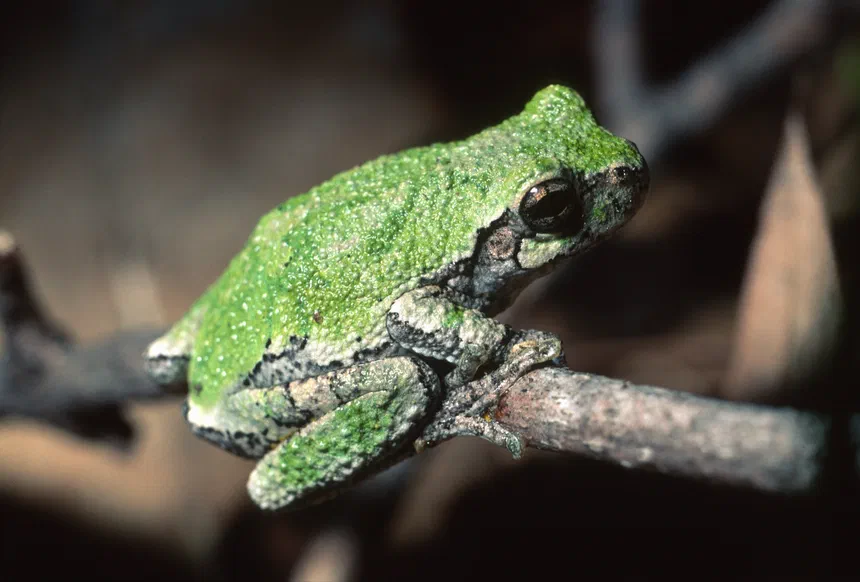
Image: Paul Harrison — CC BY-SA 4.0 · source
What Is a Grey Tree Frog?
The grey tree frog (Dryophytes versicolor) is a small, arboreal amphibian native to the woodlands of eastern North America. A member of the tree frog family Hylidae, it is best known for its remarkable ability to shift its skin color and for the loud, musical trill that males produce on warm summer nights.
Appearance and Identification
The grey tree frog is a compact, stout-bodied frog measuring roughly 1.25 to 2.4 inches (3.2 to 6 centimeters) from snout to vent, with females generally larger than males. As its species name versicolor suggests, this frog can change its coloration between shades of gray, green, and brown depending on temperature, humidity, and its surroundings. Its skin is warty and often bears a darker, irregular blotch on the back. A distinctive white patch marks the area beneath each eye. The hidden inner surfaces of the thighs flash a bright orange to yellow, a warning signal that becomes visible when the frog leaps. Large, sticky toe pads allow it to cling firmly to bark and leaves.
The grey tree frog is nearly identical in appearance to Cope’s grey tree frog (Dryophytes chrysoscelis), and the two are most reliably distinguished by their calls and by their number of chromosomes, since D. versicolor is a tetraploid species.
Habitat and Range
This species inhabits deciduous and mixed forests across the eastern United States and southeastern Canada, from the Gulf Coast north into Ontario, Quebec, and the Maritime provinces. Grey tree frogs spend much of their lives high in trees and shrubs, descending toward water mainly to breed. They favor woodlands that include shallow, fish-free ponds, marshes, swamps, and temporary pools where they can lay eggs safely away from predatory fish.
Diet
Grey tree frogs are carnivorous ambush predators. Adults feed on a wide range of insects and other small invertebrates, including moths, beetles, flies, crickets, ants, spiders, and snails. They hunt mostly at night, using their sticky tongues to capture prey among the leaves and branches. Tadpoles, by contrast, are largely herbivorous, grazing on algae and organic debris suspended in their pools.
Behavior
Highly nocturnal and secretive, grey tree frogs are far more often heard than seen. During the day they rest quietly against bark or foliage, where their variable coloring provides excellent camouflage. On warm, humid nights from spring through summer, males gather near breeding water and call with a short, resonant, birdlike trill to attract females. The species is well adapted to cold: individuals can survive the freezing of a large portion of their body water by producing glycerol and glucose that act as natural antifreeze, allowing them to overwinter beneath leaf litter and bark.
Life Cycle and Reproduction
Breeding takes place from spring into midsummer, timed with warm rains. A female drawn to a calling male deposits her eggs in loose clusters attached to vegetation at the surface of shallow water; a single female may lay well over a thousand eggs across a season. The eggs hatch within a few days into tadpoles, which develop over roughly one to two months. Grey tree frog tadpoles are often marked with reddish or orange coloring on the tail, thought to help deter predators. After metamorphosis, the tiny froglets leave the water and move into surrounding vegetation, reaching sexual maturity in about one to two years.
Conservation Status
The grey tree frog is listed as Least Concern by the IUCN. It has a broad geographic range and remains common throughout much of its territory, with populations considered generally stable. Like all amphibians, it can be affected by habitat loss, wetland drainage, road mortality, and pollution, so protecting the shallow woodland pools it depends on for breeding is important to its continued success.
Frequently Asked Questions
Can a grey tree frog really change color? Yes. It can gradually shift among gray, green, and brown tones in response to temperature, moisture, activity, and background, though it does not change instantly like a chameleon.
Are grey tree frogs dangerous to people? No. They are harmless, though their skin secretions can irritate the eyes or mouth, so it is best to wash your hands after handling one.
How do you tell it apart from Cope’s grey tree frog? The two look almost identical. The most reliable clues are the call, which differs in speed and pitch, and the fact that the grey tree frog is a tetraploid with twice the usual number of chromosomes.