Amphibians Guide
Green Tree Frog
What Is a Green Tree Frog? The green tree frog (Dryophytes cinereus) is a small, slender tree frog native to the southeastern United States. Long placed in the genus Hyla, it belongs to a family of arboreal frogs known …
At a glance
What Is a Green Tree Frog?
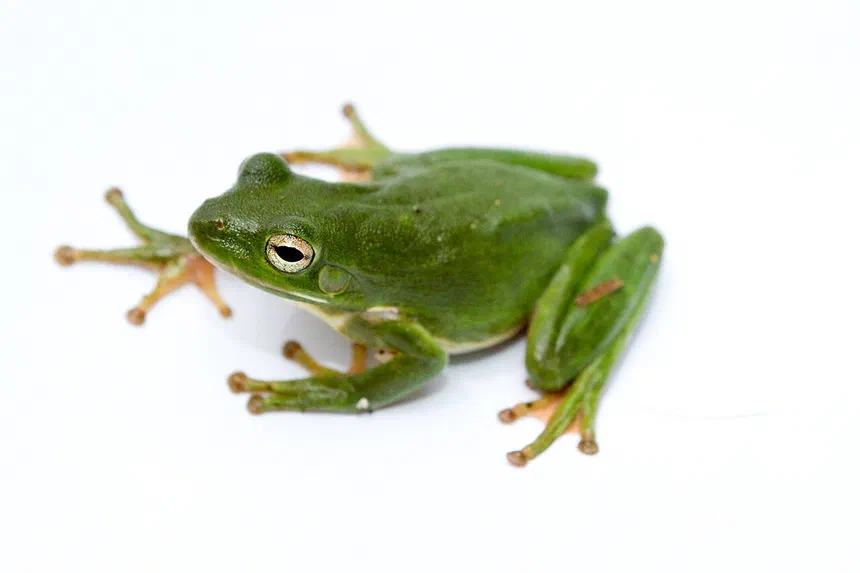
The green tree frog (Dryophytes cinereus) is a small, slender tree frog native to the southeastern United States. Long placed in the genus Hyla, it belongs to a family of arboreal frogs known for climbing with adhesive toe pads. It is a familiar backyard species across much of its range and serves as the official state amphibian of both Georgia and Louisiana.
Appearance and Identification
Green tree frogs are typically bright leaf-green, though their color can shift toward olive, yellowish, or gray depending on temperature, light, and activity. The most reliable field mark is a crisp, cream-to-white stripe running along each side of the body from the jaw toward the hind legs, sometimes bordered with a thin darker line. Small golden or yellow flecks often speckle the back. They have smooth, moist skin, large eyes, and rounded, sticky toe pads that let them cling to leaves, stems, and glass. Adults reach roughly 1.25 to 2.5 inches (3 to 6 cm) from snout to vent, with females generally larger than males. Males have a wrinkled, grayish or yellowish throat pouch that inflates during calling.
Habitat and Range
The species occupies the coastal plain and lower Piedmont of the southeastern U.S., broadly from Virginia and the Carolinas south through Florida and west along the Gulf Coast into eastern Texas, with populations reaching up the Mississippi River valley. It favors well-vegetated freshwater habitats such as swamps, marshes, floodplain forests, pond and lake edges, and slow streams. Dense emergent plants, cattails, and overhanging shrubs provide both cover and perches. Green tree frogs also adapt readily to human-modified settings, turning up around garden ponds, drainage ditches, and lit porches where insects gather.
Diet
Green tree frogs are insectivorous carnivores that hunt at night. Their diet is dominated by flies, mosquitoes, moths, crickets, beetles, and other small invertebrates, along with the occasional spider or small worm. They are visual, sit-and-wait predators, often lingering near lights that attract flying insects and snapping up prey that ventures within reach. Because they consume large numbers of mosquitoes and other pests, they are frequently welcomed by gardeners.
Behavior
This is a nocturnal, largely arboreal frog that rests by day tucked among leaves or in shaded, humid spots, then becomes active after dark to feed. Its skin color can lighten or darken to help with camouflage and temperature regulation. Males are highly vocal during the breeding season, producing a nasal, bell-like “queenk” call that is repeated rapidly and can form loud choruses on warm, humid nights. Green tree frogs are generally solitary outside of breeding aggregations and rely on their green coloration and stillness to avoid predators such as snakes, birds, and larger frogs.
Life Cycle and Reproduction
Breeding occurs mainly from spring through late summer, timed to warm weather and rainfall. Calling males gather near still or slow water to attract females. After amplexus, the female deposits eggs in small clusters attached to floating or submerged vegetation at the water’s surface; a single female may lay several hundred to over a thousand eggs in a season. Eggs hatch within a few days into aquatic tadpoles, which graze on algae and organic matter. Metamorphosis into small froglets typically takes roughly one to two months, depending on temperature and food, after which the young leave the water for vegetation. Individuals may reach breeding maturity within about a year.
Conservation Status
The green tree frog is listed as Least Concern by the IUCN. It remains common and widespread across its range and tolerates a variety of habitats, including some disturbed and suburban ones. Like all amphibians, it can be affected by wetland loss, water pollution, pesticides, and disease, so maintaining clean, vegetated freshwater habitats is important for keeping local populations healthy.
Frequently Asked Questions
Are green tree frogs poisonous or dangerous to people? No. They are harmless to humans and are not meaningfully toxic, though like most amphibians they secrete mild skin compounds, so it is best to avoid handling them and to wash your hands afterward.
Why do they gather around porch lights? Outdoor lights draw moths, mosquitoes, and other insects, and the frogs simply follow the food, waiting nearby to catch prey.
Do green tree frogs change color? Yes. They can shift between bright green, olive, and grayish tones in response to temperature, light, and activity level, which also helps them blend into their surroundings.