Amphibians Guide
Goliath Frog
What Is a Goliath Frog? The goliath frog (Conraua goliath) is the largest living frog on Earth, capable of reaching the size of a small housecat. It belongs to the family Conrauidae and lives in a narrow band of …
At a glance
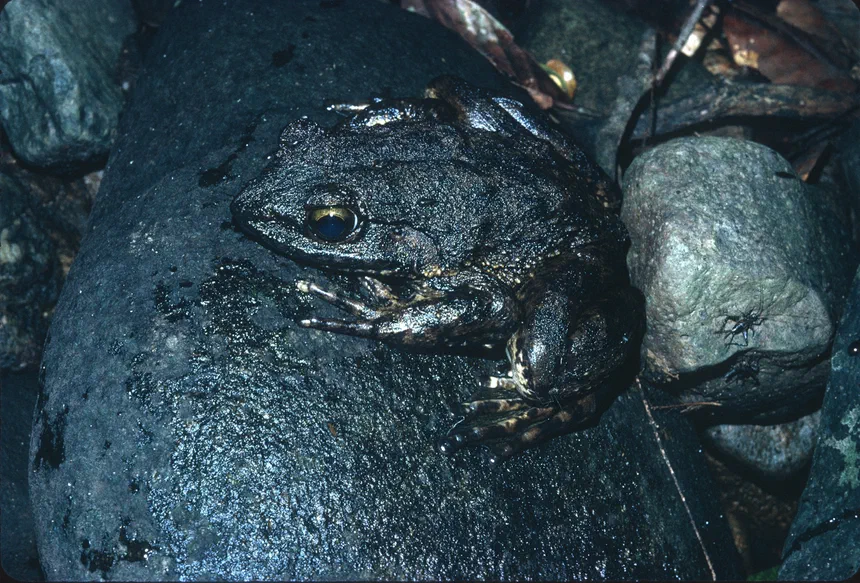
What Is a Goliath Frog?
The goliath frog (Conraua goliath) is the largest living frog on Earth, capable of reaching the size of a small housecat. It belongs to the family Conrauidae and lives in a narrow band of rainforest in West-Central Africa, where it depends on fast-moving, well-oxygenated rivers.
Appearance and Identification
As its name suggests, the goliath frog is defined by its enormous size. A large adult can measure roughly 17 to 32 centimeters (about 7 to 13 inches) from snout to vent and weigh up to about 3.3 kilograms (around 7 pounds), rivaling many mammals. Despite this bulk, its proportions resemble those of an ordinary frog. The skin is granular and greenish-brown across the back, blending well against wet, mossy rock, while the belly and inner legs are a paler yellow to orange. The eyes are large and can be nearly 2.5 centimeters across. Powerful, heavily muscled hind legs give the frog both strong swimming ability and impressive jumping power. Unlike many frogs, males and females are similar in size, and the species lacks a vocal sac, so it does not produce the loud calls typical of many amphibians.
Habitat and Range
The goliath frog has a very restricted range, occurring only in a small region spanning southern Cameroon and parts of Equatorial Guinea. Within this area it is tied closely to fast-flowing rivers, rapids, and waterfalls running through dense, humid rainforest. These waters are typically clear, cool, and highly oxygenated. Adults are often found on rocks within or beside the current, where the spray keeps their skin moist. Because the species is so dependent on this specific riverine habitat, it cannot easily disperse across dry land or tolerate degraded, silted, or polluted water.
Diet
The goliath frog is a carnivore with a broad appetite. It ambushes prey along riverbanks and in shallow water, feeding on insects, crustaceans such as crabs and shrimp, mollusks, worms, spiders, fish, and smaller amphibians. Larger individuals have even been recorded taking small snakes and young of other frog species. Like most frogs, it swallows prey whole, relying on quick lunges rather than pursuit to secure a meal.
Behavior
Goliath frogs are generally shy, wary, and mainly active at night. They have excellent eyesight and are quick to leap into rushing water and dive when disturbed, using strong legs to power away from danger. Remarkably, these frogs are also builders: adults have been observed clearing and arranging heavy rocks to construct and maintain small pools at river edges. This nest-building behavior, unusual among amphibians, may help explain how such a large frog cares for its offspring in turbulent river settings. Moving stones weighing up to about half the frog’s own body mass hints at considerable strength.
Life Cycle and Reproduction
Reproduction is tied to the rocky river pools that adults help create and defend. Females lay several hundred eggs, attaching them to submerged vegetation or rocks in these calmer pockets of water, safe from the strongest current. The eggs hatch into tadpoles that feed on specific aquatic plants found in the fast-flowing streams. Tadpole development takes several months before metamorphosis into small frogs. Growth to full adult size is slow, and individuals are thought to live around 15 years in the wild, with longer lifespans possible in captivity.
Conservation Status
The goliath frog is classified as Endangered by the IUCN, and its population is believed to be declining. The main threats are habitat loss from deforestation, agriculture, logging, and sedimentation of the clear rivers it needs, along with intense collection for the bushmeat trade and, historically, the pet and export market. Its naturally small range makes it especially vulnerable, since disturbances in a single river system can affect a large share of the total population. Conservation efforts focus on habitat protection and reducing unsustainable harvesting.
Frequently Asked Questions
How big can a goliath frog get? It is the world’s largest frog, reaching up to about 32 centimeters (13 inches) snout to vent and roughly 3.3 kilograms (7 pounds) in weight.
Do goliath frogs croak? No. The species lacks a vocal sac, so it does not produce the loud mating calls common in many other frogs.
Where do goliath frogs live? They are found only in fast-flowing rainforest rivers of southern Cameroon and Equatorial Guinea in West-Central Africa.