Amphibians Guide
Golden Poison Frog
What Is a Golden Poison Frog? The golden poison frog (Phyllobates terribilis) is a small, brilliantly colored amphibian native to the rainforests of western Colombia. Despite its modest size, it is widely regarded as one …
At a glance
What Is a Golden Poison Frog?
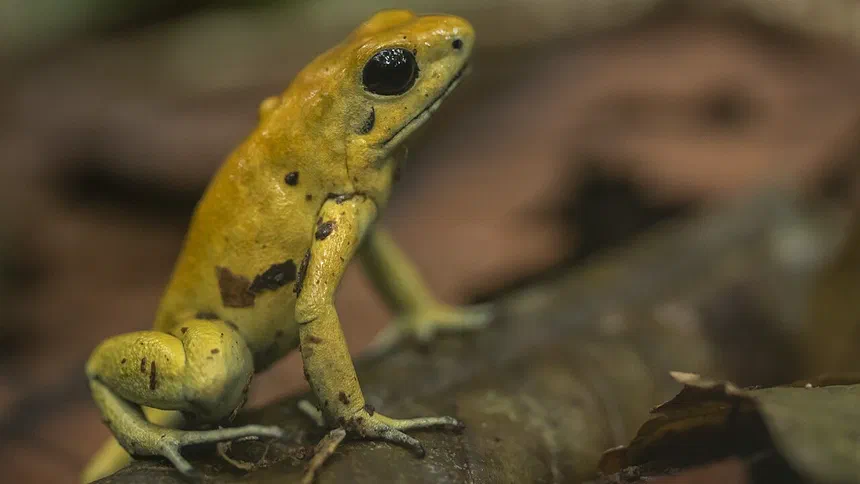
The golden poison frog (Phyllobates terribilis) is a small, brilliantly colored amphibian native to the rainforests of western Colombia. Despite its modest size, it is widely regarded as one of the most toxic animals on Earth, carrying enough potent skin alkaloid to make it dangerous to nearly any predator.
Appearance and Identification
This species is instantly recognizable for its uniform, vivid coloration, which ranges from bright golden-yellow to orange or, in some populations, a pale mint green. Unlike many of its poison-frog relatives, it lacks the bold contrasting spots or bands and instead wears a single saturated hue across its smooth skin. Adults typically measure about 1 to 2 inches (2.5 to 5 cm) in length, making them among the largest of the poison dart frogs. Their bright color is a textbook example of aposematism, a warning signal that advertises their toxicity to would-be predators.
Habitat and Range
The golden poison frog occupies a very restricted range along the humid Pacific lowlands of western Colombia. It favors the leaf-littered floor of dense, wet rainforest, where warm temperatures and high humidity persist year-round. These frogs stay near the ground and are seldom found far from the streams and moist microhabitats that their eggs and tadpoles depend on. Because their entire global distribution is small and increasingly fragmented, habitat loss poses a serious threat.
Diet
Golden poison frogs are carnivorous and feed on a variety of tiny invertebrates, including ants, termites, small beetles, and other insects they find among the leaf litter. Their diet is closely tied to their toxicity: the potent alkaloids in their skin are thought to be derived, at least in part, from certain prey items they consume in the wild. Frogs raised in captivity on a controlled diet gradually lose their extreme toxicity, which supports this link between food and poison.
Behavior
Active during the day, these frogs move about the forest floor in search of food and rarely try to hide, relying instead on their conspicuous coloring for protection. They can be surprisingly social and are often observed in loose groups. Males are territorial and produce a distinctive trilling or buzzing call to attract mates and warn off rivals. Because their skin secretions are so hazardous, they have essentially no natural predators, with one snake species being a rare known exception.
Life Cycle and Reproduction
Reproduction centers on careful parental involvement, a hallmark of poison frogs. After courtship, the female deposits a small clutch of eggs in a sheltered, moist spot on the forest floor, often among leaf litter. Once the eggs hatch, an adult, usually the male, allows the tadpoles to wriggle onto its back and carries them to a suitable pool of water where they can continue developing. The tadpoles then feed and grow until they metamorphose into tiny froglets. This attentive care improves the survival of their relatively few offspring.
Conservation Status
The golden poison frog is classified as Endangered by the IUCN. Its naturally tiny range makes it especially vulnerable, and ongoing deforestation for agriculture and other development continues to shrink and fragment suitable habitat. Collection for the pet trade and the spread of amphibian diseases add further pressure. Conservation efforts include habitat protection and managed captive-breeding programs that help safeguard the species against extinction in the wild.
Frequently Asked Questions
How poisonous is the golden poison frog? It is considered one of the most toxic animals known. A single wild frog carries enough batrachotoxin in its skin to be lethal to many potential predators, and indigenous communities have historically used the toxin to tip blowgun darts.
Why are captive golden poison frogs less toxic? Their toxicity appears to depend on compounds obtained through their natural diet. Frogs bred and fed in captivity lose most of their poison over time, which is why captive individuals are far less dangerous than wild ones.
Where do golden poison frogs live? They are found only in a small area of humid lowland rainforest along the Pacific coast of western Colombia, making their range extremely limited.