Amphibians Guide
Fire Salamander
What Is a Fire Salamander? The fire salamander (Salamandra salamandra) is a striking black-and-yellow amphibian native to the forests of Europe, western Asia, and North Africa. It is one of the best-known salamanders on …
At a glance
What Is a Fire Salamander?
The fire salamander (Salamandra salamandra) is a striking black-and-yellow amphibian native to the forests of Europe, western Asia, and North Africa. It is one of the best-known salamanders on the continent, easily recognized by its bold warning coloration. As a member of the family Salamandridae, it spends most of its life on land, unlike many amphibians that remain tied to water.
Appearance and Identification
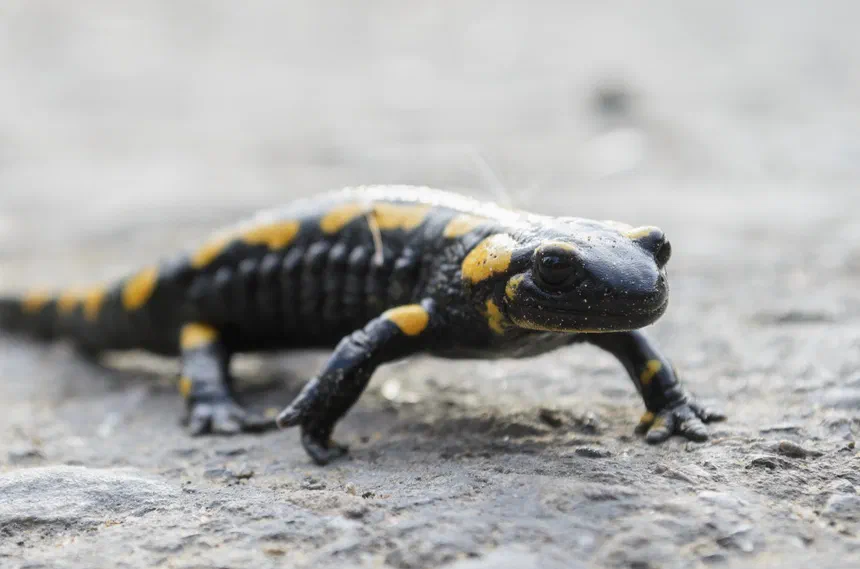
Fire salamanders have a stout body, a broad rounded head, and a fairly short tail. Their smooth, glossy skin is deep black and marked with vivid yellow patterning that may appear as spots, blotches, or connected stripes; in some populations the markings are tinged orange or red. This high-contrast pattern is a form of aposematism, warning predators that the animal is toxic. Behind the eyes sit prominent parotoid glands, and rows of smaller glands run along the back. Adults typically reach about 6 to 10 inches (15 to 25 cm) in total length, with females often slightly larger than males. Individual patterns are unique, allowing researchers to identify specific animals.
Habitat and Range
This species favors cool, humid deciduous and mixed woodlands, usually in hilly or mountainous country with clean, well-oxygenated streams, seeps, or springs. It ranges across much of central and southern Europe, extending into parts of the Middle East and northwestern Africa. Fire salamanders shelter by day beneath logs, leaf litter, moss, and rocks, or in burrows and crevices, emerging when conditions are damp. Because their skin must stay moist, they depend heavily on humidity and are rarely found far from reliable water for breeding.
Diet
Fire salamanders are carnivores that feed on a variety of small invertebrates. Their diet includes earthworms, slugs, snails, spiders, insects, insect larvae, and other soft-bodied prey. They hunt mostly at night or during rainy weather, using a slow, deliberate approach before seizing prey with a quick snap of the jaws. Larvae in the water eat aquatic invertebrates and, in some cases, may prey on smaller larvae.
Behavior
Largely nocturnal and secretive, fire salamanders become most active after rainfall and on humid evenings when the risk of drying out is low. They are slow-moving and rely on chemical defense rather than speed to survive. When threatened, the parotoid and skin glands can secrete samandarin, a potent alkaloid toxin that irritates the eyes and mouth of would-be predators. Some individuals can even spray these secretions a short distance. Fire salamanders are relatively long-lived and tend to be faithful to particular home sites, often returning to the same shelters year after year.
Life Cycle and Reproduction
Reproduction in fire salamanders is unusual among amphibians because fertilization is internal. Males deposit a packet of sperm (a spermatophore) that the female takes up, and she then retains the developing young inside her body. Most populations are ovoviviparous: the female gives birth to well-developed aquatic larvae, depositing them in cool streams or pools, where they breathe through external gills. Larvae later metamorphose into land-dwelling juveniles. In certain high-elevation or isolated populations, females skip the aquatic larval stage entirely and give birth to fully formed young on land. Sexual maturity is generally reached after several years.
Conservation Status
The fire salamander is currently listed as Least Concern by the IUCN, reflecting its wide distribution and generally stable numbers across much of its range. Even so, local populations face real threats. Habitat loss, stream pollution, and road mortality all take a toll, and the emerging fungal disease caused by Batrachochytrium salamandrivorans (Bsal) has caused severe die-offs in parts of Western Europe, particularly the Netherlands, Belgium, and Germany. Efforts to limit the spread of this pathogen and protect clean forest streams are important for the species’ long-term future.
Frequently Asked Questions
Are fire salamanders poisonous? Yes. Their skin glands secrete toxic alkaloids that deter predators and can irritate skin and mucous membranes, so handling them is discouraged. They are not aggressive and pose no danger unless the toxin is touched or ingested.
Do fire salamanders live in fire? No. The name comes from an old folk belief that arose when salamanders sheltering in logs fled as the wood was burned. They actually require cool, moist habitats and cannot tolerate heat or dryness.
How long do fire salamanders live? In the wild they commonly live 10 to 20 years, and individuals in captivity have been recorded living considerably longer.