Amphibians Guide
Fire-Bellied Toad
What Is a Fire-Bellied Toad? The fire-bellied toad (Bombina orientalis) is a small, brightly colored amphibian native to eastern Asia. Despite its common name, it is not a true toad but belongs to a distinct family of …
At a glance
What Is a Fire-Bellied Toad?
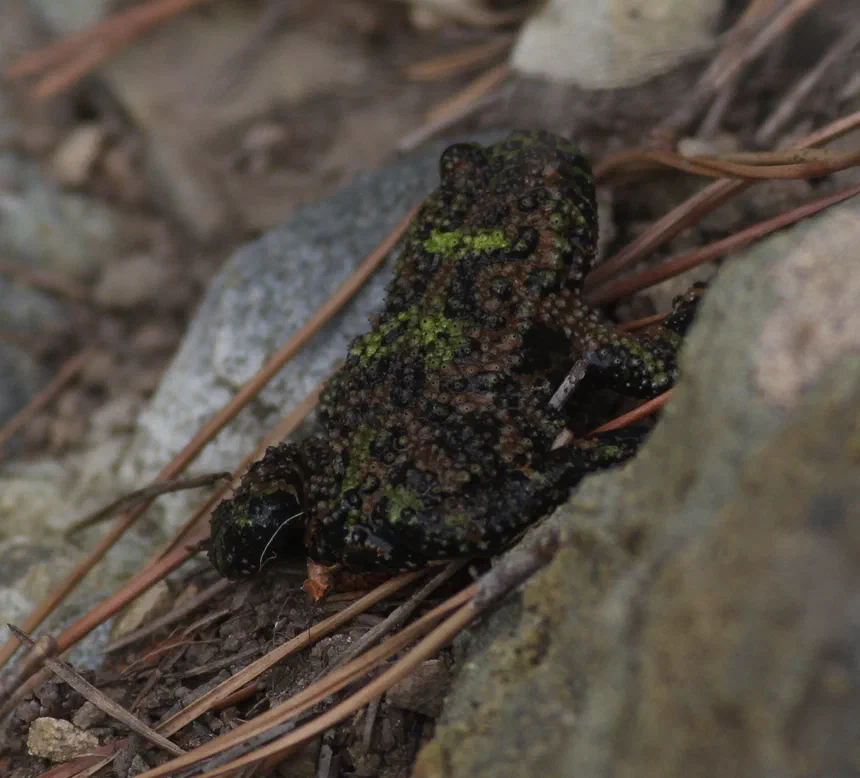
The fire-bellied toad (Bombina orientalis) is a small, brightly colored amphibian native to eastern Asia. Despite its common name, it is not a true toad but belongs to a distinct family of primitive frogs, and it is best known for the striking red-and-black warning coloration on its underside.
Appearance and Identification
This is a compact, small-bodied amphibian, usually about 1.5 to 2 inches (4 to 5 cm) in length. The upper surface is typically bright green, often marbled with irregular black blotches, though some individuals are more brownish or grayish depending on mood and surroundings. The most distinctive feature is the belly, which is vivid orange to red and marked with dark spots. The skin on the back is rough and covered with small, wart-like tubercles. The pupils are triangular or heart-shaped, a trait shared with related species. Males and females look broadly similar, though males may develop dark nuptial pads on the forelimbs during breeding.
Habitat and Range
Fire-bellied toads occur across northeastern China, the Korean Peninsula, and southern parts of the Russian Far East. They favor cool, moist environments and are often found in and around slow-moving streams, shallow ponds, marshes, flooded ditches, and the damp margins of forests. Highly aquatic for a frog of its size, the species spends much of its active season in or near water, but it can also be found in nearby meadows and woodlands. It ranges from lowlands into hilly and mountainous terrain.
Diet
As a carnivore, the fire-bellied toad feeds on a range of small invertebrates. Its diet includes insects such as beetles, flies, and their larvae, as well as worms, snails, and other small creatures it can catch near the water’s edge. Unlike many frogs, it does not have a highly projectile tongue, so it often lunges forward and uses its mouth and forelimbs to seize prey. Prey is generally taken opportunistically based on availability.
Behavior
When threatened, the fire-bellied toad performs a defensive posture known as the “unken reflex,” arching its back and lifting its limbs to flash the bright red-and-black belly at a would-be predator. This display advertises the toad’s toxicity: its skin secretes irritating and mildly poisonous compounds that deter many attackers. The coloration is a classic example of aposematism, or warning coloration. The species is mostly diurnal and can be active during daylight, often floating at the surface of quiet water. It becomes dormant during cold months, overwintering on land in leaf litter, burrows, or other sheltered spots.
Life Cycle and Reproduction
Breeding takes place in spring and summer, typically after the animals emerge from winter dormancy. Males produce soft, repeated calls to attract females. After mating, the female lays eggs in water, attaching small clusters to submerged vegetation or other underwater surfaces. The eggs hatch into aquatic tadpoles, which feed and grow over several weeks to a few months before undergoing metamorphosis into small toadlets. Sexual maturity is generally reached within a year or two. In the wild these amphibians may live for roughly 10 to 15 years, and captive individuals sometimes live longer.
Conservation Status
The fire-bellied toad is listed as Least Concern by the IUCN, reflecting a broad range and generally stable populations. It remains fairly common across much of its distribution and adapts to a variety of freshwater habitats. Localized threats include habitat loss, water pollution, and collection for the international pet trade, where the species is popular because of its hardiness and vivid colors. Maintaining clean wetland habitats is the main safeguard for its long-term future.
Frequently Asked Questions
Are fire-bellied toads poisonous? Yes, mildly. Their skin secretes toxins that can irritate the eyes, mouth, and skin of predators and people, which is why washing your hands after handling them is recommended.
Why is their belly so brightly colored? The red-and-black underside is a warning signal. By flashing it in a defensive arch, the toad tells predators that it is distasteful or toxic and best left alone.
Is it really a toad? Not in the strict sense. It belongs to a separate, ancient family of frogs and only resembles a toad in its bumpy skin and stout body.