Amphibians Guide
Emperor Newt
What Is a Emperor Newt? The emperor newt (Tylototriton shanjing) is a strikingly colored salamander native to the mountains of southwestern China. Also known as the Mandarin newt or crocodile newt, it belongs to the …
At a glance
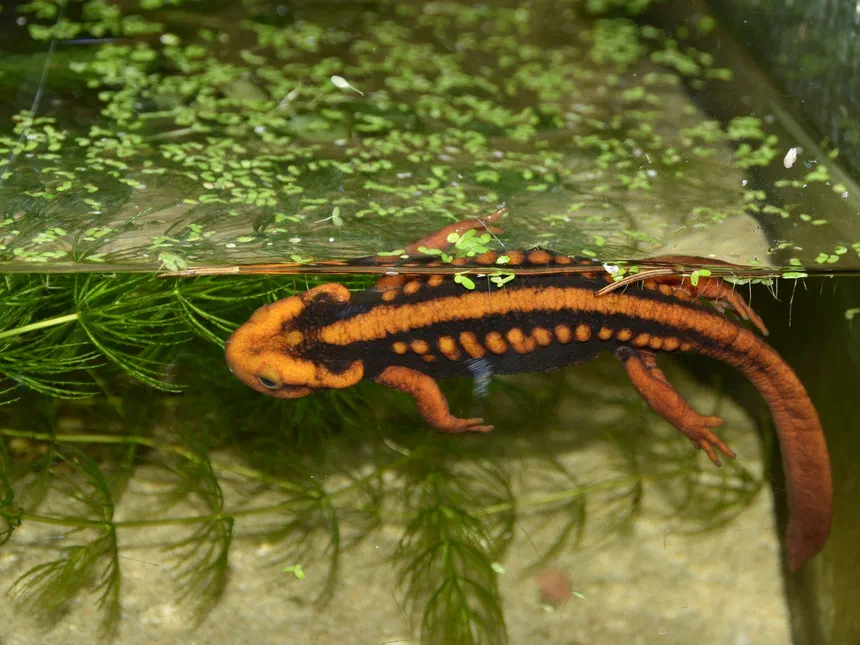
Image: NasserHalaweh — CC BY-SA 4.0 · source
What Is a Emperor Newt?
The emperor newt (Tylototriton shanjing) is a strikingly colored salamander native to the mountains of southwestern China. Also known as the Mandarin newt or crocodile newt, it belongs to the family Salamandridae and is prized for its bold black-and-orange warning coloration, which advertises the toxins in its skin.
Appearance and Identification
Emperor newts are among the most vivid amphibians in Asia. The body is mostly dark brown to black, offset by bright orange to rusty-orange markings on the head, along the raised vertebral ridge running down the back, and on a series of prominent wart-like glands, or “rib nodes,” lining each side of the body. The toes, tail edge, and underside are also washed with orange. This rough, knobby skin and the ridged head give the animal a slightly reptilian, “crocodile” look. Adults typically reach about 5 to 8 inches (13 to 20 cm) in total length, with females tending to be a little larger and heavier than males. The paratoid glands behind the eyes and the row of side glands secrete a milky toxin when the newt is threatened.
Habitat and Range
This species is restricted to the highlands of Yunnan Province in southwest China, generally at elevations between roughly 3,000 and 8,000 feet (about 1,000 to 2,500 meters). It favors cool, moist montane environments, including broadleaf and pine forests, subtropical scrub, terraced hillsides, and the margins of ponds, ditches, and slow-moving streams. For much of the year emperor newts are terrestrial, sheltering under leaf litter, logs, and rocks, but they return to still or gently flowing water to breed.
Diet
Emperor newts are opportunistic carnivores. On land and in water they hunt a variety of small invertebrates, including insects and their larvae, earthworms, slugs, snails, and other soft-bodied prey. Larvae in the water take tiny aquatic invertebrates and gradually shift to larger prey as they grow. Prey is generally located by scent and movement and taken with a quick snap of the jaws.
Behavior
For most of the year these newts lead a slow, secretive life on land, remaining hidden by day and becoming active in humid or rainy conditions, especially at night. When confronted by a predator, an emperor newt relies on its aposematic coloring as a first warning. If pressed further, it may arch its body and raise its head and tail in a defensive posture that shows off the bright underside, while the skin glands exude an unpalatable, mildly toxic secretion. These defenses make the species largely unappealing to would-be predators.
Life Cycle and Reproduction
Breeding is tied to the arrival of the warm, wet season, typically in late spring and summer when monsoon rains fill ponds and pools. Males and females gather at breeding waters, where courtship involves the male nudging and positioning himself near the female before depositing a spermatophore that she takes up. Females lay eggs singly or in small clusters, attaching them to submerged vegetation or debris. The eggs hatch into aquatic larvae with feathery external gills, which feed and grow in the water over several weeks to a few months before metamorphosing into terrestrial juveniles. Emperor newts are relatively long-lived amphibians and may survive for well over a decade in favorable conditions.
Conservation Status
The emperor newt is listed as Near Threatened by the IUCN. Its limited montane range makes it sensitive to habitat loss from deforestation, agriculture, and land conversion, as well as to pollution of its breeding waters. Heavy collection for the international pet trade and for use in traditional medicine has added pressure on wild populations. Habitat protection and controls on collection are important for the species’ long-term survival.
Frequently Asked Questions
Is the emperor newt poisonous? Yes. Like many brightly colored salamanders, it produces toxins in its skin glands. These are a defense against predators and can be irritating, so the animal should be handled with care and hands washed afterward.
Why is it called the emperor newt? The name reflects its regal, richly colored appearance. The bold orange-on-black pattern is thought to have inspired both “emperor” and “Mandarin” as common names.
Where do emperor newts live? They are found only in the mountainous highlands of Yunnan Province in southwestern China, in cool forests near ponds and slow streams.