Amphibians Guide
Eastern Spadefoot
What Is a Eastern Spadefoot? The eastern spadefoot (Scaphiopus holbrookii) is a stout, burrowing amphibian native to the eastern United States. Although it is often called a toad, it belongs to the spadefoot family …
At a glance
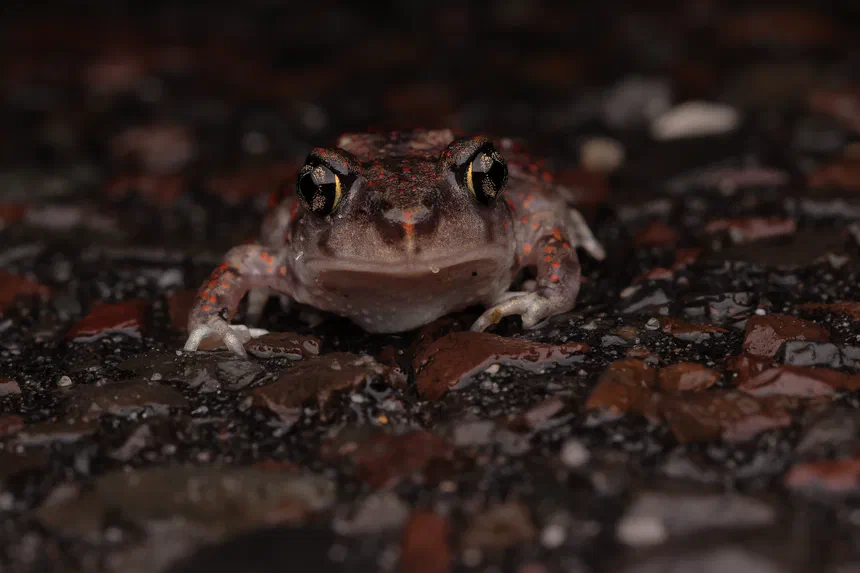
Image: User:Rstanton13 — CC BY-SA 4.0 · source
What Is a Eastern Spadefoot?
The eastern spadefoot (Scaphiopus holbrookii) is a stout, burrowing amphibian native to the eastern United States. Although it is often called a toad, it belongs to the spadefoot family (Scaphiopodidae) and differs from true toads in several ways. Its name comes from the hard, sickle-shaped “spade” on each hind foot, which it uses to dig backward into loose soil.
Appearance and Identification
This is a plump, medium-small amphibian, typically 4.5 to 7 centimeters (about 1.8 to 2.8 inches) from snout to vent. The skin is relatively smooth compared with true toads, with only scattered small warts, and the color ranges from brown to olive or grayish. Two pale, lyre-shaped stripes usually run down the back, sometimes meeting to form an hourglass pattern. Its most distinctive feature is the vertical, cat-like pupil, which sets it apart from the round or horizontal pupils of true toads. A single dark, wedge-shaped spade is present on the underside of each hind foot.
Habitat and Range
The eastern spadefoot occurs across much of the eastern United States, from southern New England south to Florida and west toward the Mississippi River, with scattered populations beyond. It favors areas with sandy or otherwise loose, easily dug soils, including pine woodlands, mixed forests, old fields, floodplains, and coastal plains. Because it spends most of its life underground, it can persist in places where it is rarely seen.
Diet
Adults are carnivorous and feed on a wide range of small invertebrates. Typical prey includes beetles, ants, flies, crickets, spiders, earthworms, and other soft-bodied creatures. Foraging usually happens at night, when the animal emerges from its burrow after rain or in humid conditions. Tadpoles are largely omnivorous, grazing on algae, detritus, and organic matter, and they may also scavenge or become somewhat predatory when food is scarce.
Behavior
The eastern spadefoot is highly fossorial, meaning it spends the great majority of its time buried in the soil. Using the spades on its hind feet, it shuffles backward into the ground, sometimes reaching depths well below the surface to escape heat and drought. It can remain dormant underground for long stretches, emerging mainly during warm, wet weather. This secretive, largely nocturnal lifestyle makes it one of the least frequently encountered amphibians within its range, despite being locally common.
Life Cycle and Reproduction
Breeding is explosive and opportunistic, triggered by heavy rains that create temporary pools. When conditions are right, large numbers of spadefoots emerge and gather at these ephemeral waters, where males produce low, groaning calls. Females lay eggs in bands or clusters attached to vegetation, and development is remarkably fast. Eggs may hatch within a few days, and tadpoles can complete metamorphosis in as little as a couple of weeks, an adaptation that lets them mature before the temporary pools dry out. Newly transformed juveniles then disperse and adopt the burrowing habits of adults.
Conservation Status
The eastern spadefoot is generally listed as Least Concern on a range-wide basis, and it remains widespread. However, it is patchily distributed and can be uncommon or of conservation concern in individual states, especially at the northern edges of its range. The main threats are loss and fragmentation of sandy-soil habitats and the draining or degradation of the temporary wetlands it needs for breeding. Protecting both upland burrowing sites and nearby ephemeral pools is important for maintaining local populations.
Frequently Asked Questions
Is the eastern spadefoot a true toad? No. Despite the “toad” nickname, it belongs to the spadefoot family and differs from true toads by its smoother skin, vertical pupils, and the digging spade on each hind foot.
Why is it so rarely seen? It spends most of its life underground and comes to the surface mainly during warm, rainy nights, so even in areas where it is common it is easy to miss.
Can it irritate skin? Handling a spadefoot can cause mild skin or eye irritation in some people because of its secretions, so it is best to avoid touching your face afterward and to wash your hands.