Amphibians Guide
Eastern Newt
What Is a Eastern Newt? The eastern newt (Notophthalmus viridescens) is a small, widespread salamander native to eastern North America. It is best known for its unusual three-stage life cycle and for the bright orange …
At a glance
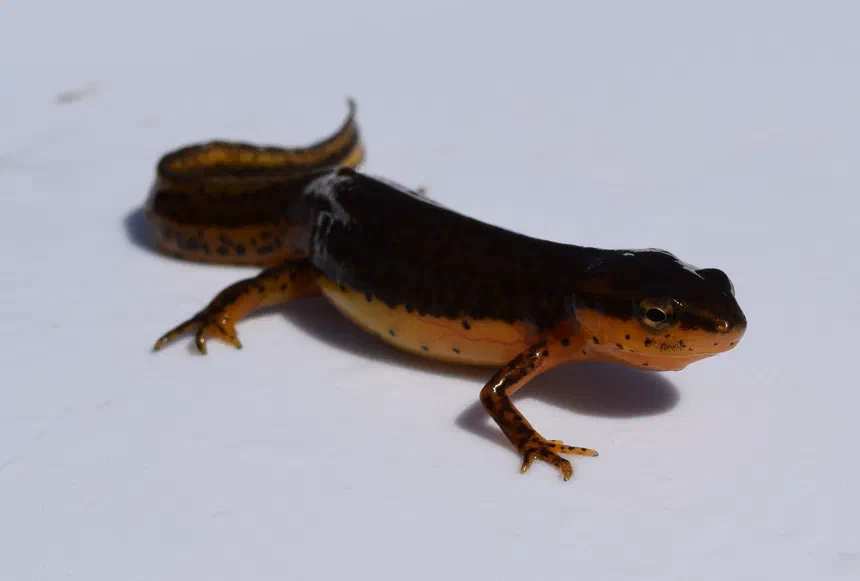
Image: Fredlyfish4 — CC BY-SA 4.0 · source
What Is a Eastern Newt?
The eastern newt (Notophthalmus viridescens) is a small, widespread salamander native to eastern North America. It is best known for its unusual three-stage life cycle and for the bright orange land-dwelling juvenile phase called the “red eft.” Despite its delicate appearance, the species is remarkably hardy and can be found across a broad range of freshwater habitats.
Appearance and Identification
Adult eastern newts are typically olive-green to yellowish-brown on the back, fading to a yellow belly speckled with small black dots. A hallmark feature is a series of small red or orange spots, often ringed in black, running along each side of the body. Adults are slender with a laterally flattened, keeled tail that aids swimming.
The juvenile “red eft” stage looks strikingly different: bright orange to reddish-orange skin, a rougher and drier texture, and a rounded tail suited to life on land. This vivid coloration is a form of aposematism, warning predators that the animal’s skin secretes toxins. Adults generally measure 2.5 to 5 inches (about 7 to 12 cm) in total length, with females often slightly larger than males.
Habitat and Range
Eastern newts occur throughout much of eastern North America, from the Maritime Provinces of Canada south to Florida and west toward the Great Lakes and eastern Texas. They favor small ponds, lake margins, marshes, ditches, and slow-moving streams with abundant aquatic vegetation. During the terrestrial eft stage, they roam moist woodlands, hiding under logs, leaf litter, and damp debris. Several regional subspecies are recognized, differing slightly in color and pattern.
Diet
This species is a carnivore that feeds on a wide variety of small prey. Aquatic adults and larvae consume insect larvae, small crustaceans, worms, snails, leeches, and the eggs of amphibians and fish. Terrestrial red efts hunt small invertebrates such as springtails, mites, insects, and tiny snails found in the leaf litter. Eastern newts play a useful role in controlling mosquito larvae and other aquatic insects.
Behavior
Eastern newts are active by day and night and are relatively bold compared with many salamanders, partly because their toxic skin deters most predators. The skin contains tetrodotoxin-like compounds that make the animal unpalatable and potentially poisonous if eaten. Adults are largely aquatic and can remain active under ice through winter, while efts wander on land and may travel considerable distances. When threatened, an eft may arch its body to display its bright underside as a warning.
Life Cycle and Reproduction
The eastern newt has one of the more complex life cycles among North American amphibians, typically passing through three stages. Breeding occurs in water, usually in spring. Females lay eggs singly, attaching each to submerged vegetation, and may deposit a few hundred eggs over a season.
Eggs hatch into gilled aquatic larvae that feed and grow through the summer. Many larvae then transform into the terrestrial red eft, which may spend one to several years on land before returning to water. Once mature, the newt develops into the aquatic adult form. In some populations, particularly where suitable land habitat is scarce, the eft stage may be shortened or skipped entirely.
Conservation Status
The eastern newt is listed as Least Concern by the IUCN and remains common across most of its range. Its adaptability and toxic defenses help it persist in varied habitats. Nonetheless, it faces threats from wetland loss, water pollution, road mortality during migrations, and emerging amphibian diseases. Maintaining clean, vegetated ponds and connected forest habitat is important for the long-term health of local populations.
Frequently Asked Questions
Are eastern newts poisonous to touch? Their skin secretes toxins that are dangerous if ingested and can irritate mucous membranes, so it is best to avoid handling them and to wash your hands afterward. Simple contact is generally not harmful if you are careful.
What is a red eft? The red eft is the bright orange, land-dwelling juvenile stage of the eastern newt. After this stage, the animal returns to water and matures into a greenish aquatic adult.
How long do eastern newts live? In the wild they can live well over a decade, with some individuals reaching 12 to 15 years under favorable conditions.