Amphibians Guide
Dyeing Poison Dart Frog
What Is a Dyeing Poison Dart Frog? The dyeing poison dart frog (Dendrobates tinctorius) is a boldly patterned amphibian native to the rainforests of northeastern South America. It is one of the largest members of the …
At a glance
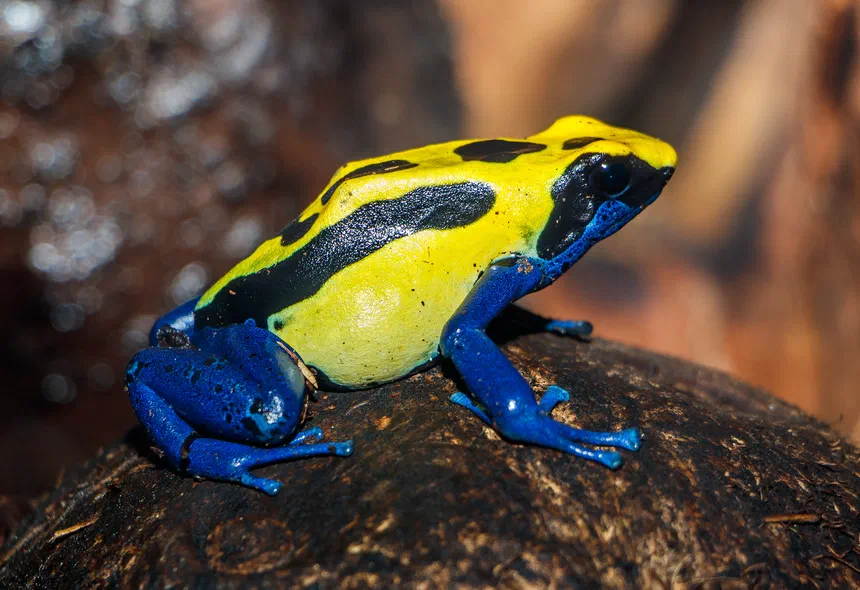
Image: H. Zell — CC BY-SA 3.0 · source
What Is a Dyeing Poison Dart Frog?
The dyeing poison dart frog (Dendrobates tinctorius) is a boldly patterned amphibian native to the rainforests of northeastern South America. It is one of the largest members of the poison dart frog family (Dendrobatidae) and is known for its striking combination of black, blue, yellow, and white coloration.
Appearance and Identification
This is a relatively large dart frog, with adults typically measuring about 1.5 to 2 inches (4 to 5 cm) in body length; females tend to be slightly larger and rounder than males. The body is usually black with irregular patches of bright yellow or white across the back, while the legs are often washed in blue and marked with dark spots. Color and pattern vary dramatically between populations, and the species includes many recognized regional morphs, some almost entirely yellow, others dominated by deep blue. These bold colors are a form of aposematism, warning predators that the frog carries toxins in its skin. The toes end in flattened, adhesive disks that help the frog climb and grip surfaces.
Habitat and Range
The dyeing poison dart frog lives across the Guiana Shield region, including parts of French Guiana, Suriname, Guyana, and northern Brazil. It favors humid tropical rainforest, spending most of its time on or near the forest floor among leaf litter, fallen logs, and low vegetation. Although largely terrestrial, it will climb into low plants and requires access to small pools of water for breeding. Populations are often patchy and localized, with different color morphs isolated on separate hills or plateaus.
Diet
Like other dart frogs, this species is an insectivorous carnivore. It feeds mainly on ants, termites, mites, tiny beetles, and other small invertebrates gathered from the forest floor. Its diet is closely tied to its toxicity: in the wild, the frog acquires the alkaloid compounds that make its skin poisonous from the invertebrates it eats. Captive-bred frogs raised on a diet of fruit flies and other cultured insects lack these dietary sources and are therefore not toxic.
Behavior
The dyeing poison dart frog is active during the day, when its warning colors are most visible to predators. It is generally bold and slow-moving, relying on its toxins rather than camouflage or speed for defense. Males can be territorial and use soft, buzzing calls to advertise their presence and attract mates. Individuals often maintain small home ranges within the forest and may return repeatedly to favored feeding and shelter sites.
Life Cycle and Reproduction
Reproduction is closely linked to the rainy season and to the frog’s notable parental care. After courtship, the female lays a small clutch of eggs on the moist forest floor or on leaves, and the male usually guards and moistens them. Once the eggs hatch, a parent, most often the male, carries the tadpoles one at a time on its back to small water-filled sites such as tree holes or the pools that collect among plant leaves. The tadpoles develop in these tiny nurseries over several weeks before metamorphosing into froglets. Individuals may live roughly 8 to 12 years in the wild, and often longer under human care.
Conservation Status
The dyeing poison dart frog is currently listed as Least Concern by the IUCN, reflecting its wide range and generally stable populations. Even so, it faces localized threats from habitat loss, deforestation, and collection for the pet trade. Because many color morphs are restricted to small, isolated areas, some local populations are more vulnerable than the overall status suggests. Most frogs in the pet trade today are captive-bred, which helps reduce pressure on wild populations.
Frequently Asked Questions
Why is it called the “dyeing” poison dart frog? The name comes from a historical belief that Indigenous peoples used the frog’s skin secretions to alter, or “dye,” the feather colors of parrots. While the name persists, this practice is not well documented.
Is the dyeing poison dart frog dangerous to humans? Its skin toxins can cause irritation and are dangerous if they enter the body, but the species is far less potent than the golden poison frog. Captive-bred individuals raised on cultured insects are effectively non-toxic.
How does it care for its young? Parents guard the eggs on land and then transport the hatched tadpoles individually on their backs to small pools of water, where the tadpoles finish developing.